The most violent music Vivaldi ever wrote lives inside a piece we play at weddings.
This is the strange paradox of 『The Four Seasons』, composed by Antonio Vivaldi in 1725 and performed so frequently since that it has become acoustic wallpaper, the kind of music piped into elevators and wine shops and waiting rooms where nobody waits with any real attention. We think we know it. We hum fragments of “Spring” without realizing that the same collection contains some of the most ferocious depictions of natural destruction in the Baroque repertoire. The opening of “Summer” crackles with heat exhaustion. “Winter” begins with teeth-chattering strings that sound less like a pastoral scene and more like a body trying to survive. We have turned a portrait of nature’s full brutality and tenderness into something polite, and in doing so, we have done to Vivaldi what we so often do to our own lives: edited out the storm to keep only the bloom.
But the bloom means nothing without the storm. That is the tension sitting at the center of these four concertos, and it is a tension that runs through every human life that has the courage to look at itself honestly.
Where Lightning Meets Birdsong
Listen to the opening of “Spring” closely, and you hear something almost naive in its optimism. The violins trill upward like birds calling across a garden at dawn. The rhythm bounces with the confidence of someone stepping outside after months of confinement, lungs filling with air that finally smells green. Vivaldi paired each concerto with a sonnet, and the one for Spring describes shepherds dancing, a dog barking, nymphs moving through meadows. It is pure joy, uncomplicated, the world announcing its own resurrection.
Now skip ahead to “Summer.” The same violin that sang like a lark is now gasping. The solo line in the opening Allegro non molto is languid, dragging itself through thick humidity, interrupted by sudden violent outbursts from the orchestra. The sonnet tells of a young shepherd terrified by approaching thunder. By the third movement, the storm arrives in full: sheets of sixteenth notes crash down like hail, the ensemble lurches and bucks, and whatever pastoral calm existed in Spring has been torn apart.
These are not separate stories. They are the same story.
We tend to compartmentalize our experiences the way a streaming playlist might separate these concertos into individual tracks. The good years go here. The hard years go there. We narrate our lives as though happiness and suffering take turns politely, each waiting in the wings for the other to finish its scene. But Vivaldi understood something more honest. He published all four concertos together as the first four works in a larger collection called Il cimento dell’armonia e dell’inventione, which translates roughly to “The Contest Between Harmony and Invention.” Even the title suggests conflict, a wrestling match between order and surprise. The Seasons were never meant to be separated. The terror of the summer storm is what gives spring its sweetness. The frost of winter is what makes the harvest of autumn feel earned.
Think of that morning after a terrible night, when the light coming through the window seems almost aggressive in its beauty. Or the way food tastes after illness, how a plain piece of bread becomes a revelation. We know this in our bones. Pleasure deepens in proportion to the pain that preceded it. Comfort means nothing to someone who has never been cold.
What Vivaldi rendered in sound is something that philosophy has circled for centuries: the idea that contrast is not a flaw in the design of living but the very mechanism by which we perceive anything at all. A world of permanent spring would not feel like spring. It would feel like nothing.
The Calendar We Carry Inside
 Photo by
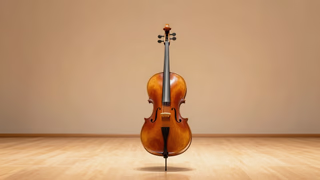
 The Four Seasons has survived nearly three hundred years not because it is the most technically sophisticated music of its era, but because it maps onto something we recognize immediately, a pattern older than any composition. Every culture marks the turning of the year. Every language has words for the feeling of late autumn, that particular ache when the afternoon light turns amber and the air carries a premonition of endings. The Japanese call the pathos of passing things mono no aware. The Portuguese have saudade for the longing that accompanies what is gone. English, for all its sprawling vocabulary, often fumbles here, resorting to “bittersweet” as if the best it can do is smash two opposites together and hope meaning emerges from the collision.
Vivaldi did not need a word. He had a violin.
And what the violin tells us, across centuries, across every border, is that the cycle is the point. Not arrival. Not some final destination where the weather stabilizes and the music resolves into an eternal major chord. The passage itself. The turning. We are not moving toward a season that will last; we are moving through seasons, and the movement is the life.
Consider how fiercely we resist this. We chase permanence with savings accounts and skincare routines and five-year plans, as though we might, through sheer diligence, lock the calendar on June. When grief arrives, we treat it as an interruption rather than a season of its own, something to push through quickly so we can return to the “real” business of being happy. When joy comes, we hold it so tightly that we bruise it, anxious about the moment it will slip away.
But Vivaldi’s Winter does not apologize for existing. It arrives with its own stark beauty, the slow movement of the second concerto painting a picture of someone sitting by a fire while rain lashes the windows outside. There is warmth in that image, but it is warmth defined by the cold pressing in from every side. The comfort is inseparable from the threat. And the threat, somehow, makes the comfort more vivid, more precious, more real.
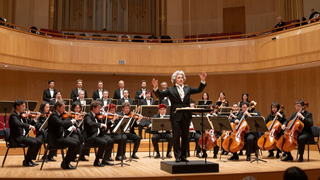
Across time, performers have brought wildly different readings to these concertos. Some play Spring with a ferocity that borders on punk, as the ensemble Il Giardino Armonico did in the 1990s, stripping away the gentility to reveal something raw and angular underneath. Others, like Anne-Sophie Mutter, find in Winter a lyricism so warm it almost contradicts the programmatic content. Neither reading is wrong. The music holds both because life holds both. The same winter that kills also preserves. The same spring that heals also floods.
 Photo by
 This is how a piece of music written in Venice three centuries ago continues to say something true about a Tuesday in November when you walk outside and the wind hits your face and you feel, simultaneously, how fragile and how persistent you are.
What the Frost Knew All Along
 Photo by
 So we return to the paradox. The most violent music Vivaldi wrote lives inside the piece we play at weddings, and we play it at weddings because, somewhere beneath our preference for comfort, we understand that love is a seasonal thing. Not in the cynical sense that it fades, but in the deeper sense that it transforms. The giddiness of early romance is a kind of spring. The long summers of raising children or building a shared life carry their own unbearable heat, their own sudden storms. Autumn brings the collecting of what grew, the quiet reckoning of what did not. And winter, when it comes, whether as loss or distance or the simple passage of decades, offers its own gift: clarity. The bare branches let you see the shape of the tree.
Vivaldi’s concertos end with Winter, but they do not end in despair. The final movement is an Allegro, brisk and bright, full of energy that feels almost mischievous. The ice is still there, the sonnet tells us, but the figure in the music is no longer cowering. They are moving across it, carefully, even playfully. There is skill in navigating the cold. There is life in the frozen landscape.
And if you listen to the full cycle and then press play again, Spring returns. The birds call. The rhythm bounces. But now you hear it differently. You hear the storm already gathering inside the bloom, and the bloom already promised inside the storm. The sweetness is not naive anymore. It is brave. It is the sweetness of someone who has been through winter and stepped outside anyway, lungs filling with air that finally smells green, knowing full well that the warmth will not last, and letting it matter precisely because of that.