We have it exactly backward. We treat thinking as something that happens above the neck, a clean and weightless event, separate from the mess of sinew and sweat. Sit still, close your eyes, quiet the body so the mind can work. But look at the most iconic image of thought ever created, and you will find a figure that is all body, every muscle tensed, the act of reflection rendered as something closer to labor than to leisure.
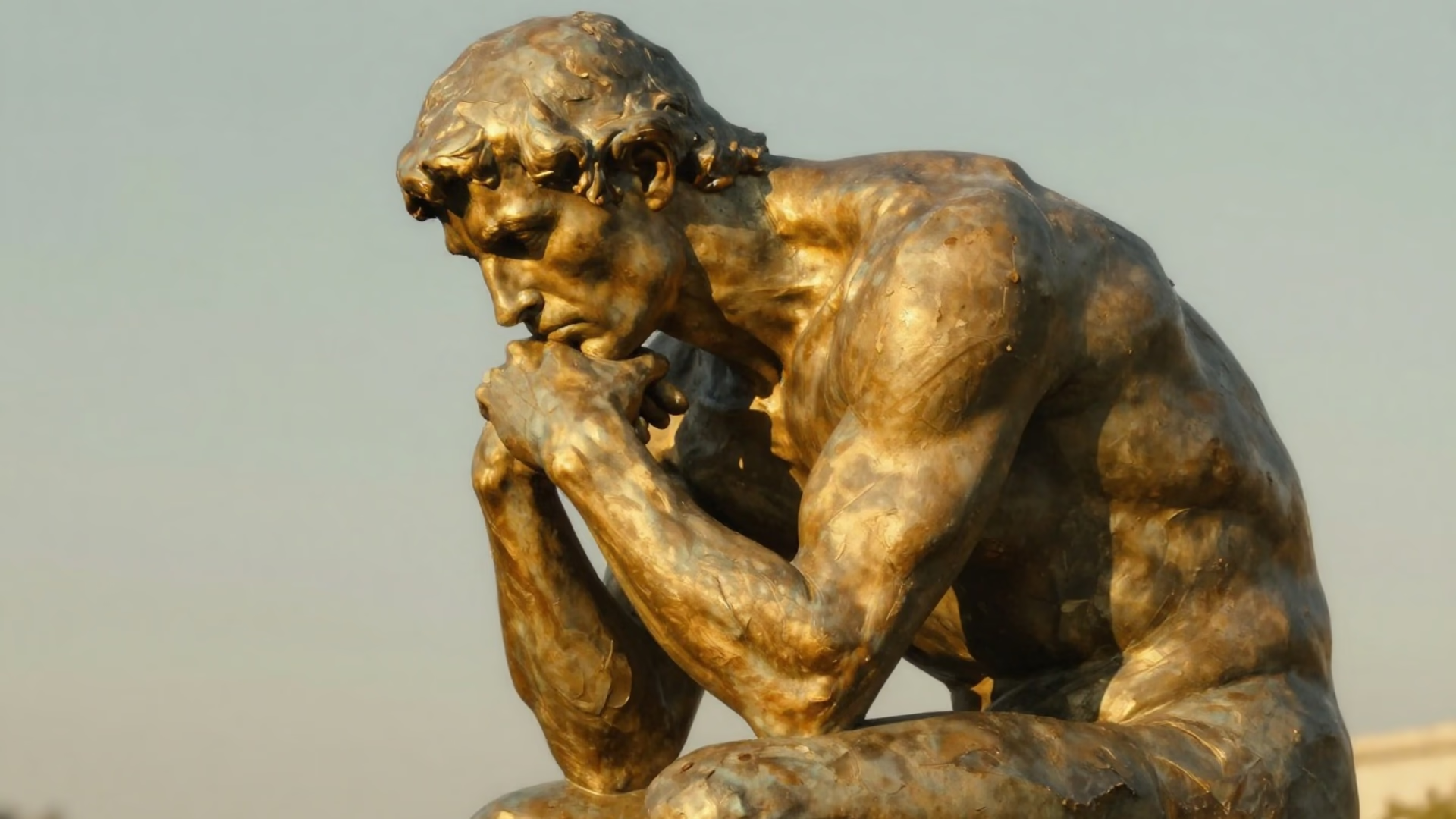
Auguste Rodin’s 『The Thinker』, cast in bronze in 1904, sits hunched on a rough stone pedestal with his right elbow planted on his left knee, his chin pressing into the back of his hand so hard the knuckles seem to whiten. The torso curves forward like a question mark. The toes grip the edge of the base as though the figure might slide off into some abyss only he can see. His back is a landscape of tension, the muscles along the spine bunched and knotted. The shoulders, broad enough to carry actual weight, round inward as if the man were folding himself around a single burning thought.
Stand in front of any of the full-sized casts, in Paris or Philadelphia or Tokyo, and the first thing that strikes you is the scale. The figure is larger than life, nearly six feet of solid bronze. You expect a thinker to be gaunt, perhaps ascetic, maybe a scholar with thin wrists and a furrowed brow. Instead you get the body of someone who could break stone. The neck is thick. The calves are carved. Even the feet are powerful, each toe articulated. This is not a man who has retreated from the world to think. This is a man whose thinking costs him something physical.
The surface of the bronze catches light unevenly because Rodin never smoothed it to a polish. You can see the marks of his hands, the places where clay was pressed and pulled before the mold was made. The texture is rough, almost agitated, as if the material itself is restless. Light pools in the hollows of the eye sockets but the eyes remain obscured, turned downward, hidden. You cannot meet his gaze. Whatever he is looking at, it is not you.
Where the Weight Settles
The sculpture began as something else entirely. Rodin conceived the figure as part of a massive decorative doorway called The Gates of Hell, inspired by Dante’s Inferno. The thinker was originally Dante himself, seated at the top of the gates, looking down at the damned. He was a poet surveying suffering, trying to make sense of it, trying to turn agony into language. When Rodin later extracted the figure and enlarged it as a standalone work, something shifted. The figure lost its literary identity and became universal. He was no longer Dante. He was anyone who has ever sat with something too large to resolve.
That transformation matters. When the figure was Dante, his brooding had a specific object: the souls writhing below him, the architecture of punishment, the theological machinery of sin and consequence. Once separated from that context, the thought becomes nameless. We do not know what he is thinking. We only know that it weighs on him.
And this is where the sculpture begins to mirror something we rarely talk about. We speak of thinking as if it were a skill, a productivity tool, a cognitive function to be optimized. We download meditation apps and attend workshops on decision-making frameworks. But the kind of thinking Rodin captured has no app. It is the thinking that arrives when the stakes are real and the answers are not. The late-night sitting at a kitchen table after a diagnosis. The long walk after a conversation that changed the shape of a relationship. The stillness in a car, engine off, parked in a driveway, not yet ready to go inside because something needs to be turned over one more time.
Real thought is not efficient. It is heavy, physical, and slow, and it bends the body around itself like gravity bends light.Notice the posture. The Thinker does not sit upright. He does not look confident. His body is compressed, drawn inward, almost fetal. This is not the posture of someone arriving at a solution. It is the posture of someone still inside the problem. Rodin understood that the most important thinking happens before resolution, in the long, uncomfortable middle where nothing is clear. The figure’s muscles are not flexed in triumph. They are locked in sustained effort, the effort of staying with difficulty instead of turning away from it.
We live in a culture that celebrates answers, the breakthrough, the eureka, the moment of clarity that can be captured in a TED talk or a tweet. But Rodin immortalized the part that comes before all of that. The part that has no audience. The part where you are alone with complexity and you do not yet know what you think.
The Body Knows Before the Mind
 Photo by
 Think of the last time you faced a decision that truly mattered. Not choosing a restaurant or a vacation destination, but something that would rearrange the landscape of your life. A career change. A move to a new city. Whether to stay or leave. Whether to speak or stay silent.
You probably felt it in your body first. A tightness in the chest, a clenching in the jaw, a restlessness in the legs that made sitting still feel almost impossible. The body registers the weight of consequential thought before the mind can articulate it. We pace. We lose our appetite. We sleep badly, not because of any physical ailment, but because the work of reckoning vibrates through every nerve.
Rodin knew this. His decision to give The Thinker such a powerful, muscular body was not an accident or a preference for heroic anatomy. It was an argument. Thought is not disembodied. The Cartesian split between mind and body, the idea that thinking is pure cognition floating above the machinery of flesh, collapses under the weight of that bronze figure. Look at his clenched toes. Look at the veins in his forearms. This man is thinking with his entire self.
And perhaps this is why the sculpture endures while so many philosophical treatises on the nature of thought gather dust. It bypasses argument and goes straight to recognition. You see the figure and you know that posture. You have been that posture. Hunched over a desk at two in the morning, forehead in your hands. Curled on a couch, knees drawn up, staring at nothing. Sitting on the edge of a bed with your elbows on your thighs and your head bowed, waiting for something inside you to come clear.
The Thinker does not speak. He does not write. He does not gesture or teach or proclaim. He simply sits with the full weight of his own consciousness, and that, Rodin seems to say, is enough. That is already monumental. The quiet act of wrestling with your own mind deserves a sculpture six feet tall and cast in bronze. It deserves to stand in public squares. It deserves to be called heroic.
What Remains When We Rise
 Photo by
 Sooner or later, the thinking ends. We stand up from the kitchen table. We turn the key in the ignition. We walk inside, make the call, write the letter, say the thing we have been turning over for weeks. The posture of The Thinker is not permanent. It is a moment, caught and held, but in life it passes.
 Photo by
 What stays, though, is the mark it leaves. The body remembers. Long after a difficult decision is made and its consequences have unfolded, something in the shoulders recalls the weight. A particular hour of the night can bring back the feeling of sitting alone with an impossible question, even years later.
We tend to remember our decisions by their outcomes. We say, “I’m glad I made that choice” or “I wish I had chosen differently.” But the thinking itself, the hours of silent struggle, rarely gets narrated. It is the invisible architecture behind every turning point, the unsexy prelude to every dramatic act. Rodin gave it a form. He made the invisible visible and placed it on a pedestal, literally, so that we might pause and honor it.
The next time you find yourself bent under the weight of something you cannot yet resolve, you might remember that posture. Not as a symbol of paralysis, but as a symbol of courage. Because staying with a hard question, refusing to reach for a premature answer, resisting the urge to distract yourself into numbness, that requires a kind of strength the world does not always recognize.
The bronze figure on the pedestal will never stand up. That is the sculpture’s limitation and its gift. It holds the moment of struggle forever, preserving it as something worthy of attention, something permanent. But we do stand up. We move through the struggle and into the next hour of our lives, changed by having thought deeply even if we cannot say exactly how.
The body carries what the mind has labored over. We rise, and we go on.