The most complete things we encounter tend to arrive in pieces.
This feels wrong. We expect wholeness to announce itself with grandeur, with orchestras and fireworks and the unmistakable weight of significance. But think of how you actually experience a late afternoon: the way light pools on a kitchen counter, a dog barking three streets over, the faint smell of something someone is cooking next door. None of these fragments ask to be assembled. They simply accumulate until, without warning, you realize the afternoon has become something you will carry for years.
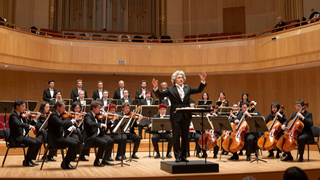
Johann Sebastian Bach composed his 『Cello Suite No. 1 in G Major』 around 1720, during his years as court music director in Köthen. The piece calls for one cellist, one instrument, no accompaniment. For nearly two centuries after its creation, musicians treated it as a technical exercise, a set of drills for students to sharpen their bowing. It took Pablo Casals, a thirteen-year-old boy rummaging through a secondhand music shop in Barcelona, to pull the score from a dusty pile and sense what no one else had bothered to hear: that these exercises were, in fact, a cathedral.
What interests me is not the rediscovery itself but what it implies about the things right in front of us, the fragments of beauty and meaning we handle every day without recognition.
The Scattered Tiles
Listen to the Prelude that opens the suite, and you hear what sounds like simplicity itself. A single voice moves through arpeggiated chords, each note placed with the care of someone setting stones into wet mortar. The bow draws one phrase, then another, each self-contained, each modest. No melody leaps out and demands your attention. Instead, the notes seem to orbit a center of gravity you can feel but not name.
Now consider the Allemande that follows. The rhythm shifts, grows more deliberate, almost conversational. Where the Prelude flowed like water finding its path downhill, the Allemande walks. It pauses. It thinks. If the Prelude is the moment you open your eyes in the morning, the Allemande is the first conscious thought that follows.
Then come the Courante, the Sarabande, the paired Minuets, the Gigue. Each is a distinct world. The Courante runs, propulsive and eager. The Sarabande slows to the pace of breath, so spare and exposed that every note vibrates with the vulnerability of saying something true. The Minuets introduce a lightness that borders on play. And the Gigue finishes the sequence with an energy that circles back, somehow, to where everything began.
Six movements. Six moods. Six small rooms in a house you walk through one at a time.
But here is what strikes me: none of these movements quote each other. They share a key signature and a composer, and that is nearly all. Played in isolation, any single movement is beautiful but bounded, a tile removed from its mosaic. You could spend a lifetime with the Sarabande alone and never suspect the Gigue existed.
We live this way too. Our days arrive as disconnected episodes. The commute. The meeting. The lunch eaten standing up. The phone call with a friend we haven’t spoken to in months. The ten minutes before sleep when we stare at the ceiling and something unnamed moves through us. Each moment feels separate. Each seems to end when the next begins.
And yet.
Threads Beneath the Surface
 Photo by
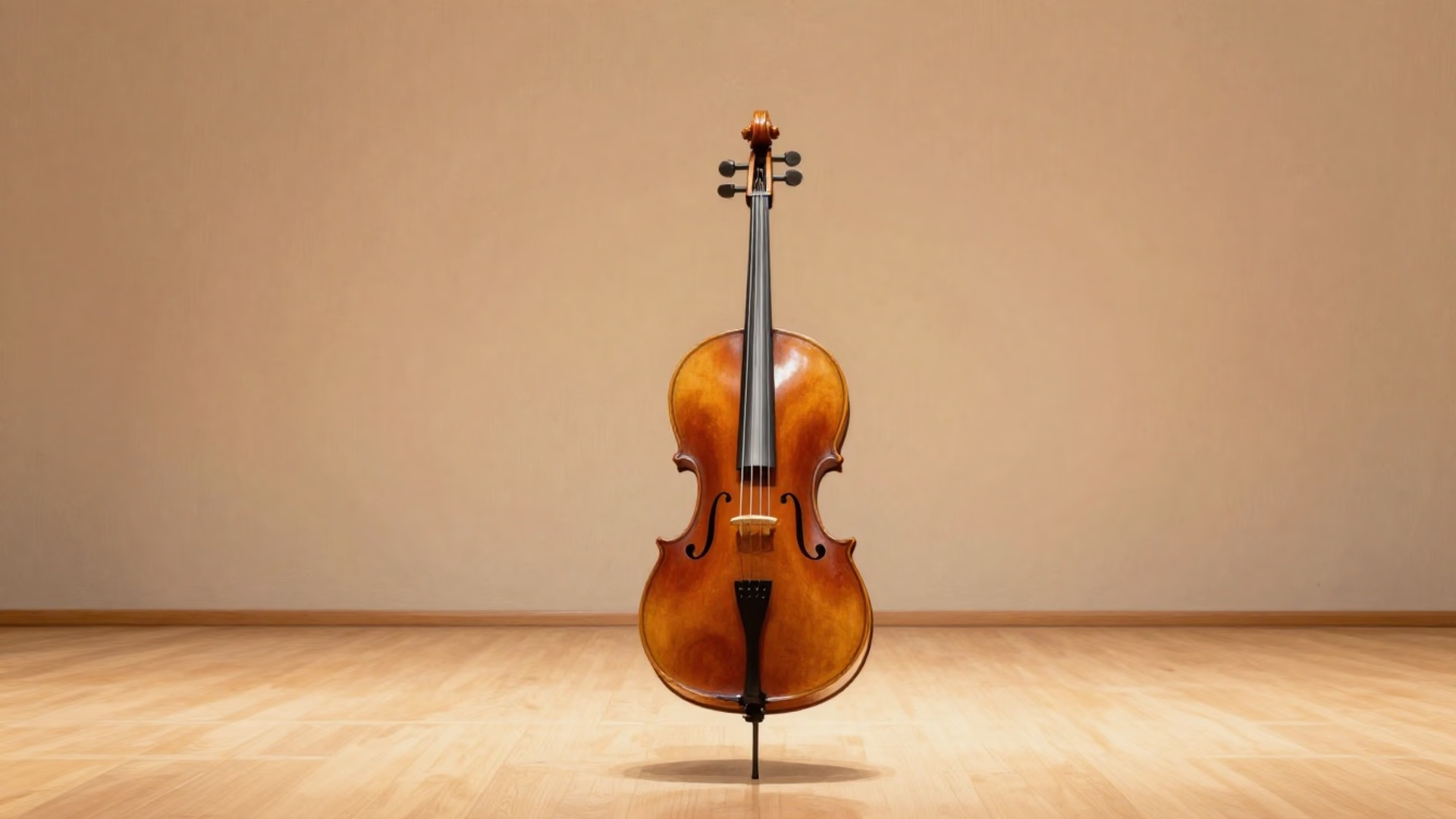
 Something holds these movements together, and it is not the program notes or the track listing. It lives deeper. Bach built the entire suite from a single instrument’s range and resonance, which means every passage exists within the same physical constraints: four strings, the reach of one human hand, the length of one bow stroke. The cello’s body becomes the room all six movements share.
This is the hidden link. Not a melodic theme that recurs, not a clever quotation woven through the fabric, but a set of limits that paradoxically creates freedom. Because the cello can only do so much, Bach was forced to imply what he could not state outright. When you hear a bass note and a melody note in rapid succession, your mind fills in the harmony between them. A single line becomes a chord. A chord becomes a world. The deepest music is the music your own mind completes in the silence between the notes.
This is how connections work in a life, too. You do not see the thread linking a conversation you had at twenty-two to a decision you make at forty. The constraint is simply being one person, one body moving through time, unable to live two moments at once. But within that limit, something accrues. The friend who mentioned a book. The book that changed how you thought about forgiveness. The forgiveness that let you stay in a relationship long enough to see it transform. No single moment contains the whole story. The thread only becomes visible when you step back far enough to see the distance it has traveled.
Bach’s cello suites were forgotten for two hundred years not because they lacked beauty but because people looked at the fragments and failed to see the mosaic. The notes on the page looked like exercises. Only when Casals played them as music, as a unified utterance from a single voice reaching toward completeness, did the pattern reveal itself.
We do this with our own lives constantly. We mistake the fragments for the whole story. A bad week becomes evidence of a bad life. A single failure becomes an identity. We look at the individual tiles and declare them dull or broken, never stepping back to see the image they compose together.
The Shape That Was Always There
 Photo by
 What emerges from the six movements, when you listen to the suite from beginning to end, is not a narrative. It is closer to what you feel when you walk through a forest and gradually become aware of a pattern in the canopy: the way branches angle toward gaps in the leaves, each tree solving the same problem of light differently, all of them collaborating on a shape none of them planned.
The G Major suite begins in openness and ends in joy, but the path between those two points includes weight, hesitation, grief, playfulness. It includes the Sarabande, which might be the loneliest piece of music ever written for a single instrument. That loneliness does not contradict the joy of the Gigue. It makes the joy possible. You cannot arrive at lightness without first passing through gravity.
This is the pattern the mosaic reveals: that a life is not made meaningful by the presence of only beautiful pieces. It is made meaningful by the arrangement, by the fact that sorrow sits next to contentment, that boredom precedes wonder, that the long stretch of nothing in particular turns out to be the ground on which everything important grows.
We keep waiting for the moment when life will finally cohere, when all the scattered experiences will click into a legible shape. But coherence is not an event. It is a way of looking. The suite was always a masterpiece; it simply needed someone willing to hear it as one.
After the Last Note
 Photo by
 A cellist finishes the Gigue and lifts the bow. The room holds its breath for a moment before the silence fills back in. But the silence that follows the suite is not the same silence that preceded it. It has been shaped by what passed through it, curved like the walls of a resonating chamber.
Somewhere, an afternoon is assembling itself from nothing: light on a counter, a dog barking far away, the scent of someone else’s dinner drifting through a window. No one has named it yet. No one has stepped back far enough to see the whole. But the tiles are already in place, waiting for the moment when a single glance will turn the scattered pieces into something you will want to carry home and keep.