Most of the greatest moments in cinema are moments where nothing happens at all.
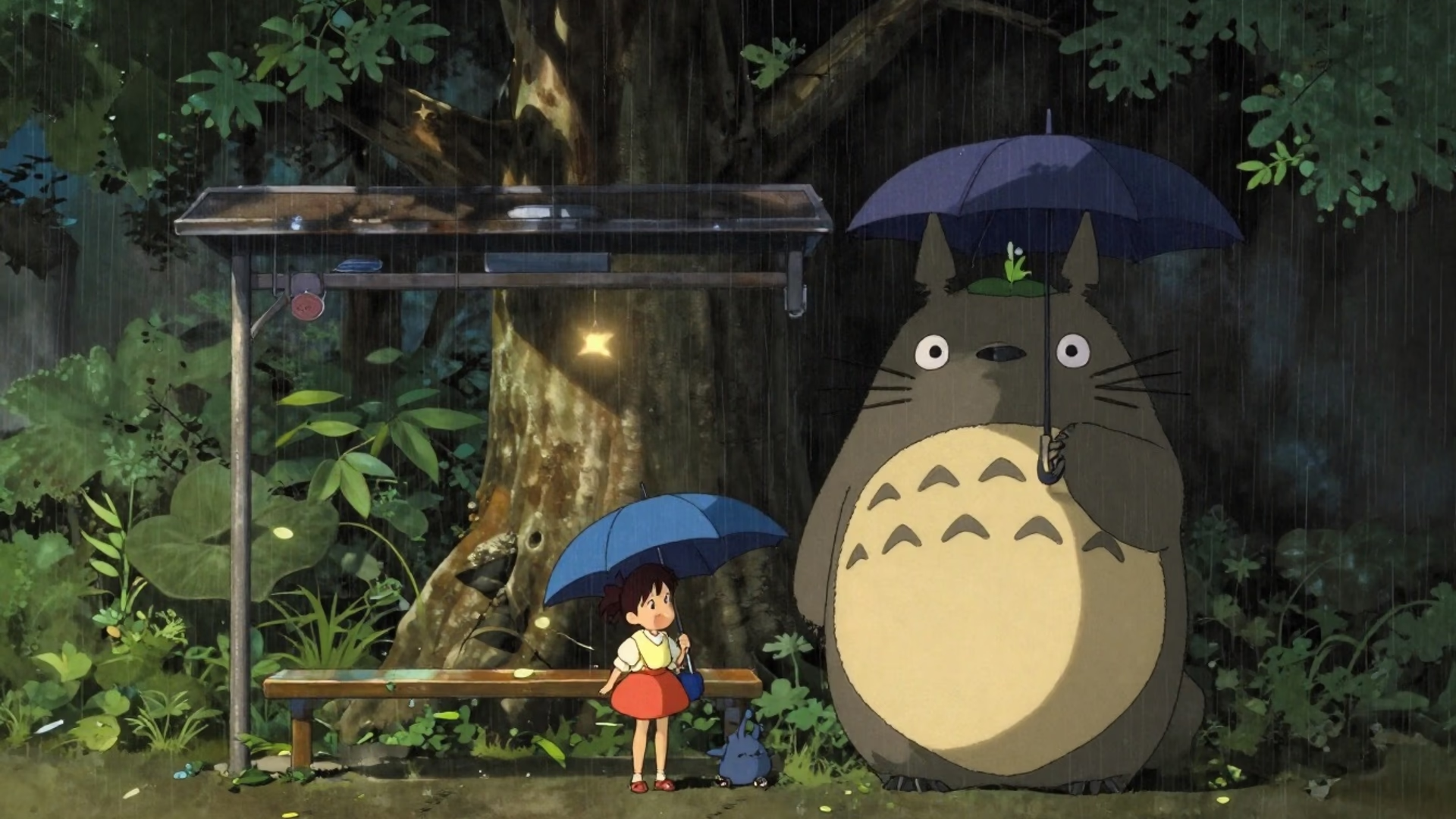
This sounds wrong, and that’s the point. We’ve been trained to associate meaning with action, insight with conflict, depth with suffering. But consider the scene that has stayed with millions of viewers for over three decades: a small girl standing at a country bus stop in the rain, waiting. Beside her stands a massive, fur-covered creature holding a leaf over its head. A bus arrives. The creature boards it. That’s all. No chase, no revelation, no villain lurking in the shadows. Just rain, breathing, and a peculiar kind of company. In 『My Neighbor Totoro』, directed by Hayao Miyazaki in 1988, this is the scene people carry with them for life.
The rain falls in fat drops. You can almost hear each one landing on the umbrella Satsuki holds over her little sister Mei, who has fallen asleep on her back. The bus stop is nothing more than a wooden post and a small fox shrine along a dirt road flanked by rice paddies and towering camphor trees. Night has come, and the road is empty in the way that rural roads are empty, not threatening but vast, as though the world has quietly decided to step back and leave you alone with yourself. Then the forest spirit appears, not in a flash of light or a peal of thunder, but simply by being there, the way a cat appears on a windowsill. Totoro stands beside Satsuki, dwarfing her completely, and yet there is no menace. He wears the rain on his fur the way a hill wears fog. When Satsuki offers him an umbrella, he takes it with the clumsy curiosity of someone encountering a gift for the first time. The sound of raindrops hitting the umbrella delights him so thoroughly that he jumps, sending a cascade of water from the trees overhead. His joy is enormous and uncomplicated. And in this moment, a girl who has been carrying far too much weight for a child her age gets to laugh.
Rain on Leaves, and What We Pretend Not to Hear
Beneath the soft watercolors and gentle comedy of Miyazaki’s film lies a story shaped by anxiety. Satsuki and Mei have moved to the countryside with their father because their mother is in a hospital, ill with a condition the film never names. The girls are cheerful and energetic, but watch Satsuki closely. She makes lunches. She waits for her father at the bus stop when he’s late. She comforts Mei when their mother’s visit is postponed. She is ten years old, and she is already performing the quiet, exhausting labor of holding a family’s hope together.
The film never announces this. It never gives us a scene where Satsuki breaks down and confesses how scared she is, at least not until the very end, and even then it lasts only a moment before the world rushes in to help. Instead, Miyazaki lets us feel the weight through accumulation. The way Satsuki’s smile tightens when she reads a telegram about her mother. The speed with which she runs to find Mei. The tiny beat of silence before she reassures her sister that everything will be fine.
This is the layer most adults recognize on second viewing. Children watch My Neighbor Totoro and see a magical creature who gives rides through the sky. Adults watch it and see a child who cannot afford to be a child, and a world that, through some combination of kindness and enchantment, insists that she be one anyway. Totoro does not solve problems. He does not cure the mother. He does not explain life. He offers a ride on a spinning top that flies above moonlit fields. He makes seeds grow overnight into an enormous tree. He summons a bus that is also a cat. None of this addresses the family’s real crisis, and all of it addresses something just as urgent.
Sometimes the most radical thing the world can do for a burdened child is to be, for a few hours, absolutely astonishing.The forest in this film breathes. Dust spirits scatter in dark rooms like living soot. Acorns tumble out of hiding places with conspiratorial energy. The wind moves through the grass with such attentive animation that you realize how rarely films bother to show what wind actually looks like when it crosses a meadow. Miyazaki drew on his own childhood memories of rural Japan, and you can feel the specificity in every frame. This is not a generic pastoral. This is a landscape remembered with the sharpness of someone who once stood barefoot in a particular creek and never forgot the temperature of the water.
And yet the film is not nostalgic in the sentimental sense. Nostalgia sweetens and simplifies. My Neighbor Totoro does something harder. It presents a child’s world in full, with its terrors and its wonders given equal weight, and suggests that neither cancels the other out. The mother’s illness is real. Totoro is also real. The film holds both without flinching.
The Invisible Threshold
 Photo by
 Think of the last time you paused to watch rain fall. Not glanced at it through a car window while thinking about where you needed to be, but actually stopped and watched. The way it darkens stone unevenly. The way a puddle receives each drop with a small, circular argument. Most of us cannot remember when we stopped doing this regularly. It wasn’t a decision. It was an erosion, slow and unnoticed, like the way you stop hearing a clock after living with it long enough.
Miyazaki’s film suggests that the boundary between those who see Totoro and those who don’t is not really about age. It’s about attention. The father in the film believes his daughters when they describe the forest spirit. He thanks the giant camphor tree for looking after them. He isn’t humoring anyone. He is a man who has not yet sealed off the part of himself that can accept the unreasonable beauty of the world.
We tend to narrate growing up as a story of gaining. Gaining knowledge, gaining independence, gaining the ability to see things as they really are. But growing up is also a story of losing, and one of the things we lose most reliably is the willingness to be stunned. Not the capacity. The willingness. We learn to filter. We learn that stopping to examine a beetle on a leaf is unproductive, that wonder is a luxury, that the appropriate adult response to a rainstorm is annoyance.
The genius of My Neighbor Totoro is that it does not argue against adulthood. It does not suggest we should all return to some prelapsarian state of wide-eyed innocence. What it does, with extraordinary gentleness, is remind us that the world never stopped being extraordinary. The trees did not become less alive because we stopped talking to them. The rain did not become less interesting because we started carrying better umbrellas.
We build our adult lives around the management of worry, and rightly so. Bills, health, the safety of people we love. But somewhere along the way, management becomes the only mode we know. We forget that the original purpose of managing worry was to make room for something else. For the feeling of soil between fingers. For the absurd pleasure of a leaf held over a head in a downpour. For the company of something enormous and quiet standing beside us in the dark.
 Photo by
 What the Bus Stop Still Holds
 Photo by
 So return, for a moment, to that rain-soaked road. The wooden post, the small shelter, the vast and empty night. Satsuki stands there holding her sleeping sister. She is tired. She is worried about her mother. She is waiting for a bus that should have arrived already.
And then something impossible is simply there, beside her, as naturally as breath.
When the scene first plays, it looks like a story about a magical encounter. But after sitting with it, after letting its quiet accumulate, the scene reshapes itself. It becomes a portrait of what happens when someone too young to carry their burden meets a world that has not forgotten how to be generous. Not generous with solutions. Generous with presence. Totoro does not take the worry away. He stands in it, with her, and makes the rain sound like music on the stretched skin of an umbrella.
The bus stop is still there. The rain has never stopped falling in that particular, attentive way. The only question is whether you walk past it or whether, just once, you put down what you’re carrying long enough to hear the drops land. The scene hasn’t changed. But you, standing before it again after all this time, might find that you have. That the child who once watched it for the magic now watches it for the mercy. And that both of those were always the same thing, waiting at the same rain-slicked road, quiet and enormous and holding a leaf over its head like it had all the time in the world.