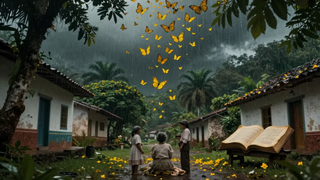
You go back to the street after fifteen years, prepared for everything except what you actually find. The bakery is still there, but smaller. The gate has been replaced with something modern that makes no sound. You walk the route you walked every day of your childhood, and it takes four minutes. You remember it taking hours.
This is the moment of the reckoning. Not the moment you arrive, but the moment you realize that the city you came looking for was never made of brick and mortar and concrete. The street has not changed so much as it has revealed something about the person walking it. You were taller then, or the world was. The distance between your house and the corner store was a journey. Now it is nothing. The elm tree that seemed to touch the sky has become an ordinary tree, and you understand that you have not returned to your old neighborhood. You have returned to the person you were, and that person no longer lives there.
The shop owner does not recognize you. Why would she? To her, you are a stranger. But you recognize her - you think you do - and in that moment something odd happens. The neighborhood you are standing in and the neighborhood you remember begin to exist in the same space, like a double exposure on film. The city you came looking for was never a location. It was made of the height of your eyes. Now you are taller, and everything is scaled differently. The familiar is foreign. The foreign is somehow intimate. You are homesick for a place you are standing in, and you realize this feeling will not pass when you buy a ticket home. It will follow you wherever you go next, quietly coloring the way you see every street, every corner, every doorway you pass without really looking.
This is the strange gift that homesickness offers, if we stop fighting it. The place we have lost is not behind us, locked in time. It travels with us, and it changes us. Every new city we enter is measured against it, every new street is compared to an old one, and in that constant measuring we are not diminished. We are deepened. The past does not trap us; it teaches us how to look. And what we are really homesick for is not a place at all. It is the attentiveness that place once demanded of us, the way we had to notice everything when everything was new. That attention is still available. It is waiting in the doorways we pass tomorrow, in the ordinary streets we walk without seeing.