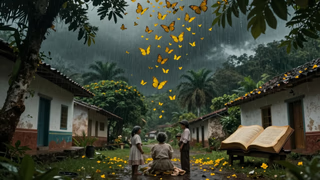
A faint smell of lemon verbena drifts through the pages before you even know where you are. It clings to the hair of a woman named Clara, who writes in her notebooks with the calm, unshakable certainty of someone recording not just what happened but what the happening felt like, tasted like, sounded like in the dark. You can almost feel the worn leather of those notebooks under your fingertips, the slight give of paper that has absorbed decades of ink and tears and prophecy.
This is the opening world of 『The House of the Spirits』, the sprawling, ferocious debut novel by Isabel Allende, first published in 1982 while the author was living in exile from her native Chile. The story spans generations of the Trueba family, tracing the lives of women who see ghosts and move tables with their minds and men who build empires out of rage and land. But beneath the magic, beneath the earthquakes and the green hair and the spirits who wander the hallways, the novel pulses with a quieter question: who is keeping the record? Whose hand holds the pen when history tries to devour itself?
Clara, the novel’s spiritual center, begins writing in her notebooks as a young girl and never stops. She records births and deaths, political shifts and small domestic betrayals, the color of the sky on the day her daughter was married, the name of a dog that once slept at her feet. She writes everything. Not because she believes someone will read it, but because she understands, with the instinct of someone who has lived close to both the visible and the invisible, that memory left unwritten becomes a ghost of a different kind. One that haunts not by appearing but by vanishing.
Where the Walls Remember
Look closer at the novel and you notice something the plot alone won’t tell you. The house on the corner, the big house that Esteban Trueba builds to contain his family and his ambitions, is not simply a setting. It breathes. Its rooms expand and contract with the emotional weather of whoever lives inside. When Clara fills it with her séances and her notebooks and her quiet, stubborn love, the house feels infinite. When Esteban, consumed by jealousy and control, tightens his grip, the walls seem to close in. The house is a body, and the family is its nervous system.
We all know a house like this. Not one with spirits floating through the parlor, necessarily, but one where the atmosphere changes depending on who is home. Think of walking into your childhood kitchen after a fight has happened there. The chairs are in the same place. The clock still ticks. But the air is different, heavier, as though the room absorbed the argument and is slowly exhaling it back.
Allende understood this. She grew up in the orbit of Salvador Allende, her father’s cousin, who became Chile’s president and died during the 1973 military coup led by Augusto Pinochet. The House of the Spirits began as a letter to her dying grandfather, an attempt to preserve a world that political violence was erasing. The novel is fiction, but its bones are built from real grief. And that grief shaped its deepest insight: that the spaces we inhabit hold our stories whether we want them to or not.
The Trueba house accumulates layers of meaning the way a cathedral accumulates candlesmoke. Each generation leaves its residue. Alba, Clara’s granddaughter, eventually inherits both the house and the notebooks, and with them, the responsibility of making sense of the whole tangled, beautiful, brutal history. She does not do this from a position of authority or distance. She does it from the floor of a prison cell, after being tortured by agents of a regime the novel never names but whose shadow falls across every page.
This is where the novel stops being about a family and starts being about something we all carry. The most radical act in The House of the Spirits is not the magic or the revolution but the refusal to let pain have the final word. Alba writes to survive. She writes because forgetting would be a second death, not only for herself but for every woman who handed the story down to her.
The Thread That Doesn’t Break
 Photo by
 We tend to think of resilience as a solitary quality, a muscle that individuals either have or lack. But Allende offers a different picture. In her novel, resilience is inherited. It passes through touch, through stories told at bedtime, through the simple act of a grandmother brushing a granddaughter’s hair and saying, without drama, “Let me tell you about the time the earth shook.”
The women in the Trueba family are not heroic in the conventional sense. Clara does not fight. Blanca makes quiet, stubborn choices that look, from the outside, like passivity. Alba stumbles into political activism almost by accident, pulled by love rather than ideology. Yet together, across decades, they form a chain that holds. Not because any single link is unbreakable, but because each link knows it is connected to the others.
We see this pattern outside the novel’s pages all the time, if we pay attention. The grandmother who survived a war and now insists, with what seems like irrational persistence, on keeping a full pantry. The mother who writes down every family recipe in a battered notebook, not for culinary posterity but because the recipes contain memories of hands that are gone. The daughter who, without quite knowing why, keeps every letter. These are not sentimental gestures. They are acts of defiance against the tide of forgetting.
Allende wrote The House of the Spirits from exile, separated from the country and the people whose story she was trying to save. That distance gave the novel its ache, the way homesickness sharpens every detail of the place you’ve lost. You remember not the grand events but the small ones: the way light fell across a table, the sound of a gate closing, a particular laugh. The novel is full of these precise, tender details, and they do more work than any political speech within its pages. They are proof that someone was paying attention. That someone loved this world enough to write it down.
And this is where the novel meets us where we live. Most of us are not in exile. Most of us have not survived coups or torture. But all of us know what it feels like to sense a world slipping away. A parent aging. A neighborhood changing. A language that your grandparents spoke but you never learned. The slow, quiet erosion of the particular.
What Allende shows us, through Clara and her notebooks and the generations of women who carry them forward, is that the act of remembering is not passive. It is a choice, renewed daily, sometimes at great cost. To sit down and write what happened. To tell a child a story. To keep the notebook, even when the soldiers are burning everything else in the courtyard.
What Survives the Fire
 Photo by
 Near the end of the novel, after the coup, after the violence, after so much loss that the reader’s heart feels bruised, Alba sits with Clara’s notebooks spread around her. The pages are yellowed. Some are torn. The handwriting changes over the decades, growing shaky in places, exuberant in others. And Alba begins to write her own account, weaving it together with her grandmother’s, creating a single, continuous story that stretches from one century into the next.
 Photo by
 She is not writing history. She is writing something more dangerous and more necessary: a family’s memory of itself. A record kept not by the victors but by the survivors, the ones who stayed in the kitchen after the men went to war, the ones who buried the dead and then got up and made breakfast.
We carry these records, too, in ways we rarely name. A phrase your mother always used that now comes out of your own mouth, unbidden. A habit of checking the locks twice, inherited from a father who grew up in an unsafe place. The way you hold a cup of tea with both hands, exactly like someone who died before you were old enough to remember them clearly. These are the spirits in our houses. Not ghosts in the supernatural sense, but presences, impressions left in the grain of who we are.
Allende gave us a novel that uses magic to tell the truth. Tables levitate. A woman is born with green hair, and her great-niece inherits it. A clairvoyant child stops speaking for nine years and no one can make her start again. But none of these wonders matter as much as the simplest, most human act in the book: a woman opens a notebook and begins to write.
The soldiers come, the regime falls, the spirits come and go, and still the notebooks survive, because someone always thinks to carry them out of the room.