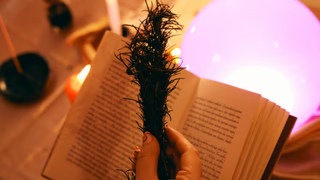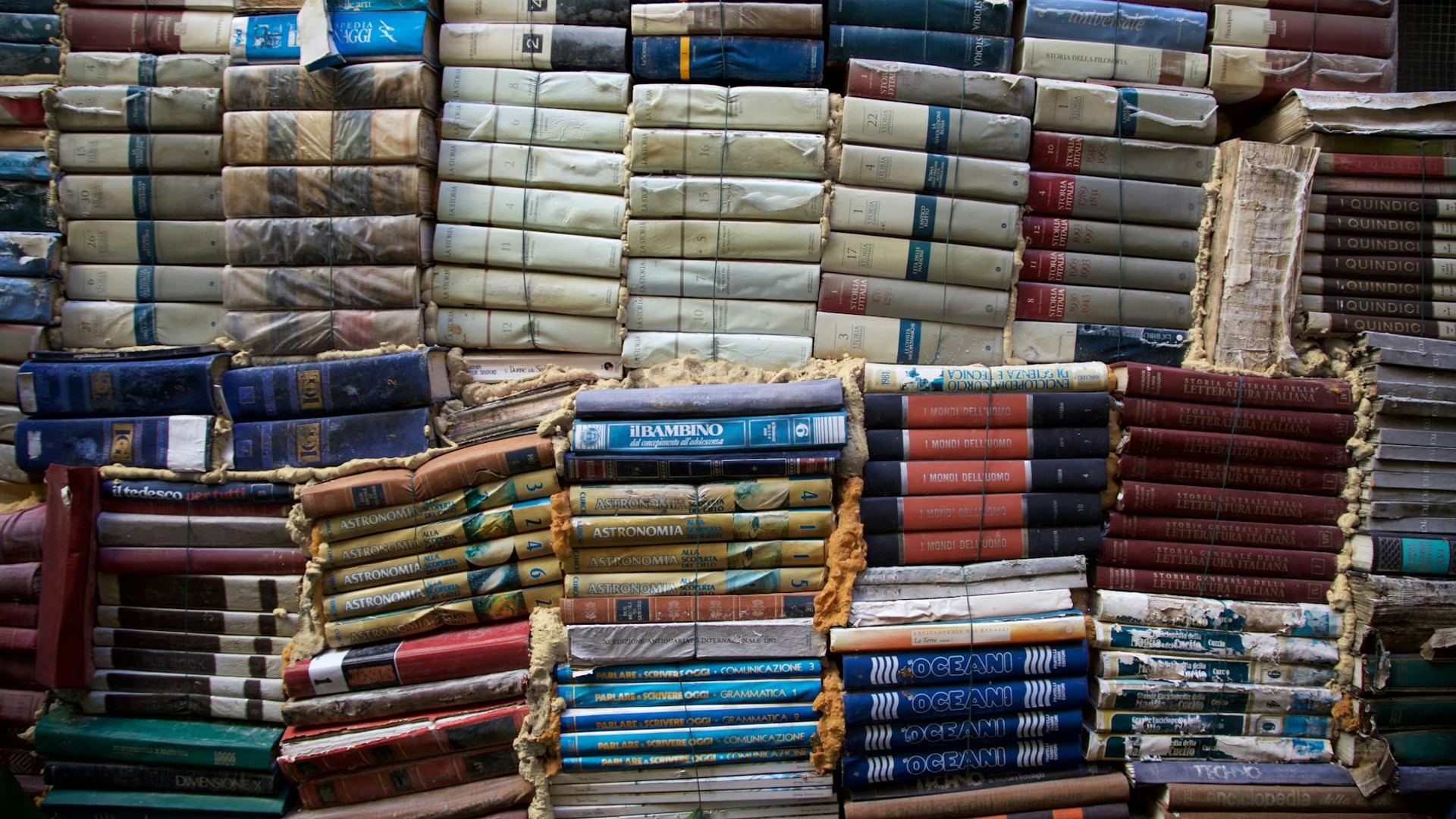
A small girl sits cross-legged on the carpet of a public library, a book almost too heavy for her lap open across her knees. The librarian watches her from behind the desk, the way one watches weather change. No one has brought this child here. No one waits to take her home. She turns a page, and in that small motion, a question rises like steam from a teacup: what does a child do when the world that surrounds her is too small, too loud, too cruel to contain who she actually is?
This is the question Roald Dahl placed at the center of 『Matilda』 in 1988, near the end of his long career of writing books that adults sometimes mistook for simple. The story belongs to a five-year-old prodigy whose parents find her existence inconvenient, whose headmistress is a former hammer-throwing champion with a taste for cruelty, and whose only allies are a kind teacher and the entire contents of the public library. It is a children’s book. It is also, quietly, one of the most radical arguments ever made on behalf of small people who are told daily that they do not matter.
The question Matilda asks is not whether the powerless can survive the powerful. Children’s books have asked that for centuries. The question is sharper, stranger: what happens inside a person who decides, very early and very clearly, that the unfairness of her circumstances is not a law of physics but simply a mistake someone made, and that mistakes can be corrected.
The Stories Told at Bedtime
Dahl wrote the book late. He was in his seventies, living at Gipsy House in Great Missenden and writing in a brick hut at the bottom of the garden, sharpening six pencils in the same ritual each morning. The first draft was, by his own admission, a disaster, and he threw it out and rewrote the book from the beginning.
The first draft was, by his own admission, a disaster. The original Matilda was a wicked child who used her powers to play tricks. His editor, Stephen Roxburgh, told him gently that the book did not work. Dahl, famously prickly, agreed. He rewrote almost the entire thing. The wicked child became a good one. The powers, instead of being whims, became weapons of justice. The villains sharpened. Miss Honey, the gentle teacher who would eventually take Matilda home, emerged from the rewrite like a figure surfacing from deep water.
What changed, between the failed draft and the finished book, was the moral center. Dahl stopped writing about a clever child and started writing about a child whose cleverness had a purpose. Matilda reads not because she is precocious but because books are the only place where the world makes sense in proportion to her, where her intelligence is met rather than punished. She moves objects with her mind not because she is magical but because the pressure of being unseen and unfair-treated has to go somewhere, and in Dahl’s universe it goes outward, toward the people who deserve it.
The man who wrote this had lost a daughter, Olivia, to measles encephalitis when she was seven. He had spent years writing books in which terrible things happened to children and children, against all odds, prevailed. He understood something about the wound of being small in a world run by adults who could not be trusted. He spent the last decade of his life writing for those children specifically, the ones who suspected, correctly, that the grown-ups around them were not as wise as they pretended.
What the Library Knew
 Photo by
 Think of that moment when you were young and someone, a teacher, a stranger, a parent who was having a good day, looked at you and saw you accurately for the first time. Not the version they expected. Not the version that was convenient. The actual person, with the actual mind, sitting in the actual chair. Most of us can name the moment. For some of us there was no such moment, and we had to become that person ourselves, later, in private, against resistance.
Matilda is a book for both kinds of reader. It says, with the clarity that only children’s books can muster, that being unseen is not the same as being invisible. That the adults who dismiss you are not arbiters of what is true. That intelligence, when it is paired with kindness, becomes a force that can rearrange a room.
The library in the book is not a refuge from her life but a correction to it, a place where the proportions of the world finally match the proportions of her mind. This is what books do, at their best, for the children who need them most. They do not provide escape. They provide accurate measurement. They tell the child who has been told she is too much, too loud, too curious, too strange, that she is in fact exactly the right size, and that somewhere else, in some other room, there are people who would recognize her on sight.
This is also what the right teacher does. Miss Honey, who has so little, who lives in a tiny cottage and walks home each day past the house her aunt stole from her, sees Matilda immediately. Not as a problem to be managed. As a person to be welcomed. The book’s most quietly devastating sentence is not about magic or revenge. It is the moment Miss Honey realizes that no one has ever taken this child seriously, and resolves, in a single internal decision, to be the first.
The Correction of Small Things
 Photo by
 We carry, most of us, some version of the Wormwoods in our histories. The voice that told us we were silly for caring about what we cared about. The teacher who could not be bothered. The adult who treated our intelligence as an inconvenience to be tolerated until we grew out of it. The lasting work of becoming an adult, it turns out, is not getting over these voices. It is recognizing them as mistaken and continuing on.
 Photo by
 Dahl understood that justice, for children, is not abstract. It is immediate and physical and often funny. Matilda does not give speeches. She glues her father’s hat to his head. She puts a parrot in the chimney. She writes on a blackboard with chalk that floats in mid-air. Her resistance is specific, local, exact. She does not try to reform the system. She removes the people who are hurting her and goes to live with the person who loves her, and the book treats this not as a fantasy but as a reasonable outcome that the universe owes her.
There is something in this that adults need as much as children, though we are more embarrassed to admit it. The conviction that unfairness is not the texture of reality but a series of correctable errors. That the small things, the daily indignities, the people who treat us as less than we are, can be answered. That intelligence and kindness, held together, are not soft virtues but structural ones. They hold up rooms. They rebuild houses. They make it possible, eventually, to walk out of the place where you were told you did not belong and into the place where you do.
The last image in the book is Matilda leaping into Miss Honey’s arms while her family’s car pulls away to Spain with its tyres screaming. She has chosen her family. She has corrected the mistake. The library, the teacher, the books, the small accumulating evidence of her own worth have brought her here. She is five and a half years old.
Most of us take much longer. But the principle is the same. Somewhere in each of us is the child on the carpet with the book too heavy for her lap, deciding what is true and what is merely loud. That child is not gone. She is reading still. She is moving small things with her mind, and the small things are becoming larger, and the room, slowly, is becoming the right size.