A strip of celluloid flickers in the dark, and on it, a procession of kisses. Lips meeting lips, edited together by the hands of a dying man who once, decades ago, cut them out at the orders of a village priest. Each kiss was deemed too much, too carnal, too alive for the parish eyes of Giancaldo. The priest rang his little bell, the projectionist Alfredo obediently sliced them from the reel, and the villagers watched their love stories break at the moment of consummation, lovers leaning in and then suddenly, mysteriously, pulling apart. The censored frames were saved in a tin. Forty years later, those kisses return to a grown man sitting alone in a screening room in Rome, and he weeps.
This is the closing sequence of 『Cinema Paradiso』, the 1988 film by Giuseppe Tornatore, scored by Ennio Morricone with a tenderness that still, after all these years, feels like a hand placed gently on the shoulder. The scene is famous. It is also, in some way, the quiet machinery of memory itself made visible. All the moments someone once decided we could not have, returned to us too late, spliced into a single ribbon of longing.
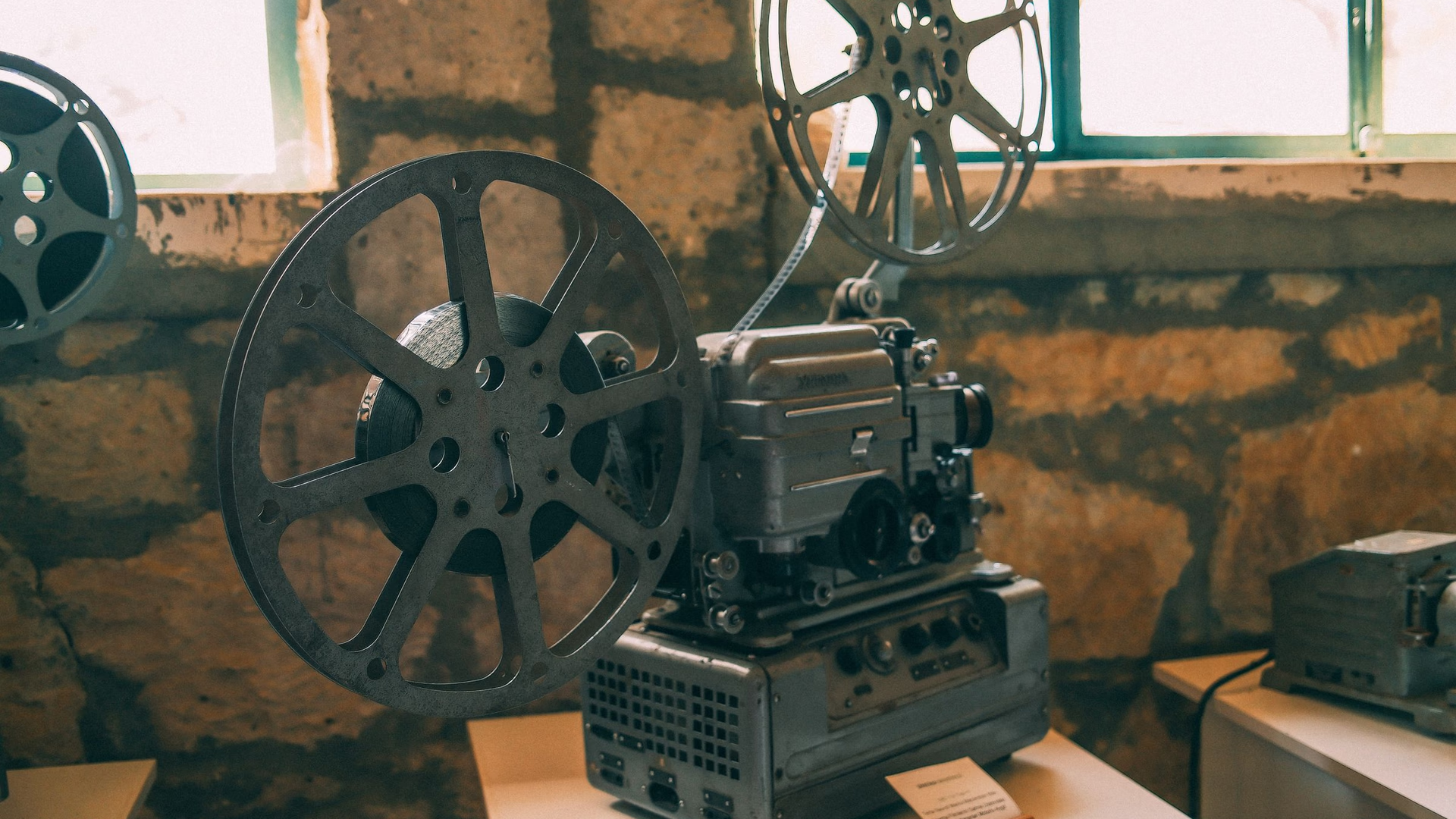
Before the tears, there is the boy. Toto, six or seven years old, perches on a stool beside the enormous carbon-arc projector. His face is smudged. His eyes are full of the beam of light passing through the lens. Alfredo, gruff, unlettered, patient, teaches him how to thread the film, how to watch for the cigarette burn in the corner of the frame that signals a reel change. The projection booth smells of hot metal and acetate. Outside, in the wooden seats of the Cinema Paradiso, the whole village laughs and cries together, a congregation with its back to the priest and its face to the flickering wall.
The scene is warm the way a kitchen is warm in winter. It is the warmth of being a child near a man who knows how the world works, or at least one small, luminous corner of it.
What Was Cut, What Was Kept
What Alfredo does for Toto is not only teach him to run a projector. He sends him away.
Years later, when Toto has become a young man in love with a girl who vanishes from his life without explanation, Alfredo tells him to leave Giancaldo and never come back. Do not write. Do not think of us. Whatever you do, do it with love, the way you loved the projection booth as a boy. The advice is cruel in its tenderness. It asks the boy to sever himself from the only place that made him, in order to become something the place could not contain.
And Toto obeys. He leaves. He becomes Salvatore, a successful filmmaker in Rome, a man with beautiful women passing through his apartment and no one waiting up for him. He does not return for thirty years. Only Alfredo’s death brings him back, to a village he barely recognizes, to a mother who has kept his room exactly as he left it, to the old Cinema Paradiso now scheduled for demolition to make way for a parking lot.
Here the film does something more honest than nostalgia usually allows. It does not pretend the leaving was a mistake. Salvatore’s life in Rome is real. His craft is real. The man he became could not have been born in Giancaldo. But it also does not pretend the leaving was free. Something was cut out of him, the way the kisses were cut out of those old films, so that the rest could keep moving.
This is the deeper layer beneath the lyrical surface. The people who shape us often do so by making us capable of losing them. A good mentor does not teach you how to stay; a good mentor teaches you how to leave, and then spends the rest of their life being the place you left. Alfredo understood this. He knew that if Toto stayed, the love between them would curdle into obligation, and the boy’s gift would dim in the small rooms of a small town. So he gave the most difficult blessing a teacher can give. He refused to be needed.
What Alfredo kept, secretly, was the reel of kisses. Every censored embrace, every forbidden tenderness, saved in a tin with Salvatore’s name on it. He did not send it. He waited until he was gone. It is a strange, beautiful inheritance. Here is everything they would not let you see. Here is everything I could not say.
The Places That Live Inside Us
 Photo by
 Most of us carry a Giancaldo. It is not always a village. Sometimes it is a street, an apartment, a summer, a kitchen, a face. It is the geography that formed us before we knew we were being formed, and the strangeness of adult life is that this place continues to exist inside us long after it has ceased to exist outside us. The Cinema Paradiso in the film is demolished. Salvatore watches the walls come down. The building is gone, but the building is not gone, because he is standing there, and he is in part made of it.
There is a particular ache that belongs to returning. You walk down the street you walked down as a child and everything is smaller and wronger. The bakery is now a phone shop. The neighbor who used to wave from her balcony has been dead for twelve years. The child you were is not there to greet you, and neither, fully, are you. And yet something in you lights up like an old projector warming its bulb, and for a moment, the street is both what it was and what it is, superimposed, double-exposed.
We do not often admit how much of who we are was given to us by people who did not know they were giving it. The uncle who taught you to whistle. The teacher who lent you a book she never asked back. The friend whose laugh you unconsciously borrowed. These small transmissions accumulate into a self. And when those people fall away, through distance or death or the ordinary erosion of years, we do not lose them so much as internalize them further. They become the interior architecture. They become the reel running behind the eyes.
To grow up is, in part, to realize that the love you received was often edited. Things were cut for your protection, or for someone else’s comfort, or because the rules of the time required it. You did not see every kiss. You did not hear every word. Only later, sometimes too late, do the cut frames come back to you, and you understand what was withheld and why, and you weep not from bitterness but from the enormity of being loved imperfectly by people doing their best with the reels they were handed.
The Long Return
 Photo by
 There is a moment near the end of the film when Salvatore, back in Rome, sits alone and watches Alfredo’s final gift unspool. The kisses come one after another, black and white and color, silent and scored, stars and strangers, all the love the village was not allowed to witness, now delivered to one man in the dark. He laughs a little. He cries. The camera stays on his face longer than is comfortable.
 Photo by
 What is happening in that face is something the film trusts us to understand without explanation. It is the moment when a life finally connects to itself. The boy in the projection booth and the man in the screening room, separated by forty years and a thousand kilometers and countless edits, are briefly the same person. The reel is the bridge.
We spend a great deal of our lives in pieces. The child self, the student self, the lover, the professional, the one who left, the one who stayed. These versions rarely sit in the same room together. But occasionally something arrives, a song, a photograph, a smell, a film, a tin of old frames, and the pieces align for an instant, and we feel the whole shape of ourselves the way you might feel the whole shape of a sentence only when you reach its final word.
Giuseppe Tornatore made this film out of his own childhood in a Sicilian village, his own love of cinema, his own debt to the men who threaded the light. What he made became a mirror for millions of strangers, because the particular, rendered with enough tenderness, always opens outward.
What we call nostalgia is often misdiagnosed. It is not, at its truest, a wish to return. It is the recognition that we are still, in some essential way, there; that the places we left did not stay behind when we walked away but walked with us, projected against every new wall we stand before.
Alfredo saved the kisses because he knew something Salvatore would only learn by living: that love’s job is not to keep you close, but to keep you company on the long way home to yourself.