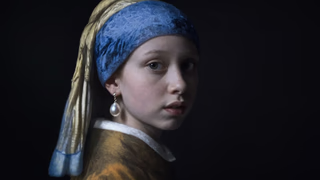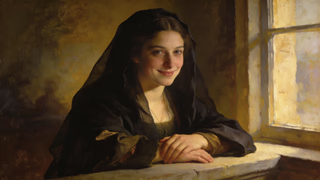
A hand traces the outline of an ear in the dark. Not touching it, not yet. The painter’s fingers hover just above the curve of cartilage and skin, memorizing the architecture of a woman she has been hired to capture on canvas but has no permission to love. The gesture lasts only a breath, but it contains the entire vocabulary of longing.
This single, almost invisible moment from Céline Sciamma’s 『Portrait of a Lady on Fire』 stays long after the credits roll. Set on a remote Breton island in the eighteenth century, the film follows Marianne, a painter commissioned to create a wedding portrait of Héloïse, a young woman recently pulled from a convent to marry a Milanese nobleman she has never met. Héloïse has already refused to sit for one painter. So Marianne must work in secret, studying her subject during daytime walks along the cliffs, then painting from memory each night by candlelight. What unfolds is not simply a love story. It is a prolonged, devastating meditation on what it means to truly see someone, and what we are left holding when the person we’ve seen is taken from us.
But let’s stay with that hand for a moment longer. The fingers tracing air just above skin. Because something happens in that gap, that sliver of space between touch and not-touch, and we all know what it is. We have all lived inside that gap. It is the space where desire and restraint coexist, where the body says yes and the world says no, and the distance between a fingertip and a collarbone becomes the widest canyon on earth.
The Gaze That Gives
We are trained to think of looking as taking. The camera steals the soul, we say. The male gaze consumes. Surveillance violates. To be watched is to be diminished. And so much of visual history bears this out, centuries of portraits in which women were arranged like fruit, posed for someone else’s appetite, their expressions smoothed into compliance.
Sciamma dismantles this entirely, and she does it without polemic, without argument. She does it with the quiet revolution of two women looking at each other and neither one flinching. When Marianne first observes Héloïse on their walks, she does so as a professional, cataloguing features the way a cartographer records coastline. The tilt of the jaw. The way the hood shadows the brow. She is collecting data for a portrait, not a person. But something shifts. Héloïse begins to look back. And in that returned gaze, the entire power structure of artist and subject, watcher and watched, collapses into mutuality.
This is the first and perhaps most radical insight the film offers. Looking can be an act of generosity. When we look at someone with genuine attention, not to judge or categorize or possess, but simply to know them, we offer something rare. We say, without language, that they are worth the effort of seeing. That their particular arrangement of features and expressions and contradictions matters enough for us to slow down and pay attention.
Think of how seldom we experience this. How often do we move through a day, a week, a year beside people whose faces we barely register? We glance. We scan. We assess in fractions of seconds whether someone is useful, attractive, threatening, boring, and then our eyes slide off them like water off glass. To actually look, to hold someone in your full attention long enough that you could paint them from memory, is so unusual it feels almost aggressive. Or sacred. Sometimes both.
Héloïse understands this. When Marianne finally reveals the finished portrait, painted in secret, Héloïse studies it and delivers a verdict that cuts to the bone: “Is that how you see me?” Not because the painting is unflattering. Because it is conventional. Because Marianne, in trying to produce a painting suitable for a distant fiancé, has painted presence without personality, beauty without the restless intelligence that makes Héloïse herself. She has looked without truly seeing.
The portrait is technically accomplished and emotionally hollow. And Héloïse can tell. She knows the difference between being observed and being known, and she refuses to accept a version of herself that only skims the surface. This moment breaks something open between them. Marianne destroys the canvas. She starts again. But this time, Héloïse agrees to sit.
What follows is not a painting session so much as a slow, mutual act of revelation. Héloïse sits, but she also watches Marianne work. They trade positions, subject and artist blurring, each one studying the other with an intensity that makes the air in the room feel thinner. The portrait that emerges from these sessions is different. You can feel it. It carries the weight of genuine encounter.
Burning Into Memory
 Photo by
 The title refers to a scene near the film’s center. During a nighttime bonfire on the beach, Héloïse’s dress catches fire. For a long moment, she doesn’t notice. The flames lick at the hem of her gown while she stares across the fire at Marianne, and the image sears itself into the film’s consciousness, an emblem of desire so focused it becomes dangerous, so consuming it ignites the very body that contains it.
Love, the film suggests, is not a feeling that washes over us but a fire we choose to stand inside, knowing full well it will burn.But there is a second burning, quieter and more lasting. It is the burning of memory. Marianne and Héloïse both know their time together has a deadline. The portrait’s completion means Héloïse will be sent to Milan, to a marriage and a life in which Marianne will have no part. They never pretend otherwise. No one hatches an escape plan. No one suggests running away together. The constraints of their century, their gender, their class, are absolute, and the film honors those constraints rather than fantasizing them away.
So what do you do when you love someone and you know, with the clarity of a calendar, exactly when you will lose them? You memorize. You turn every shared moment into material for the portrait you will carry inside you for the rest of your life, the one no one commissions and no one sees. This is what Marianne does. This is what many of us have done.
We know this kind of burning. Not all love ends because it fails. Some love ends because the world is shaped in ways that will not accommodate it. A job in another city. A family obligation that cannot be refused. A war, an illness, a difference in timing that no amount of devotion can bridge. And when we lose someone not to betrayal or boredom but to the sheer geometry of circumstance, the grief is different. It is cleaner and, in some ways, more cruel, because there is no anger to hide behind. Only the ache of what was real and is now gone.
Memory becomes, in these cases, not a consolation prize but the primary artifact of love. We carry people inside us. We replay conversations, reconstruct the exact quality of someone’s laughter, summon the precise weight of a hand on our shoulder. The details sharpen rather than fade, because we have polished them so many times with our attention, like stones in a river.
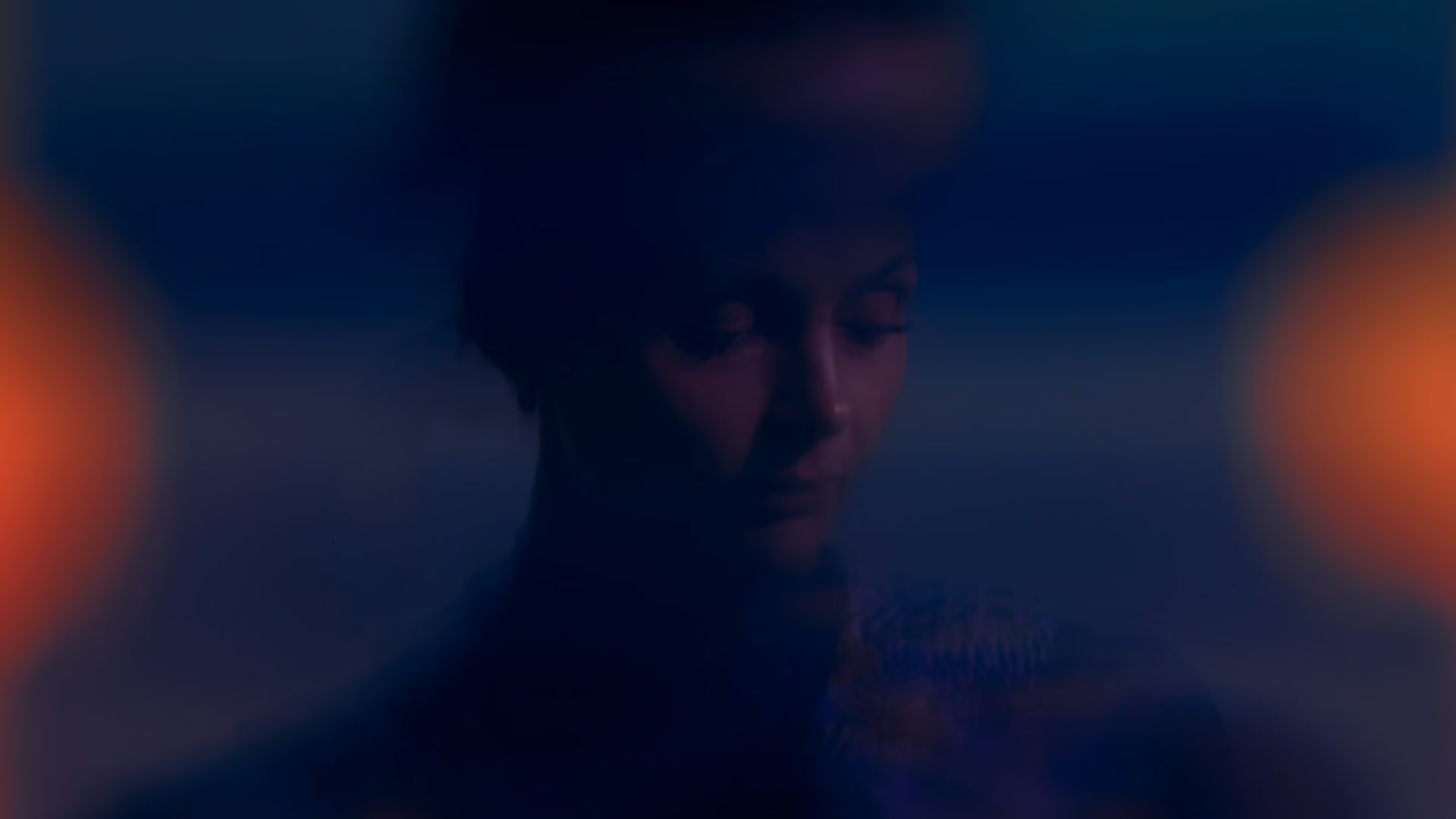
Sciamma understands this. The film’s final act unfolds in a series of separations and reunions, each one briefer than the last, each one more saturated with everything that cannot be said. And the very last image of the film, Héloïse’s face in a concert hall years later, is a portrait of memory itself, all the grief and joy of a life compressed into a single expression that the camera refuses to explain.
What We Keep When We Cannot Hold
 Photo by
 Let’s step back from the film for a moment and sit with what it illuminates about the rest of our lives.
 Photo by
 We are all, in our way, painting portraits of the people we love. Not on canvas, but in the medium of daily attention. Every time we notice the particular way someone stirs their coffee, the cadence of their voice when they are tired, the small frown they make when they are thinking and don’t know anyone is watching, we are adding a brushstroke to an interior portrait that no one else will ever see. These portraits are our most honest work. They are painted not for exhibition or sale but because the looking itself is the point.
And like Marianne’s portrait, our inner images of the people we love are only as true as the quality of our seeing. If we look with distraction, with assumption, with the lazy shorthand of familiarity, we produce the equivalent of that first rejected canvas, technically accurate and emotionally void. But if we look with the full force of our attention, if we resist the temptation to reduce someone to the version of them that is most convenient for us, we create something living. Something that can survive even the loss of the person it depicts.
This is what Portrait of a Lady on Fire ultimately teaches. Not that love is tragic, though it sometimes is. Not that art is redemptive, though it can be. But that the act of truly seeing another person, the sustained, courageous, trembling act of looking at someone as they are, is itself a form of love. The most durable form, perhaps. The form that outlasts presence, outlasts touch, outlasts even the sound of a voice you will never hear again.
We move through the world so quickly. We accumulate faces and names and interactions at a pace that would have astonished the inhabitants of that Breton island. And yet the question the film leaves us with is not about pace or modernity. It is much older than that.
Picture someone you love, right now, in this moment. Not a photograph of them. Not a memory of something they did. Just their face, in repose, when they don’t know you’re looking. Can you see them? Can you trace the outline of their ear in the dark, from memory alone? And if you cannot, what would it take to look closely enough, long enough, bravely enough, to burn that image so deeply into yourself that no distance and no time could ever fully extinguish it?
Somewhere, in a fictional concert hall, a woman sits alone and listens to Vivaldi’s “Summer,” and her face becomes the canvas on which an entire love is written. She does not know she is being watched. The music swells. Her composure holds, then doesn’t. And the film ends not with an answer but with that face, burning still, carrying everything.