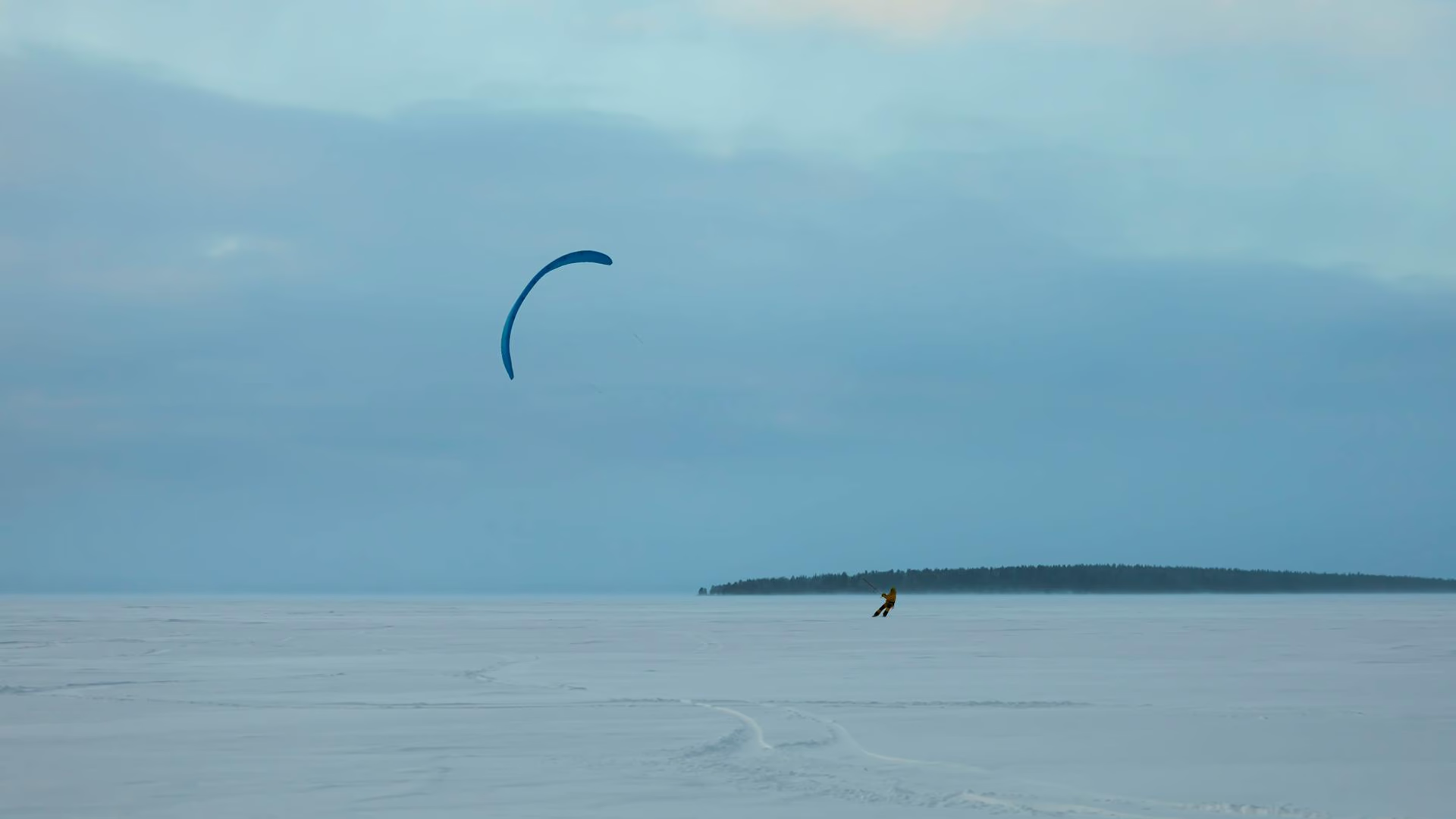
The snap of wind against taut fabric, high and bright in a cold Kabul sky. A kite, green with red trim, catches the light as it climbs, its string humming with tension between a boy’s bleeding fingers and the pull of something much larger than air. Below, the city sprawls in haze and dust. The streets smell of smoke and roasting turnips. And somewhere in that crowd, a boy is running, eyes fixed upward, his loyalty so complete it never occurs to him to question it.
This is the opening world of 『The Kite Runner』, the 2003 debut novel by Khaled Hosseini, and it begins with what feels like joy. Two boys, Amir and Hassan, sharing the ritual of kite fighting in the winter tournament, one holding the spool and the other chasing the defeated kites as they tumble from the sky. The scene thrums with color, with the shouts of children, with that particular exhilaration that belongs to games played outdoors in freezing weather. You can almost feel the rawness of the string against skin, the ache in the neck from looking up too long. It is a scene so alive it seems impossible that anything could go wrong.
But we know, even before the novel tells us, that something will. The warmth of this opening exists specifically so it can be broken. Hosseini understood something about storytelling and about life: we do not carry our worst moments alone. We carry them alongside the memory of what came just before, when everything was still whole.
The Alley Where Everything Splits
Beneath the kite-fighting and the winter light, The Kite Runner is a story about a single act of cowardice and the decades it takes to face it. Amir witnesses something terrible happen to Hassan, his closest friend and servant, and he does nothing. He stands at the mouth of an alley, watches, and turns away. It is not a grand betrayal in the way we usually imagine betrayals. No declaration, no confrontation. Just silence. Just the decision to keep walking.
What makes this moment so devastating is how ordinary the mechanism of it is. Amir is afraid. He is a child. He calculates, in that horrible instant, what he might lose by stepping forward, and the calculation wins. Most of us have never stood at the mouth of that particular alley. But the architecture of the choice, the way fear disguises itself as reason, the way we convince ourselves that inaction is not the same as action, this is territory we know.
Think of the moment you saw someone being mocked and laughed along, or stayed quiet. Think of the friend who needed you to speak up and you let the silence stretch until the window closed. These are smaller alleys, perhaps. But the mechanics are identical. We weigh our comfort against someone else’s pain, and we find ourselves heavier.
What Hosseini traces with such precision is not just the act but its aftermath. Amir does not forget. He cannot. The guilt doesn’t arrive as a single blow; it seeps, like water finding cracks in a foundation. He pushes Hassan away. He frames him for theft. He dismantles the friendship not because he hates Hassan but because Hassan’s presence is a mirror he cannot bear to look into. Every act of cruelty after the first one is an attempt to justify the original silence, to make it seem inevitable rather than chosen.
This is how guilt works when it goes unaddressed. It doesn’t stay still. It metastasizes. It rewrites the story of who we are until we barely recognize the original version. Amir grows up, moves to America, builds a life, and still the alley is there. Still Hassan is running.
We do not outrun the things we refuse to face; we simply carry them into new geographies.The novel eventually brings Amir back to Afghanistan, back to the rubble of everything he left behind, to rescue Hassan’s son from the Taliban. And here is where Hosseini does something remarkable. He does not offer cheap absolution. The return is not triumphant. It is painful, messy, frightening. Amir is beaten nearly to death. The boy he rescues is traumatized beyond easy repair. Redemption, the book insists, is not a feeling. It is an act, and it costs something. The famous line, “For you, a thousand times over,” is first spoken by Hassan to Amir in loyalty, and then by Amir to Hassan’s son in atonement. The echo between those two moments spans decades and continents and a grief that never fully heals.
What We Owe the Versions of Ourselves We Left Behind
 Photo by
 The Kite Runner is set against the Soviet invasion, the rise of the Taliban, the disintegration of a country. But its deepest geography is internal. It maps the distance between who we were in our worst moment and who we might still become.
We all carry some version of this distance. Not all of us have committed Amir’s specific failure, but most of us have a moment, a choice, a silence that sits uneasily in the story we tell about ourselves. The colleague we didn’t defend. The apology we composed a hundred times and never sent. The relationship we let die because repairing it would mean admitting we broke it.
What keeps these moments alive is not their severity but their unfinishedness. A wound that has been treated can scar and fade. A wound that has been covered and ignored stays raw underneath the bandage. We keep checking it, privately, late at night, wondering if it’s too late to do anything about it.
Hosseini suggests it is not too late. But he is honest about what “not too late” actually means. It does not mean the damage disappears. It does not mean the people we hurt will welcome us back with open arms. It means we can stop running in the wrong direction. We can turn around. And turning around is, in itself, a kind of beginning.
This is a harder truth than most redemption stories offer. We want clean resolutions. We want the wronged person to forgive us, the broken thing to be mended, the scar to vanish. But some relationships end. Some people are gone. Some damage is permanent. The redemption is not in the result. It is in the willingness to face the cost, to act even when the outcome is uncertain, to choose courage after a lifetime of choosing comfort.
The String That Still Holds
 Photo by
 So much of life is spent maintaining the surface. We curate, we explain, we present the version of events that keeps us comfortable. And underneath, the alley stays. The kite keeps falling.
 Photo by
 But here is something worth sitting with. The novel does not end in despair. It ends with Amir running. Running a kite for Hassan’s son, Sohrab, in a park in San Francisco, his coat flapping, his knees aching, his breath short. He is no longer a child. The sky is not Kabul’s sky. The boy watching him is not Hassan. And yet the act is the same: one person running for another, offering loyalty through motion, through the body, through showing up.
Sohrab does not smile. Not fully. There is only, Hosseini writes, a lopsided, barely-there curve at one corner of his mouth. And Amir seizes it. That tiny, fragile expression becomes enough. Not because it erases everything, but because it is real. It is present. It is happening now.
We wait, sometimes, for the grand gesture, the moment when the full weight lifts and we feel free. But most of the time, redemption looks like this: small, imperfect, a fraction of what we hoped for, and still worth everything.
The next time you catch yourself rehearsing an old guilt, turning it over in your mind like a stone worn smooth by handling, put it down for a moment. Not to forget it. Not to excuse it. But to pick up the phone instead, or write the letter, or simply say the thing you have been meaning to say for years. The kite will not fly itself. Someone has to run.