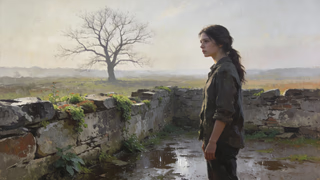
A man stands at the edge of his compound in the early morning, looking out at yam fields he carved from wild bush with his own bleeding hands. His wives are stirring inside. His children sleep in the warmth of their mothers’ huts. The village knows his name. They speak it with weight, with respect, the way you’d speak the name of a mountain. And yet, somewhere beneath his ribs, in a place he will never show anyone, something has already begun to crack. He does not hear it yet. He will not hear it for years. But we, watching from the outside, can sense it the way you sense rain before it arrives, a shift in pressure, a stillness in the birds.
This is how Chinua Achebe’s 『Things Fall Apart』 opens its arms to us. Not with thunder, but with an accumulation of ordinary mornings. Okonkwo, the novel’s central figure, is introduced as a man of tremendous physical and social power in the Igbo village of Umuofia. He has wrestled the legendary Amalinze the Cat. He has earned titles. He works his farm with a ferocity that borders on punishment, as if the earth itself were an enemy he must conquer each day before sunrise. The novel, published in 1958, offered the world something it had not bothered to look for: an African society rendered from the inside, complete with its own logic, its own beauty, its own contradictions. Achebe did not write a rebuttal to colonial narratives so much as he simply told the truth, and the truth turned out to be devastating enough on its own.
But the scene I keep returning to is not one of triumph. It is the quiet compound at dawn, the roosters, the smell of cooking fires, the way Okonkwo moves through his world with such furious certainty. Because it is in that certainty, that absolute refusal to bend, that the tragedy already lives.
The Fracture Beneath the Strength
Look closer at Okonkwo and you find a man built entirely in opposition. His father, Unoka, was gentle, musical, indebted, a man the village dismissed as agbala, a word that also means woman. Okonkwo’s entire identity is a monument erected against his father’s memory. Every yam he plants, every war he fights, every harsh word he delivers to his sons is a brick in the wall between himself and the softness he fears lives inside him.
This is the layer beneath the surface that Achebe lays bare with such devastating patience. Okonkwo is not merely proud. He is terrified. His strength is not confidence but a kind of armor welded shut, and we come to understand that he cannot remove it even when the situation demands flexibility, gentleness, or grief. When he participates in the killing of Ikemefuna, the boy who called him father, he does so not out of cruelty but out of a paralyzing fear of appearing weak. The elders had warned him not to take part. His friend Obierika later says it plainly: the act was wrong. But Okonkwo could not allow himself the vulnerability of refusal.
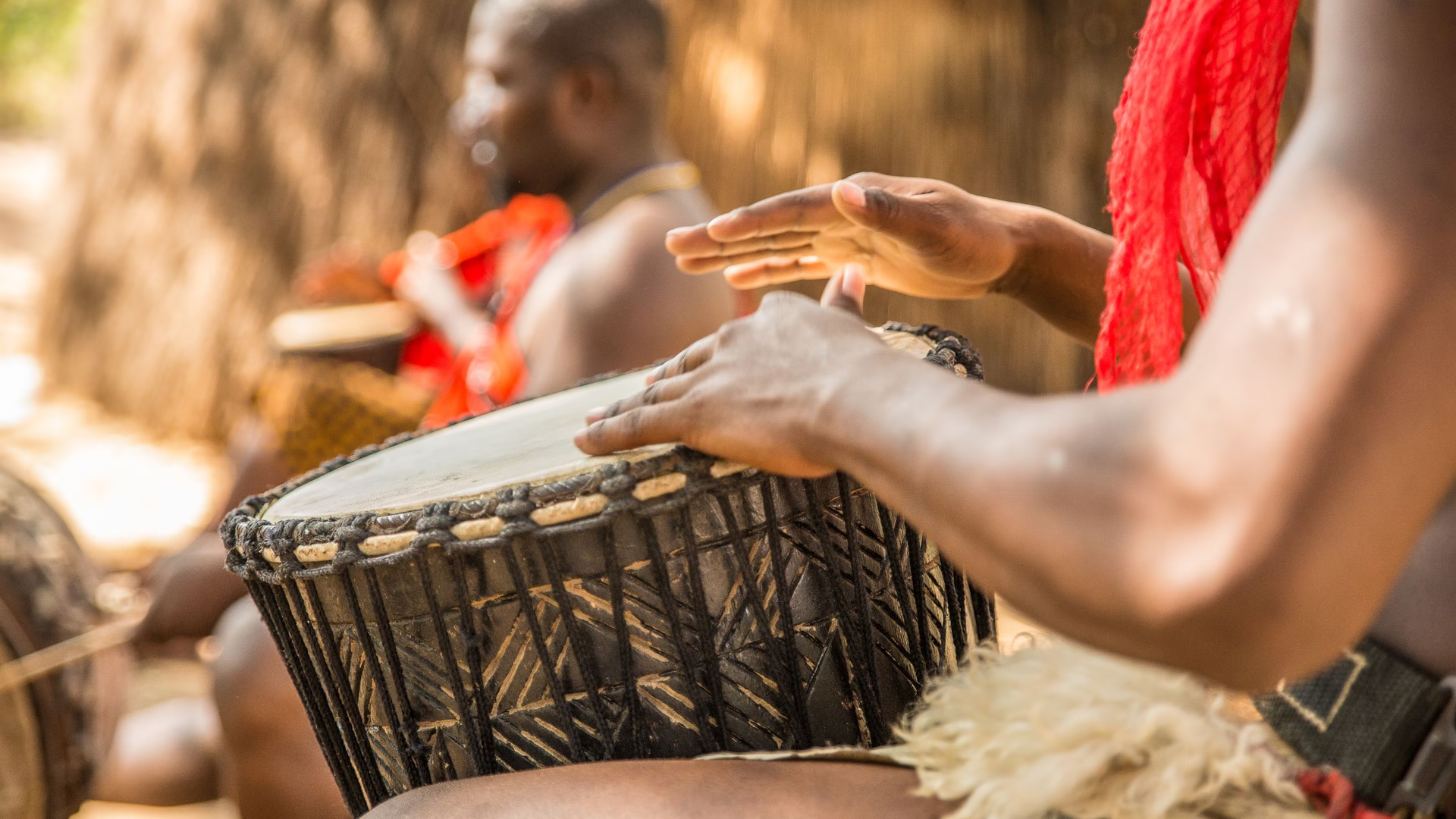
Achebe layers this portrait with scenes of daily life that pulse with warmth and complexity. The Week of Peace, the wrestling matches, the intricate negotiations of marriage, the telling of folktales by firelight. Umuofia is not a paradise; it has its own rigidities, its own cruelties, its treatment of twins, its osu caste. But it breathes. It has texture, humor, tenderness, justice. When the missionaries and colonial administrators arrive, they do not enter a void. They enter a living world, and they begin, with quiet efficiency, to dismantle it.
What makes the novel so layered is that Achebe refuses simple binaries. The church does not only destroy. It also offers refuge to those Umuofia had cast out, the mothers of twins, the untouchables. The colonial presence is not a single force but a series of encounters, some absurd, some violent, some heartbreakingly effective in their appeal to people already marginalized within their own traditions. The center does not hold, as Yeats wrote in the poem from which Achebe drew his title, but Achebe shows us that the center was already under strain.
The most dangerous collapse is never the one that comes from outside; it is the one we refuse to see because we have confused our armor for our skin.Okonkwo’s exile after accidentally killing a clansman, his return to a village already transformed, his final act of desperate violence against the colonial messenger, all of this unfolds with the momentum of a man running from something that lives inside his own chest. He cannot adapt because adaptation would require him to become, even for a moment, something like his father. And that is the one death he cannot survive.
What We All Carry
 Photo by
 We do not need to live in colonial Nigeria to recognize this architecture of selfhood. Think of that moment when you built your entire identity around being the responsible one, the strong one, the one who never asks for help. Think of how it felt the first time the world asked you to be something else, and you realized you didn’t know how.
We all carry private definitions of what it means to fail. For some of us, it is financial ruin. For others, it is emotional dependence, public tears, the admission that we are lost. We construct ourselves in opposition to the thing we most fear becoming, and then we spend our lives maintaining the structure, reinforcing the walls, patching the cracks. The effort is exhausting, and it works, right up until it doesn’t.
Achebe understood this not just as personal psychology but as a cultural phenomenon. Communities, too, build their identities in opposition. Nations define themselves by what they are not. And when the external pressure arrives, when the rules shift and the old certainties dissolve, it is the most rigid structures that shatter most completely. The flexible ones bend. They survive in altered form. But rigidity offers no such mercy.
This is not a story about Africa. Or rather, it is deeply about Africa, and it is also about every human being who has ever stood at the intersection of who they were and who the world now demands they become. The schoolteacher whose methods are suddenly obsolete. The parent whose child chooses a life unrecognizable from their own. The worker whose industry disappears. The believer whose faith community splinters. We all, eventually, arrive at the moment where our world’s rules no longer apply, and the only question is whether we can survive the translation into something new.
Okonkwo could not. His story ends with a body hanging from a tree, an act so taboo that his own clansmen cannot touch him. The colonial District Commissioner, surveying the scene, mentally reduces this enormous life to a paragraph in a book he plans to write: The Pacification of the Primitive Tribes of the Lower Niger. The gap between the life lived and the life recorded is Achebe’s sharpest indictment, not of colonialism alone, but of every system that flattens a human being into a convenient sentence.
The Weight of Being Remembered Wrong
 Photo by
 What stays after reading Things Fall Apart is not anger, though anger lives in it. What stays is a feeling closer to vertigo, the dizzying awareness that every story we tell about ourselves is partial, that every identity we construct is both real and incomplete, and that the world will go on telling its own version of our lives whether or not we participate.
 Photo by
 We fear being misunderstood. We fear it as much as we fear failure, maybe more. Okonkwo feared becoming his father so deeply that he became something perhaps worse: a man incapable of love’s softer expressions, a man whose strength consumed everything around it, including himself. And then, in the final insult, he is reduced to a footnote in someone else’s story. The District Commissioner does not see a tragedy. He sees material.
This happens to us in smaller ways every day. The colleague who summarizes you in a single adjective. The family member who still sees the person you were at fifteen. The algorithm that reduces your tastes to a cluster of data points. We live vast, contradictory, layered lives, and the world keeps trying to fit us into paragraphs.
Achebe wrote Things Fall Apart not to explain Igbo culture to outsiders, but to assert its full, breathing, complicated existence. That act of assertion, the refusal to be summarized, might be the most human impulse there is. And it is one we can practice every day, in how we see each other, in how we resist the easy story.
Some collapses cannot be prevented. Some walls need to come down. The ones we build from fear were never going to hold forever. But knowing that, sitting with that, is different from accepting it. Acceptance takes something that looks, from the outside, a lot like the softness Okonkwo spent his whole life running from.
Strength that cannot bend is not strength. It is a held breath. And every held breath, eventually, must end.