A couple stands at the threshold of a new apartment, keys still warm in one palm. The moving truck idles at the curb below. One of them turns to the other and says something small, something like “This is ours now,” and for a half-second, the weight of that pronoun, ours, lands on them both like a hand on the shoulder. They haven’t signed the marriage certificate yet, or maybe they have, or maybe they never will. It doesn’t matter. The moment is the same: two people deciding, in a room that still echoes, that they belong to each other and to this space.
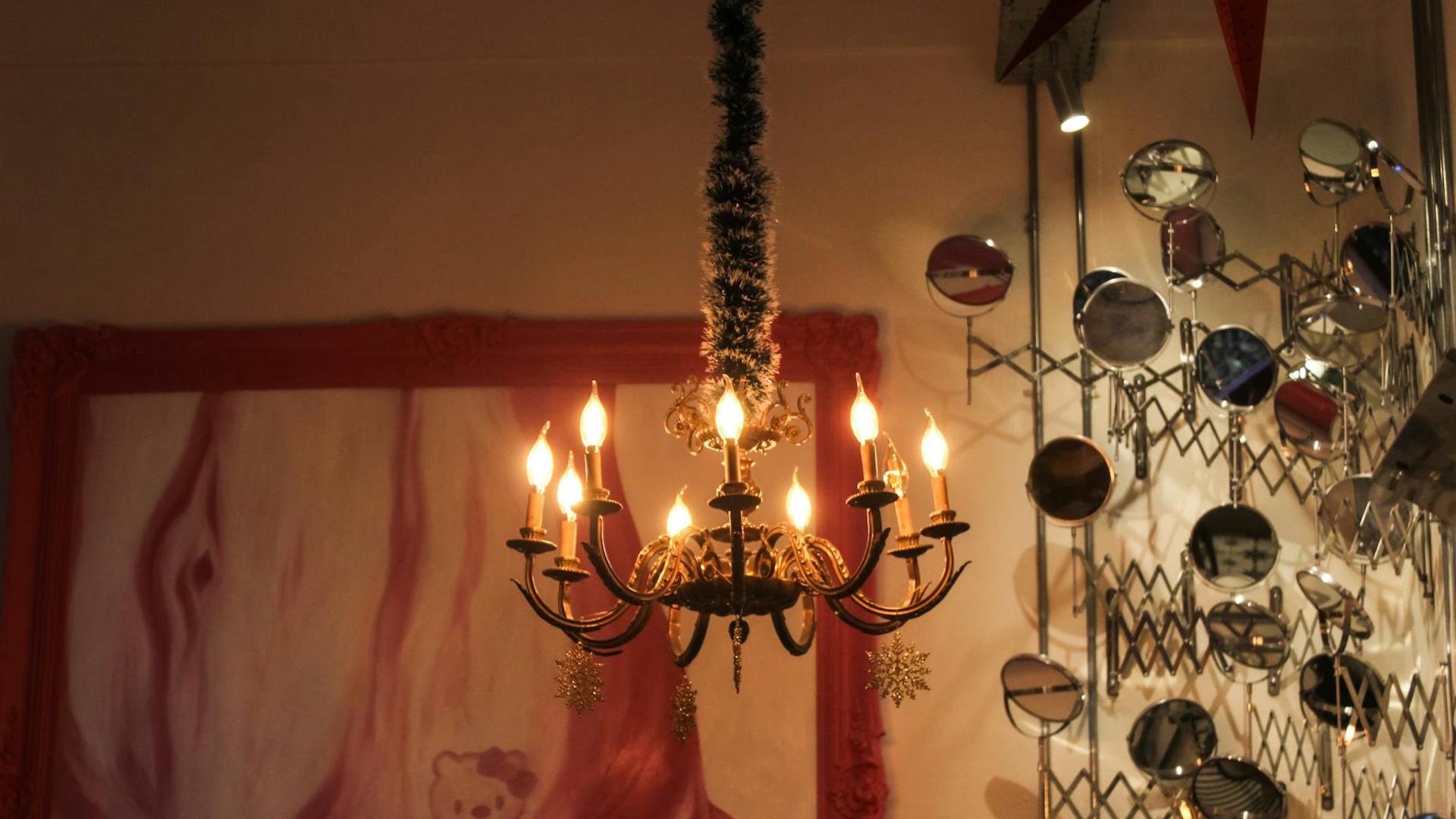
Something very like that moment was frozen into oil paint nearly six hundred years ago. In 『The Arnolfini Portrait』, completed in 1434 by Jan van Eyck, a man and a woman stand side by side in a well-appointed room in Bruges. He wears a dark fur-trimmed cloak and an enormous hat. She gathers the folds of a green gown at her waist. Their faces are calm, their postures composed, their joined hands resting between them like a clause in a contract. A small dog stands at their feet. A single candle burns in the chandelier above. The room is quiet, the light diffuse, the colors saturated with a warmth that feels less painted than remembered.
Look at them long enough and you feel like an uninvited guest, someone who has wandered into the wrong room at the wrong time and stumbled upon something private. The painting is only about two feet by three feet, small enough that in London’s National Gallery, visitors sometimes walk right past it. But step close, and it pulls you in. The textures are almost tactile: the sheen of brass, the pile of fur, the orange sitting on the windowsill catching the grey Flemish light. Van Eyck was a master of surfaces. He did not merely depict silk; he made you feel the way silk catches against skin. Every fold of fabric, every bead on the rosary hanging from the wall, is rendered with a patience that borders on devotion. This is not a painting that was hurried. It was built, layer by careful layer, the way a life together is built.
A Room Full of Signals
The temptation with the Arnolfini Portrait is to decode it, to treat every object as a symbol waiting to be cracked. And scholars have spent centuries doing exactly that. The single candle may represent the all-seeing eye of God, or Christ’s presence at a sacrament. The dog might signify fidelity. The discarded wooden shoes near the door could mark the space as holy ground. The fruit on the windowsill may gesture toward Eden, or fertility, or simple wealth. You can chase these threads for hours, and many people do, turning the painting into a puzzle box.
But something gets lost in the decoding. Strip the symbols away and what remains is still powerful: two people in a room, making a choice. The woman’s hand rests lightly in the man’s upturned palm. Not gripped, not squeezed. Offered. The gesture is so delicate it could dissolve with a breath. That open palm is perhaps the most honest image of commitment ever painted, because it shows what promises actually look like before the years fill them with weight. A promise is not a locked fist. It is an open hand, and the vulnerability of that openness is exactly what makes it meaningful.
Then the mirror. At the back of the room, between the two figures, hangs a small convex mirror. Its surface is curved, distorting the room into a fishbowl version of itself, and in its tiny reflection you can see two additional figures standing in the doorway. One of them, scholars believe, is van Eyck himself. Above the mirror, in ornate script, he inscribed the words Johannes de Eyck fuit hic: Jan van Eyck was here. Not “Jan van Eyck painted this.” Was here. The distinction matters enormously. He positions himself not as the creator of the image but as a witness to the event. The painting becomes testimony.
We tend to think of art as something that represents life. But van Eyck suggested the opposite: that art can participate in life, that a painting can serve the same function as a signature on a document or a handshake in a doorway. The mirror reflects the room back at itself, doubles the witnesses, multiplies the accountability. Every promise needs a witness, because a vow spoken into empty air has nothing to hold it accountable but the conscience of the one who spoke it.
And what about the room itself? It is not grand. It is comfortable, well-furnished, with the quiet confidence of people who have money but do not need to display it ostentatiously. The bed with its red curtains, the carved chair back, the Persian rug beneath the dog’s paws: these are the furnishings of a domestic life. A life lived indoors. A life of routine, of meals taken at the same table, of mornings waking to the same light filtered through the same window. Van Eyck lavished as much care on the brass nails of the chandelier as he did on the faces of his subjects, because he understood something we often forget: the setting of a life is not separate from the life itself. The rooms we inhabit shape us. The objects we surround ourselves with become extensions of our intentions, quiet declarations of who we hope to be.
The Gravity of Small Rooms
 Photo by
 We live in an era that romanticizes grand gestures. The proposal on the Jumbotron, the surprise trip to Paris, the elaborate public declaration. But the Arnolfini Portrait reminds us that the most consequential moments often happen in small rooms, with no audience beyond the people directly involved and perhaps a friend or two standing in the doorway. The weight of a promise does not come from spectacle. It comes from specificity. I choose you, in this room, on this day, with this light falling across the floorboards.
Think of the moments in your own life that carry the most gravity. Chances are they were quiet. A conversation at a kitchen table, not a stage. A decision made while driving somewhere ordinary. The beat of silence after someone says “I’m staying” or “I’m leaving.” These moments do not announce themselves with orchestral swells. They arrive in the middle of an afternoon, dressed in plain clothes, and by the time you realize what just happened, the day has already moved on.
Van Eyck’s genius was in recognizing that the ordinary is where the sacred hides. His mastery of oil technique, his ability to render the world with an almost hallucinatory precision, was not mere technical showing-off. It was an argument. He was saying: look at this. Look at this orange. Look at this light. Look at the way it falls on her face. These things matter. This moment, right now, in this unremarkable room, is as holy as anything that ever happened in a cathedral.
We lose sight of this so easily. The domestic realm, the daily textures of cohabitation, the quiet labor of maintaining a shared space and a shared promise: these can feel mundane, even stifling. But van Eyck’s painting insists on their dignity. The Arnolfini Portrait does not depict a wedding in a church. It depicts two people standing in their bedroom, and it treats that bedroom with the same reverence a fresco might give to the halls of heaven.
What the Mirror Holds
 Photo by
 Six centuries after van Eyck signed his name above that tiny mirror, we still stand in rooms together and make promises. We still reach out with open palms, still hope the other person will take what is offered. The forms change. The legal documents shift. The ceremonies grow simpler or more elaborate depending on the decade. But the essential act remains the same: two people deciding to bet their futures on each other, knowing full well that the odds are complicated and the road is long.
 Photo by
 The convex mirror at the center of the painting bends the room into a sphere, and in doing so, it contains the whole scene at once, the past and the future collapsed into a single curved surface. Stand in front of this painting in London, and you might catch your own reflection ghosted faintly in the glass that protects it, layered over the painted mirror, over the reflected room, over the tiny figures in the doorway. You become another witness. The painting keeps accumulating eyes, keeps gathering testimony across the centuries, as if the promise it records still needs corroboration.
Maybe it does. Maybe all promises do. Not because we doubt the people who make them, but because the act of witnessing is itself a form of care. When we attend a wedding, we are not decorative. We are functional. We are there to say: I saw this. I was here. And later, when the days grow difficult and the rooms grow too familiar, the memory of being witnessed can hold a couple steady the way a keel holds a ship.
Van Eyck did not paint a love story. He painted an agreement, and in painting it with such fierce attention to the texture of the world, he made us see that agreements can be beautiful, that contracts can be sacred, that a hand offered in a quiet room on a grey afternoon in Bruges can echo across six hundred years and still make a stranger’s breath catch in the throat.
The candle in the chandelier is still burning.