Most treasures are found by people who stopped looking for them somewhere else.
This is the quiet paradox at the center of 『The Alchemist』, the slim novel by Paulo Coelho that has been translated into more languages than any other book originally written in Portuguese. A shepherd boy named Santiago crosses a desert, survives bandits, falls in love, and learns the language of the wind, only to discover that the gold he sought was buried beneath the very tree where he first dreamed of it. We nod when we read the ending. Of course it was there all along. But the nodding is too easy, too quick. Because the real question the book leaves us with is not about where the treasure was hidden. It is about why the journey was necessary at all, if the destination was always home.
To understand what that question means, it helps to know something about the man who asked it.
A Man Who Kept Starting Over
Before Coelho became one of the most widely read authors alive, he was a man who could not seem to finish becoming anything. He wanted to be a writer as a teenager in Rio de Janeiro, and his parents, alarmed by this ambition, committed him to a psychiatric institution. Three times, in fact. He escaped. He drifted into songwriting, penning lyrics for some of Brazil’s most famous musicians in the 1970s. He was arrested by the military government, interrogated, released. He traveled. He worked in theater, in journalism, at a record label. He wrote a book. It did not succeed. He wrote another. It did not succeed either.
By his late thirties, the shape of a writing career had not materialized. What had materialized instead was a long, winding path through failure, reinvention, and the slow erosion of certainty. Think of what that feels like: to carry a conviction about who you are supposed to be, and to watch the world respond with indifference, year after year. Most of us have tasted some version of this. The application that goes unanswered. The project that collapses. The sense that the thing you were made for keeps slipping just beyond your reach.
Coelho, at a crossroads, walked the Camino de Santiago in 1986, the ancient pilgrimage route across northern Spain. Something shifted on that road. Not a dramatic revelation, from what we can gather, but more like a settling. A willingness to try once more, and to write from a place closer to his own bones. Two years later, in just two weeks, he wrote The Alchemist.
The book sold poorly at first. His Brazilian publisher printed a small run and declined to reprint. Coelho found another publisher. Slowly, through word of mouth in country after country, the novel began to travel. It moved the way Santiago moves through the desert: without guarantee, propelled by some invisible current.
What matters about this origin story is not that persistence eventually paid off. That is the version we tell ourselves because it is clean and motivational. What matters is something stranger and harder to name. Coelho did not write The Alchemist because he had figured out how to succeed. He wrote it because he had failed enough to understand what the story was actually about.
What the Desert Teaches
 Photo by
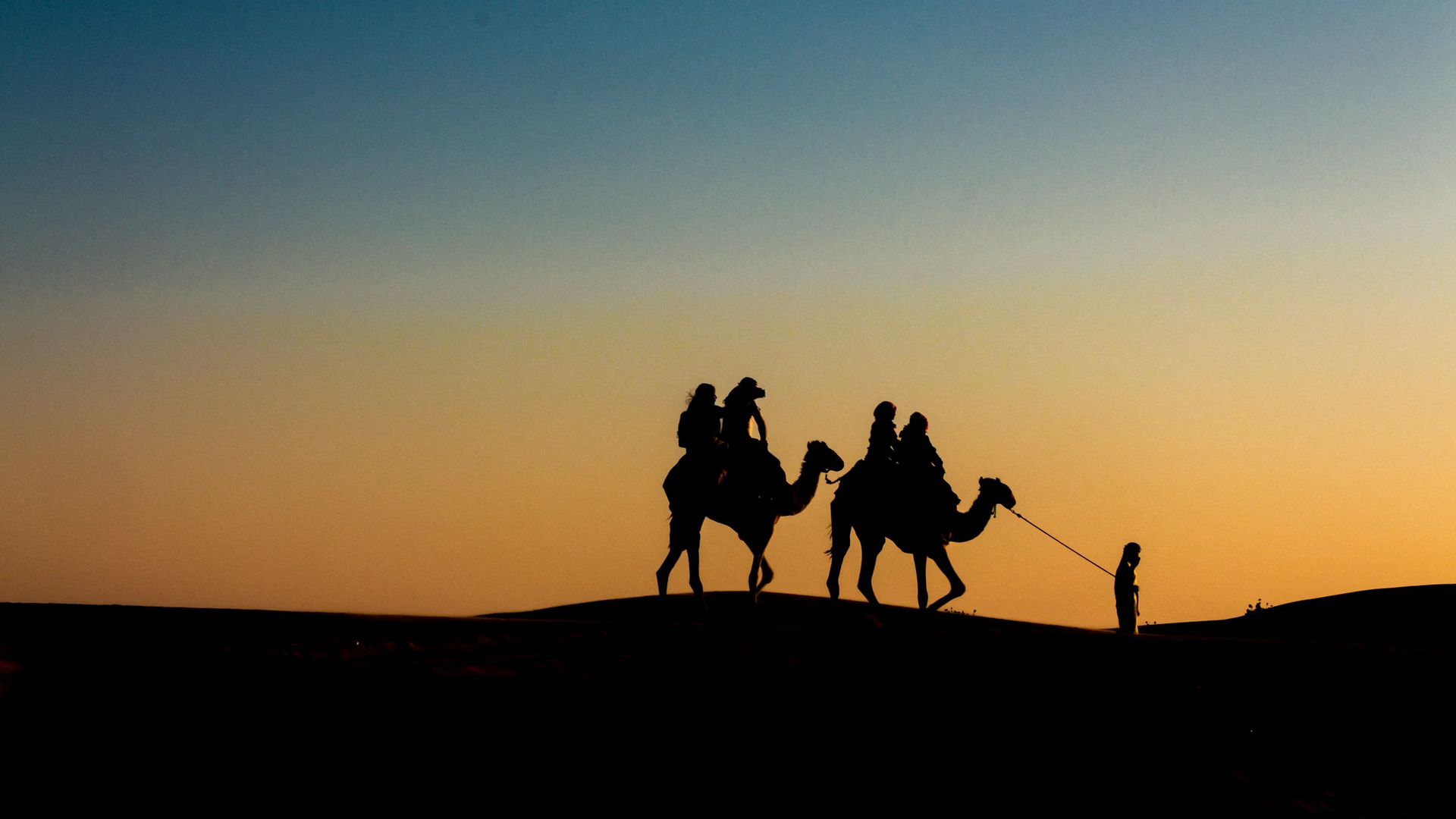
 The middle of any real journey is where the romance dies. Santiago’s crossing of the Sahara is not the postcard version of adventure. He loses his money almost immediately upon arriving in Tangier. He spends months working in a crystal shop just to survive. He falls in with strangers whose motives he cannot fully read. The desert offers heat, silence, and the constant possibility that things will not work out.
Coelho could have written a fable in which the hero moves from triumph to triumph, collecting wisdom like coins. Instead, he wrote a story in which the hero is repeatedly stripped of what he thought he needed. Santiago’s flock of sheep, his savings, his comfort, his plan. Each loss is a kind of emptying, and the emptying is not pleasant. But something fills the space that opens up.
We know this pattern in our own lives, even if we resist naming it. The job you lost that forced you into a field you now love. The relationship that ended and left you, after the grief, more honest about what you actually wanted. The plan that fell apart and scattered you into a life you never would have chosen but now cannot imagine leaving. These are not silver linings. Silver linings are what we paste onto suffering to make it bearable. What happens in The Alchemist, and what happens to us when we are paying attention, is different. It is the slow realization that the path you are on, including its detours and dead ends, is not a deviation from your story. It is your story.
The universe does not hand us a map; it hands us a willingness to be lost, and trusts that the walking itself will become the way.Santiago meets an alchemist in the desert who tells him that his heart already knows everything it needs to know. This sounds like mysticism, and perhaps it is. But it also sounds like the advice a good friend gives you at two in the morning, when you have been spinning in circles and they finally say: you already know what to do. You just don’t want to do it yet.
The struggle in The Alchemist is not against external enemies, not really. The bandits and the desert storms are backdrop. The real struggle is against the temptation to stop. To settle for the crystal shop, comfortable and safe. To marry the desert woman and abandon the dream. To turn back when the terrain becomes unfamiliar. Santiago resists these temptations not because he is brave in any heroic sense, but because something in him will not let the dream go quiet. It keeps whispering.
We all have a version of this whisper. It is the thing that nags at you on Sunday evenings, the itch beneath a life that looks fine on paper. Sometimes we honor it. Often we do not. Coelho himself ignored it for decades, or tried to, or was prevented from following it by circumstances and institutions and his own doubt. That he kept returning to it is not a testament to superhuman willpower. It is a testament to how stubborn a genuine calling can be, how it survives even our best efforts to smother it.
The Gold Beneath the Sycamore
 Photo by
 At the end of the novel, Santiago digs beneath a sycamore tree in the ruins of an old church in Spain, the same spot where he had his original dream. He finds the gold. The treasure was there the whole time.
Read one way, this is a cruel joke. Why cross a desert and nearly die if the answer was under your feet from the start? Read another way, and I think the truer way, it is a recognition that we cannot see what is right in front of us until we have traveled far enough to develop the eyes for it. Santiago needed the desert, the alchemist, the heartbreak, and the wind to become the person capable of understanding where the treasure was. The treasure did not move. Santiago did.
Coelho needed his failures, his hospitalizations, his wandering years, and his pilgrimage to become the writer capable of telling this particular story in two weeks flat. The story did not arrive from nowhere. It arrived from everywhere he had been.
This is the meaning that rises from the novel like heat from sand. Not that dreams come true if you believe hard enough. Not that the universe conspires to help you, though the book famously says it does. The deeper meaning is that the journey and the destination are not separate things. Every step Santiago takes is already the treasure. He just doesn’t know it yet.
And neither do we, most of the time. We live forward but understand backward, as someone once said. The moments that seem like detours, the years that seem wasted, the choices that seem wrong, they have a way of revealing their purpose only when we are far enough down the road to look back.
The Road That Starts Where You Stand
 Photo by
 So here you are, wherever you are. Maybe in the middle of a crossing that feels endless. Maybe at the beginning, afraid to leave the flock behind. Maybe at a point where you have already dug in several wrong places and your hands are raw.
The Alchemist does not promise that your story will end with gold. Coelho, for all his optimism, knew too much about failure to make guarantees. What the book offers is quieter than a promise. It is a permission. Permission to trust the whisper. Permission to keep walking even when the walking feels pointless. Permission to believe that the searching and the finding might, in the end, turn out to be the same thing.
You do not need to cross a desert. You do not need a sign from the universe, or an alchemist, or a king disguised as an old man. You need only to pay attention to the dream that keeps returning, the one you keep dismissing as impractical or foolish or too late. It keeps returning for a reason.
Somewhere tonight, someone is closing this book for the first time, setting it on a nightstand, and staring at the ceiling with that particular restlessness that comes from recognizing your own life in a story about someone else’s. Tomorrow morning, they will make coffee, go to work, and do the ordinary things. But something will have shifted, just slightly, like a compass needle finding north. And that small shift, invisible to everyone else, will be the beginning.