A man dies alone in a palace, and the word he speaks is not the name of his wife, his lover, his empire, or his god. It is the name of a sled. Of all the strange truths about how lives end, this one keeps returning: the more a person accumulates, the smaller and stranger the thing they reach for at the end tends to be.
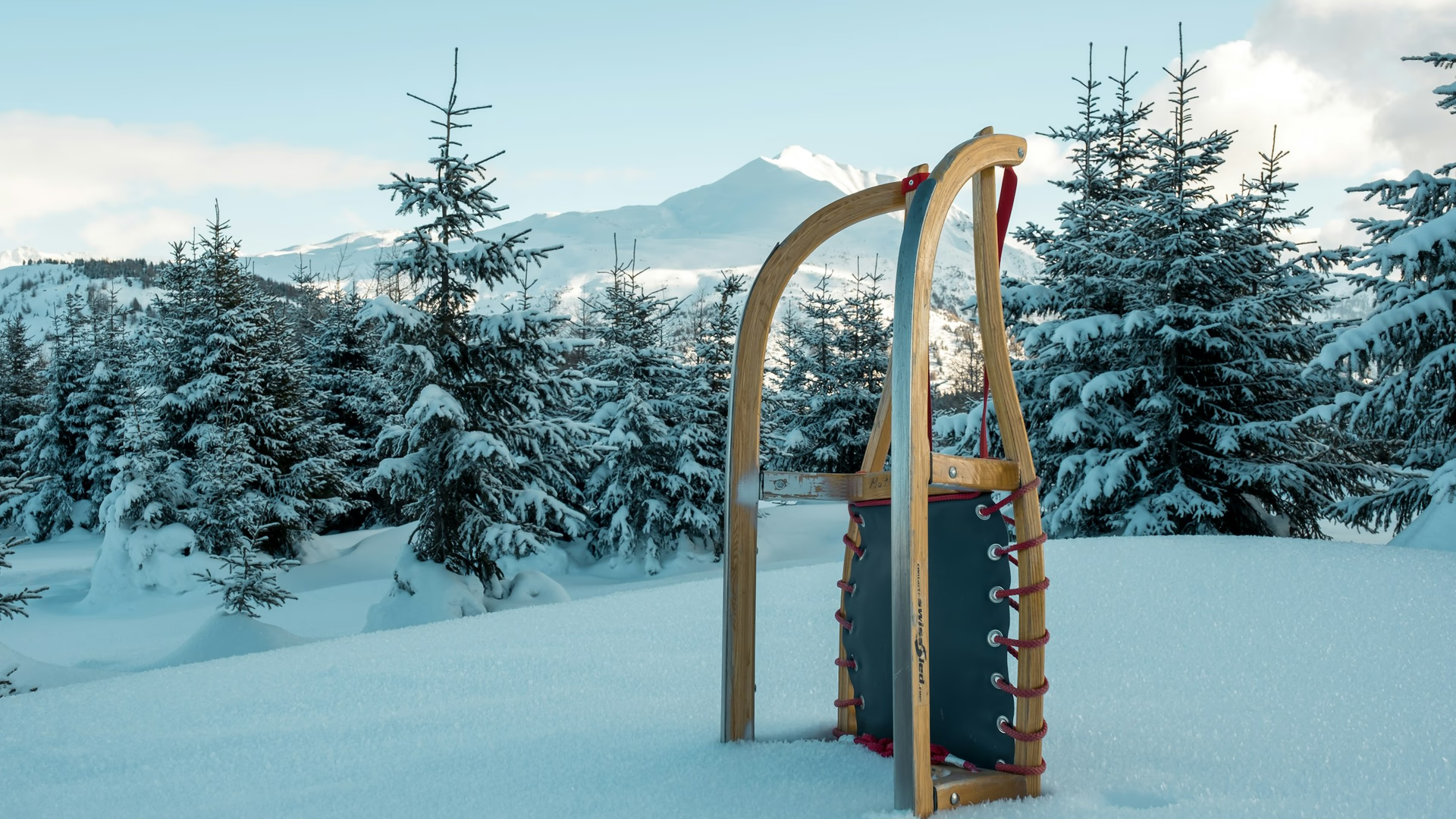
『Citizen Kane』, made by a twenty-six-year-old Orson Welles in 1941, opens with that ending. A glass globe slips from a dying hand. Snow swirls inside it. A whisper, Rosebud, drifts out into the cavernous dark of Xanadu, and a journalist spends the rest of the film trying to learn what the word meant. He never does. We do, in the final seconds, when a stagehand tosses an old child’s sled into a furnace, and the painted name on its wood blackens and curls into smoke.
The Palace Built Against the Cold
Xanadu is one of cinema’s strangest houses. It has the dimensions of a cathedral and the silence of a tomb. Statues stand in crates that were never opened. Fireplaces large enough to roast oxen warm nothing but the stones around them. Kane and his second wife, Susan, sit at opposite ends of a table so long they have to raise their voices to argue, and even then their words seem to travel through weather before they arrive. She works on a jigsaw puzzle. He watches her work on a jigsaw puzzle. Outside, somewhere beyond the high windows, there is a private zoo, a private mountain, a private everything, and none of it is being used.
Welles shoots these scenes with deep focus, which means everything in the frame, near and far, stays equally sharp. You can see Kane’s face and, simultaneously, the vast emptiness behind him. The technique was new then. It still feels accurate now, because that is how loneliness actually appears in a life: not as a blur, but as too much clarity, every distance visible at once.
The scene most people remember is not an argument or a triumph but a small one in which Susan, exhausted by being the project of a powerful man, says she wants to leave. She is not asking. She is informing him. Kane, who has bent newspapers and elections and the public mood to his will, cannot bend this. He stands in a doorway, suddenly an old man, and what he says is almost a child’s plea. Don’t go. Please don’t go. The doorway is enormous. He looks small inside it. The palace he built to hold his life has begun, finally, to hold only its echo.
What the Snow Was Protecting
 Photo by
 The film does not pretend to be a mystery solved by Rosebud. The reporter, near the end, says that no single word can sum up a man’s life, and he is right. The sled is not an answer. It is a wound.
Kane’s mother, poor and pragmatic, signed her son away to a banker’s guardianship when a fortune fell into her lap. She believed she was rescuing him. The last day of his childhood, he was outside in the snow, playing with a sled, shouting at the men who had come to take him. Then he was on a train. Then he was being educated, refined, prepared, monetized. He grew into the man who could buy anything, and who spent the rest of his life buying, because there was one thing he could not buy back, and the buying was a way of not noticing.
This is the layer beneath the layer. Kane is not lonely because he is rich. He is rich because he is lonely, and the wealth is a method, a noise loud enough to drown the smaller sound of a boy calling out in a snowfield. Power, here, is not ambition’s reward but its disguise. He runs for governor, builds opera houses, collects continents of art, and at the center of all of it sits a child who was taken away mid-sentence and never quite finished what he was saying.
What we call ambition is sometimes only a long, elaborate apology to the child we were before someone decided what we should become.Notice how the film treats his accumulations. The crates in Xanadu are inventoried by men with clipboards. They read the labels aloud, dispassionate, the way a coroner might. A Venus. A sleigh. A stove. The objects are not characters. They are sediment. A life, seen from the outside after it has ended, looks like a warehouse that someone else now has to sort through. Most of it will be thrown away. Some of it will be burned. The thing that mattered will probably be mistaken for junk.
The Rooms We Build, the Rooms We Lose
 Photo by
 Most of us will not build a Xanadu. We will build smaller versions. A career that grew larger than the life it was meant to serve. A house with rooms we stopped entering. A reputation we now have to maintain whether or not it still resembles us. The shape of the trap is the same at every scale. We construct something to protect a tender place inside us, and then the construction becomes the thing we tend to, while the tender place goes quiet from neglect.
Think of the way you sometimes catch yourself reaching for your phone in a moment of unspecified ache, the way Kane reached for another statue, another headline, another wife. The gesture is the same. We are trying to fill a room that was emptied a long time ago by something we cannot quite remember and would not want to.
And yet there is also this: every life has a Rosebud. Not necessarily a sled. Maybe a kitchen with yellow light at a certain hour. A song your father hummed while shaving. The smell of a particular wool coat. A friend’s laugh from a summer you did not know was the last summer of something. These small images sit at the bottom of us like stones in a clear pool, and most of the time we walk past the pool without looking down.
The film’s quiet argument is that these stones are not trivial. They are the actual weight of a person. Everything else, the empire, the marble, the name on the building, is the water, which will eventually evaporate. What stays is what you loved before you knew the word for love, before the world taught you what was worth wanting.
The Furnace and the Snowfield
 Photo by
 In the last shot, the camera rises above Xanadu’s gate, with its iron K and its no trespassing sign, and the smoke from the furnace climbs into the night sky. The sled is gone. No one alive knows what was burned. The secret of the man’s life leaves the world as a smudge of warmth in cold air, indistinguishable from any other smoke.
This should feel bleak. Somehow it does not. Somehow it feels like permission. Permission to admit that the things which formed us are mostly invisible to the people around us, and that this is not a tragedy but simply the condition. Permission to stop building the palace for a moment and go stand near whatever, in your own life, is the small wooden thing with a name painted on it.
Tonight, before the day fully closes, you might find yourself doing something unremarkable. Pausing at a window. Picking up an object you have not really looked at in years, a book, a cup, a photograph wedged into the frame of a mirror. Turning it over in your hands. Not to make it mean anything. Just to notice it before the inventory begins, before someone else has to decide what it was, before the snow inside the glass settles for the last time.