She stood in the doorway of her childhood kitchen, now a stranger’s renovated loft, and felt her chest tighten before she understood why. The cabinets were gone. The window had moved. Nothing she remembered was still there, yet her body knew exactly where to stand, as if the old room were still waiting underneath the new one.
We tend to think of buildings as containers: neutral boxes that hold our lives while the real story happens inside us. The truth is quieter and stranger. Rooms, doorways, ceilings, and stairwells slip into memory and identity so completely that they become soft co-authors of who we are. This isn’t sentimentality. It’s how the mind works.
The Doorway That Stopped Her
Notice what actually happened in that kitchen: the emotion arrived before the explanation.
 Photo by
 Her heart responded first, and her understanding came trailing behind.
That sequence isn’t unusual. Environmental psychology, the study of how surroundings shape mind and behavior, has found that thresholds carry surprising weight. A doorway is more than a gap in a wall. The brain treats it as an event boundary, a natural seam where one chapter of experience closes and another begins. Crossing a threshold tells your memory to file what just happened as a distinct scene, the way a page break separates one part of a story from the next.
This is why re-entering an old home can feel physical. People describe a flush of feeling, a catch in the breath, a heaviness they can’t immediately name. The space isn’t just reminding them of the past. It’s reopening a file the body helped write.
Why Rooms Feel Like Memories
The reason runs deeper than nostalgia, down to the wiring itself.
The hippocampus, the part of the brain that maps physical space, is the same region that helps organize personal memory across time. It handles where you are and when things happened using overlapping machinery. So a room and a life chapter can become bound together, filed under the same address. Recall the bedroom, and the whole season of life it belonged to tends to arrive with it.
Ancient orators understood this long before neuroscience named it. To memorize a long speech, they would mentally walk through a familiar building and place each idea in a specific room, a trick still called the memory palace. It works because spatial memory is unusually sturdy. We’re built to remember places.
“When we form deep attachments, to people, to places, to roles, our brains build neural maps that expect their presence.” [Motsinger]
For a general reader, this means your life may be organized less like a diary and more like a floor plan. You don’t just remember your twenties. You remember the apartment where you lived them.
The Myth of Neutral Buildings
Here’s an assumption worth gently setting down: that a plain room is a blank one.
 Photo by
 The beige waiting area, the ordinary office, the standard-issue hallway. We read these as psychologically empty, mere background.
They aren’t. Every design choice already leans on your mind, whether or not anyone intended it. Research links high ceilings to more expansive, abstract thinking and lower ceilings to sharper, detail-focused attention. Light, material, and proportion nudge mood in measurable ways. People are constantly reading their environments for cues about who they are and how they should behave, usually without noticing they’re doing it. [Frontiers]
Institutions have long used this quietly. Consider how certain buildings speak before anyone does:
-
Courthouses use tall symmetry and stone to project order and permanence.
-
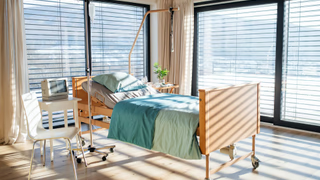
Hospitals use soft light and rounded forms to signal calm and care.
-
Banks once used heavy columns to suggest safety and weight.
None of this is accidental. The “neutral” room was designed to make you feel a specific way. Next time a space feels oddly formal or unexpectedly soothing, that feeling is probably by design, and you can name it rather than absorb it.
How Spaces Script Our Roles
If rooms shape mood, they also shape behavior, often assigning us a part to play before we speak a word.
 Photo by
 Layout does this work. A desk raised on a platform, a single chair centered under a light, a counter that separates staff from visitors: each arrangement quietly establishes who holds authority and who waits for permission. Studies of offices show that seating and desk placement alone shift how much authority we grant the person sitting there.
Homes script us too. An open kitchen that flows into the living area invites gathering and blurs the line between cook and guest. A closed, separate kitchen keeps roles fixed and traffic out. The floor plan is a kind of stage direction, telling us where to stand and how to relate.
This is also where a sense of place, the feeling that a space is genuinely yours, either grows or fails to. Belonging isn’t only emotional. It’s built into the arrangement of walls and thresholds. [The Psychology] You might try this: walk into any room and ask what role the space is handing you, and whether you want to accept it.
When Places Outlive Their Walls
The two threads, memory and behavior, meet in one striking place: buildings that no longer exist still act on us.
 Photo by
 When a beloved building is demolished, longtime residents often describe something close to grief for the structure, similar to mourning a person. Oral histories of displaced communities are full of people who still dream themselves back into torn-down homes, walking rooms that were flattened decades ago. The address is gone from every map but one: the one inside them.
That persistence is the whole argument in miniature. If a building were only a container, its removal would simply free us. Instead the space keeps working, because it was never only outside us. It had already become part of the emotional connection and sense of place we carry. [Motsinger]
So when she stood in that renovated loft and felt her chest tighten, nothing was wrong with her. Her body was doing exactly what bodies do: reading a space that had helped write her, and finding the old chapter still filed under that address.
The rooms you’ve lived in aren’t behind you. They’re woven into how you remember, how you behave, and where you feel you belong. Next time a doorway stops you cold, you can meet the feeling with recognition instead of confusion. The kitchen may be gone, but your feet still know where the doorway used to be, and now you know why.