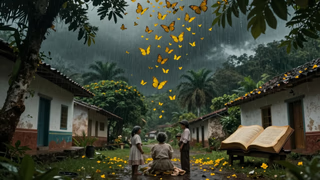
A friend who has never visited asks what your old neighborhood was like, and you begin to answer. The bakery on the corner. The stairwell with the light that took a second too long to come on. The particular sound of the gate. You are three sentences in when you notice something odd: the neighborhood you are describing does not exist anymore, and possibly never existed in quite that arrangement. The bakery closed years ago. The gate has been replaced. And still, as you speak, the place assembles itself in the air between you, warm and specific and absolutely convincing. Whose city is that? Not the one on the map. Not the one your friend will find if she goes looking.
『Invisible Cities』, published in 1972 by Italo Calvino, lives inside that gap. It is a book of cities that cannot be visited, described by a traveler to an emperor who will never see them, and it has the strange effect of making the reader suspicious of every place they think they know. Not suspicious in a cold way. Suspicious the way you become suspicious of your own face in an old photograph, recognizing it and not recognizing it at once.
The question the book leaves in the hands is small and will not let go. When we describe a place, what exactly are we describing?
The Merchant and the Emperor
The shape of the book is simple enough to state and impossible to exhaust. Marco Polo, the Venetian merchant, sits with Kublai Khan and tells him about the cities of his empire. The Khan rules more territory than any one mind can hold. His maps are complete and useless. He has conquered everything and knows almost none of it, which is a condition more of us share than we like to admit. So he listens.
What Polo gives him are not reports. They are short pieces, closer to prose poems than to inventories, each one a city with a woman’s name, each one built on a single impossible principle. Cities of memory, cities of desire, cities of signs, cities woven of threads and cities suspended and cities that dream. They are grouped and numbered with a patient, almost mathematical care, the way a folk tale collector might arrange his specimens. Calvino had spent years earlier in his life gathering Italian folk tales, and something of that labor survives here: the sense that a story is an object with joints and hinges, that it can be taken apart and set beside its cousins.
Between the cities, the merchant and the emperor talk. Their conversations circle around whether any of it is true, whether language can carry a place at all, whether the Khan is being told about his empire or about something else entirely.
And there is the turn that gives the whole book its ache. At a certain point Polo admits that every time he describes a city, he is saying something about Venice. He does not name it because naming it would spend it. The city he left is the only city he has, and it enters every other city he speaks of, coloring the water, bending the streets, deciding what he notices and what he passes without seeing.
One reading, long-standing and hard to shake, holds that this is the book’s whole secret: the fantastical cities are not inventions at all but refractions, a single home broken through a prism and thrown across a wall. Whether Calvino would have put it that way is not something we can know from the text. What we can say is the effect. You finish reading and your own hometown feels less solid, and your memory of it feels more real than it did an hour ago, and you cannot immediately tell whether you have gained something or lost it.
The book came out in 1972, in an Italy of enormous political noise, from a writer who had already tried realism and allegory and cosmic comedy. It contains no argument, no plot to speak of, no one to root for. It has stayed in print for over fifty years anyway, passed hand to hand by architects and homesick students and people who read three pages before sleep. Books like that survive because they name something people already carry without vocabulary.
The Rooms We Carry
 Photo by
 Think of the last time you gave someone directions to a place you love. You will have said something like: turn left after the school, you’ll know it by the noise. The instruction was accurate. It was also autobiographical. You chose the school because you passed it every morning for years; a stranger would have said turn left at the traffic light. Every route we describe is a confession about which things we have looked at long enough to make into landmarks.
The same thing happens when we move. You take a new apartment and for the first six months you are not living in it, you are comparing it. The kitchen is smaller than the last one. The light comes from the wrong side. The neighbors are quieter, and the quiet is not restful yet because you are still listening for a familiar noise that isn’t going to arrive. What you call the new place is really a running subtraction from the old one. Only later, slowly, does the apartment stop being a difference and become a room.
And when you finally leave it, the process reverses. The place you found strange becomes the standard against which the next place is measured. We are always one home behind ourselves.
We do not describe places so much as we describe the distance between where we are standing and where we once stood.This is why two people who lived in the same house at the same time can argue for an hour about whether the hallway was dark. It was dark for the one who was afraid of it. It was ordinary for the one who was not. Neither is lying. They lived in different cities that happened to share an address.
The strangest version of this is the place we return to. You go back to the street after fifteen years, prepared for change, and change is not the problem. The problem is the scale. Everything is smaller and closer together, the walk that took a childhood afternoon takes four minutes, and you understand that what has shrunk is not the street but the person walking it. The city you came looking for was never made of stone. It was made of the height of your eyes.
What the Map Cannot Hold
 Photo by
 Here is where the book quietly rearranges things, if you let it. We are used to thinking that description is a lesser form of the real thing, a copy, a photograph of the meal instead of the meal. Under that assumption, memory is always failing, always losing detail, and the honest thing to do is admit our recollections are unreliable and move on.
 Photo by
 But watch what actually happens when you tell someone about a place. The telling does not merely record. It selects, it presses, it decides. You mention the stairwell light and from then on the stairwell light is part of the apartment, load-bearing, and the eleven thousand things you did not mention drift off. Ten years from now, when you think of that apartment, the light will come on late. The story has gone back into the memory and changed it. This is not a defect of the machinery. This is how the machinery works.
Which means that we are not the custodians of our pasts. We are their ongoing authors, and every retelling is a small renovation. That sounds alarming until you notice its generosity. If the cities we carry are made partly of language, then they can be built as well as lost. The grandmother who describes her village to a grandchild who will never see it is not preserving a place; she is constructing one, and it will exist, and the child will inherit a real city with weather and bread in it that no cartographer ever surveyed.
It also suggests a gentler way to hold homesickness. What you miss is not retrievable, because it was never a location. Booking the flight will not do it. But it is not gone either, since it goes wherever you go, quietly editing everything you look at. The new town’s market is bright to you because some other market was dim. Your longing is not a wound in the way you have been treating it. It is a lens, and it is grinding itself finer with every year you spend away.
And there is one more thing, easy to miss. The emperor listening to those descriptions is a man who owns everything and has seen almost none of it. Most of us live like that on a smaller scale. We hold jobs, families, streets, whole decades that we possess on paper and have not actually looked at. What the traveler offers the Khan is not more territory. It is attention: the discipline of noticing one city so precisely that it becomes worth describing.
That attention is available on the walk to the station tomorrow morning. The doorway you pass without seeing, the turn of the road, the shop that has changed hands twice. These are already becoming the city you will one day describe to someone who was not there, and the care you give them now is the material it will be built from.
The places we love are not behind us. We are carrying them, and they are still being made.