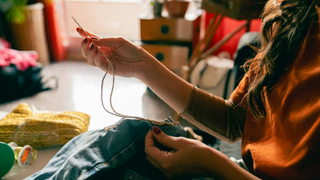


A leather patch, stitched by hand over a tear in the elbow of an old barn jacket. The thread shows. The patch is a slightly different brown than the jacket itself. Three people ask about it that evening, and none of them ask where the jacket came from. They ask who did the stitching.
That small shift is worth noticing. For most of the last few decades, the interesting part of a garment was its origin: the label, the shop, the season. Now the interesting part is often what happened to it after that, and who was trusted to fix it.
The Mended Jacket Signal
A visible repair carries information a new purchase cannot.
 Photo by
 It tells you the owner kept something long enough to wear it thin. It tells you they judged the item worth the cost of saving. And it tells you they found someone with the skill to do it, which usually means asking around, waiting, and paying for labor.
The term for this is visible mending, meaning repairs done on purpose in contrast thread, or a patch that reads clearly as a patch. That’s different from the older goal of an invisible fix nobody notices. Here, the repair is allowed to be part of the design.
Luxury houses noticed this shift early. Hermès repairs up to 100,000 pieces a year in its own workshops, with roughly 80 craftspeople working on leather goods alone. J.M. Weston resoles up to 10,000 pairs of shoes annually [Bluelink]. LVMH reported 500 million euros in 2025 revenue from repair, refill, and take-back services, covering 10 million products [The Silent]. That’s not charity. It’s a business built on the idea that care is now part of the product.
Challenging the Newness Myth
The older assumption was simple: new means money.
 Photo by
 An unworn coat, a clean sole, a current model. Plenty of people still read the world that way, and they’re not wrong that newness costs something.
But a competing read has grown alongside it. Repeated replacement now looks, to a lot of people, less like affluence and more like haste. The survey data backs up what buyers actually weigh. In a nationally representative survey of more than 2,000 UK adults, durability ranked first at 58% and repairability second at 37% among purchase considerations [Frontiers].
One honest caveat: repair isn’t automatically cheaper. A hand-stitched patch or a professional resole often costs more in labor than a low-cost replacement off a rack. France has been blunt about that friction, offering a bonus of up to 25 euros each time a consumer repairs clothes or shoes instead of discarding them [Deloitte]. That’s the quiet part of the status signal: repair takes money, or time, or a good relationship with a cobbler, usually two of the three.
Where the Two Views Meet
Put both perspectives together and the picture stops being a contest.
 Photo by
 Newness still signals resources. Care signals judgment, and judgment is harder to buy in an afternoon.
The resale market makes this measurable. On Vestiaire Collective, buyers increasingly ask about an item’s repair history, and brands like Moncler now offer repair services that travel with the object [The Ethos]. A documented mend can raise what a used piece is worth. The repair economy for clothing and footwear was estimated at 5.8 billion dollars in 2025, with projections reaching 9.4 billion dollars by 2034 [The Silent].
It’s not only a luxury story. Volunteer repair cafés, community workshops where people bring broken items for free fixing, logged over 200,000 repair attempts across 1,158 groups in 31 countries, including nearly 70,000 electronics repairs [Green Network]. Same instinct, no price tag.
One Item, This Month
If any of this appeals, the entry point can stay narrow on purpose.
 Photo by
 Pick one thing already in weekly rotation with a small flaw, and treat it as an experiment rather than a lifestyle.
-
Choose something worn. A jacket, jeans, or boots already in regular use. History is the raw material here.
-
Ask for visible over invisible. Contrast thread or an honest patch works better than a fix designed to disappear.
-
Go independent. A local tailor, cobbler, or repair café will often offer decorative techniques a big-box alteration counter won’t.
-
Expect to wait. Good menders have queues, and the wait is part of what the finished object says.
One thing that tends not to work: mending something you never liked in the first place. A repaired item you avoid wearing is just a more expensive version of clutter.
The elbow patch on that barn jacket cost more in labor than a whole new jacket from a fast-fashion rack. The patch isn’t a saving. It’s a decision made visible, one that anyone looking at the sleeve can read. Somewhere in most closets there’s an item with a small tear waiting for that same decision. Booking it in with a cobbler or a tailor this month is the entire practice. The stitches will show, slightly off in color, and people will ask who did them.
Sources
- Frontiers in Sustainability, UK consumer survey on durability and repairability
- Deloitte, From throw-away culture to repair revolution
- Bluelink, The art of repairing: a new form of luxury
- The Silent Luxury, Repair economy in fashion 2026
- The Ethos, Inside the return of the luxury repair shop
- Green Network Asia, The rising trend of community repair