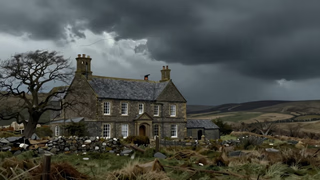
A plain woman stands in the orchard at Thornfield Hall on a warm Midsummer evening, her hands clenched at her sides, the air heavy with ripening fruit and a nightingale going somewhere behind her, and she speaks. She does not whisper. She does not plead. She looks a man who holds every advantage over her, a man of wealth, of station, of physical stature, and she tells him that her spirit addresses his spirit as if they had both passed through the grave and stood before God, equal. The evening is perfectly still. The words come out raw, almost torn from her chest, as if they had been living inside her for years, pressed down beneath layers of obedience and silence, waiting for this single rupture.
This moment in 『Jane Eyre』, written by Charlotte Brontë and published in 1847 under the male pseudonym Currer Bell, is one of the most electrically alive passages in all of English literature. It carries the force of something real, something lived. Brontë drew on her own years of loneliness, her own poverty, her own burning intelligence trapped inside institutions that saw her as small. She poured that fire into Jane, a character who refuses, at every critical juncture, to let the world shrink her into something convenient. The novel unfolds as a love story, yes, and a gothic one at that, with secrets locked in attics and fires blazing through manor houses. But beneath all of it runs a more primal current: the story of a human being who insists on her own worth when every circumstance conspires to deny it.
Picture the scene more closely. Rochester has just told Jane he intends to marry another woman, the beautiful Blanche Ingram, and that Jane must leave. He says this almost carelessly, testing her, probing. And Jane, who has schooled herself in restraint for her entire life, who has survived an abusive childhood and the frozen cruelty of Lowood School, finally breaks open. Not into tears, though tears are there. Into speech. “Do you think, because I am poor, obscure, plain, and little, I am soulless and heartless?” The words land like stones thrown at glass. You can almost hear the shattering. She is not asking for pity. She is not bargaining. She is stating a fact about the universe: that her inner life is as vast and real as his, and that no amount of money or beauty or social standing can make it otherwise.
What Burns Beneath the Surface
Look at what Brontë is really doing here, and the layers begin to multiply.
On the surface, Jane is a governess confronting her employer about the nature of their attachment. It is a scene of romantic tension, and countless adaptations have played it exactly that way, with swelling music and longing gazes. But peel back the romance and you find something harder, more unsettling. Jane is confronting a system. She is a woman with no money, no family, no beauty by the standards of her time, no protection of any kind. Rochester, for all his dark charm, holds every card. He could dismiss her with a word. He could ruin her reputation, such as it is. The power imbalance between them is not subtext; it is the very ground they stand on.
And yet she speaks.
This is what makes the scene so much more than a love confession. To demand equality from someone who has the power to destroy you is not romance; it is an act of extraordinary, almost reckless courage. Jane does not wait until she is safe to assert her dignity. She does it precisely when she is most vulnerable, most exposed, most likely to be crushed. She risks everything, not for love, but for the right to be seen as fully human.
Brontë knew this terrain intimately. She wrote the novel while living in her father’s parsonage in Haworth, surrounded by the Yorkshire moors, watching her siblings falter and fail under the weight of a world that had little use for brilliant women without connections. She published under a man’s name because the literary establishment of her era would not take a woman’s voice seriously. Think about that: the very act of writing Jane Eyre required the same kind of defiance that animates its heroine. The book is its own argument, a woman’s voice disguised in order to be heard, and then, once heard, impossible to silence.
What catches the breath, reading the novel now, is how precisely Brontë maps the psychology of self-respect under pressure. Jane does not arrive at Thornfield already whole. She builds herself, brick by brick, through every humiliation and every small victory. Her aunt’s cruelty teaches her that love cannot be earned by submission. Lowood School teaches her that endurance alone is not enough, that one must also think, and feel, and refuse to let the mind be starved. By the time she reaches Rochester, she has already fought a dozen quiet wars. The woman who speaks in that orchard has earned every syllable. The storm comes later that night, and splits the chestnut tree in half.
And later, when she discovers Rochester’s secret, when she learns about Bertha Mason locked in the attic and realizes the marriage he offered was a lie, Jane faces an even more devastating test. Rochester begs her to stay. He offers her everything except legitimacy. He tells her no one will know, no one will care. And Jane, who loves him with a ferocity that Brontë makes palpable on every page, walks away. Not because she does not feel. Because she feels too much to let feeling override the architecture of her selfhood. “I care for myself,” she says. “The more solitary, the more friendless, the more unsustained I am, the more I will respect myself.”
That line is not cold. Read it again and you can hear it tremble.
The Courage We Rehearse in Silence
 Photo by
 We have all stood on some version of that path.
Not in a gothic manor, probably, and not with a brooding figure looming before us in the mist. But we have all faced the moment when something we want, something we ache for, requires us to become smaller than we are. A job that demands we swallow an insult and smile. A relationship where love comes packaged with the expectation that we will rearrange ourselves, trim our edges, make ourselves fit inside someone else’s comfort. A friendship where honesty would cost us the friendship itself.
The world is full of these quiet negotiations. We conduct them every day, usually without noticing. We laugh at jokes that diminish us. We stay silent in rooms where our silence is mistaken for agreement. We accept terms we never agreed to because the alternative, standing on the path in the rain and saying “I am your equal,” feels too dangerous, too exposed, too likely to leave us alone.
Jane Eyre does not pretend that choosing dignity is painless. Brontë is too honest for that. After Jane leaves Thornfield, she nearly dies. She wanders the moors, starving, sleeping in hedgerows, begging for bread. The cost of her self-respect is almost her life. Brontë refuses to sugarcoat this because she knows that dignity is not a reward; it is a discipline. It does not guarantee happiness. It does not guarantee love will return on better terms. It only guarantees that you will still recognize yourself when you look in the mirror.
And this is where the novel speaks to something we feel in our bones but rarely articulate. The loneliest moments in life are not always the ones spent alone. Sometimes the deepest loneliness is sitting beside someone who loves a version of you that isn’t quite real, a version you’ve carefully constructed to keep the peace. Jane’s solitude on the moors is brutal, but it is honest. Rochester’s company, offered on his terms, would have been a softer and far more corrosive kind of solitude.
We know this. We know it the way we know that fire is hot, through proximity, through the small burns we carry.
 Photo by
 A Door Left Open
 Photo by
 Brontë gives Jane a return. Rochester is humbled, blinded, his great house burned to ruins. Some readers find this ending too neat, too convenient, a fairy tale stitched onto what was otherwise unflinching realism. But look more carefully. Jane does not return because Rochester has been punished. She returns because the terms have changed. She is now a woman of independent means, with her own inheritance, her own choices. She comes back not out of need but out of desire, freely given, and that freedom transforms the love between them into something it could not have been before.
The novel ends, famously, with Jane speaking directly to us: “Reader, I married him.” Not “he married me.” The grammar matters. She is the subject of her own sentence, the author of her own life. It is a small inversion, just three words rearranged, but it contains everything the book has been building toward.
We carry these moments from books not because they are fictional, but because they are true in the way that matters most. True to the shape of what we feel when we stand at the edge of a decision that will define us. True to the terror and the exhilaration of hearing our own voice say something we cannot take back.
Somewhere, right now, someone is swallowing words that would set them free, and the cost of that silence is so familiar it has stopped feeling like a cost at all.
Jane Eyre is the sound of those words finally spoken aloud.