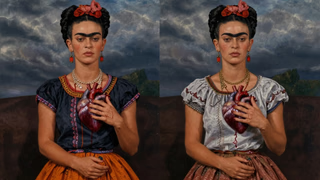

A single drop of blood beads at the base of her throat, where the thorn presses inward. It is small, almost shy, this red bead, and yet the whole painting seems to gather around it like breath held before speaking. Trace the thorn upward and you find it is not a wound at all but a necklace, a braid of brambles wound around her neck the way another woman might wear pearls. From this crown of small cruelties hangs a hummingbird, black and still, its wings spread wide as though caught mid-flight or mid-death.
This is 『Self-Portrait with Thorn Necklace and Hummingbird』, painted by Frida Kahlo in 1940, in the raw aftermath of her divorce from the muralist Diego Rivera. She gives us her own face at the center, unflinching, brows joined in a dark line, eyes looking out past us toward something we cannot see. Behind her, broad green leaves rise like a wall of jungle. A black monkey tugs at the thorns from one side. A cat crouches at the other, ears flat, watching the bird. And there she sits between them, perfectly composed, bleeding without complaint.
The Necklace That Cuts and Crowns
What stops us is not the pain but the calm. A woman wears thorns around her throat and does not wince. The thing that cuts her is also the thing that adorns her, and she has chosen, somehow, to wear it where everyone can see.
Here is the contrast that holds the whole canvas in tension. The thorns are suffering, plain and literal, the kind that draws blood. The hummingbird, in Mexican folklore, is a charm for luck in love, a small bright promise of hope. Kahlo has hung the symbol of hope from the instrument of her pain, as if to say they cannot be separated, as if the only place the bird could rest was on the very thing that wounds her.
We spend much of our lives trying to keep these two apart. We want the hummingbird without the thorns, the love without the cost, the bright life without the slow bleed it asks of us. We arrange our days to avoid the necklace altogether. And then something happens, a loss, a leaving, a diagnosis, a door closing, and we find the thorns already at our throat, fastened there before we noticed the clasp.
Kahlo does not look away from this. She has taken the thing that strangles her and turned it into something she chose to wear, and in that single act of wearing it, the wound becomes a face the world must meet. The defiance in her eyes is not the defiance of someone who has escaped pain. It is the harder defiance of someone who has decided to remain inside it and stay whole.
What the Monkey Knows and the Cat Wants
 Photo by
 Look again at the two creatures flanking her. They are not decoration. They are the two halves of an argument the painting is having with itself.
The monkey was a gift from Diego, a living memory of the marriage she had just lost. In her hands it might have been tender, a pet, a comfort. Here it pulls at the thorn necklace, tightening it, pressing the barbs deeper into her skin. The thing given in love becomes the thing that deepens the wound. Anyone who has loved and lost knows this monkey. It is the gift you cannot throw away and cannot bear to keep, the photograph in the drawer, the song that comes on without warning, the small mischievous animal of memory that tugs at exactly the wrong moment.
The cat is hunger, instinct, the part of the world that simply wants. It crouches with its eyes on the hummingbird, ready to take the last bright thing she has. It does not hate her. It is not cruel in any human sense. It is only the appetite of circumstance, the way life eyes our hopes the moment we are weakest, the way bad news seems to arrive precisely when we have the least left to lose.
And between these two, the woman holds still. This is the genius of it. She does not fight the monkey or shoo the cat. She does not even seem to feel them. Her stillness is not numbness, it is a kind of enormous effort that looks like ease. We have all met people like this, and we have all, on our best days, become them. Think of the friend who keeps her voice steady at the funeral, who pours the coffee with hands that do not shake, who carries the grief like a full glass across a crowded room without spilling a drop. The composure is not the absence of the storm. It is the storm, contained.
The dead hummingbird makes this almost unbearable. In life the bird is a blur of motion, never still, its heart beating so fast it seems made of pure energy. Kahlo paints it stopped. The hope is not alive, exactly, but it has not fallen either. It hangs there spread-winged, somewhere between flight and rest, the way our own hopes often hang in the hardest seasons, not dead and not quite living, kept aloft by nothing but the thorns themselves.
What the painting refuses to do is choose. It will not tell us whether this is a portrait of suffering or survival. It insists, with its level gaze, that these are the same picture seen from two distances.
The Oldest Necklace
 Photo by
 Thorns and crowns have always been close cousins. Long before Kahlo, the human imagination kept braiding wounds into ornaments and ornaments into wounds. The crown of thorns, the rose that pricks the hand that picks it, the pearl that is only the oyster’s answer to a grain of pain lodged in its soft body. We have always understood, somewhere beneath language, that the beautiful thing and the painful thing are often grown from the same root.
Kahlo painted in a country that knew this in its bones. Mexican art has never been squeamish about death or blood. The skull is also a celebration, the grave is also a feast, and the living visit the dead with marigolds and music rather than only tears. Into that tradition she set her own face, and what feels surreal to us, the floating bird, the watching beasts, the leaves that breathe behind her, would have felt to her like simple honesty. The inner life made visible. The pain worn outward instead of hidden.
This is the part that travels across every century and every border. In every age people have carried wounds they did not ask for, and in every age a few of them have refused to be only their wounds. The widow who learns to plant a garden. The exile who teaches her grandchildren the language of a country they will never see. The worker who loses everything and still rises in the dark to begin again. They are all wearing the necklace. They have all hung some small bird of hope from the brambles and decided to keep living underneath it.
What changes across time is only the fashion of our hiding. We have grown skilled at the smooth surface, the curated calm, the face that says everything is fine. Kahlo’s painting cuts through that the way a thorn cuts skin. It reminds us that the most honest thing a person can do is not to pretend the necklace isn’t there, but to wear it openly, blood and all, and still meet the world eye to eye.
The Composure of Ordinary Days
 Photo by
 Return now to that first small bead of blood at her throat. We began thinking it was the sign of her undoing. It is closer to the opposite. The blood means she is still alive beneath the thorns, still warm, still here. The wound is proof of the wearer.
This is what the painting leaves with us, long after we have stopped looking at the leaves and the watching animals. It does not promise that the thorns will fall away. It does not pretend the hummingbird will wake and fly. It offers something quieter and more useful, which is the image of a person sitting upright inside her own difficulty, refusing both despair and denial, holding the full glass across the room.
You can see the same composure on any ordinary morning, if you know where to look. The man at the bus stop who lost his job last week and still nods good morning. The mother who has not slept in three nights and still butters the toast in neat triangles because her child likes it that way. The old woman who waters the same window box she has watered for forty years, alone now, her hands steady on the small green leaves. None of them are free of their thorns. All of them have hung something bright from the brambles and decided, again, today, to wear the necklace out into the light. That decision, made quietly and without an audience, is the most defiant and most beautiful thing the human face has ever worn.