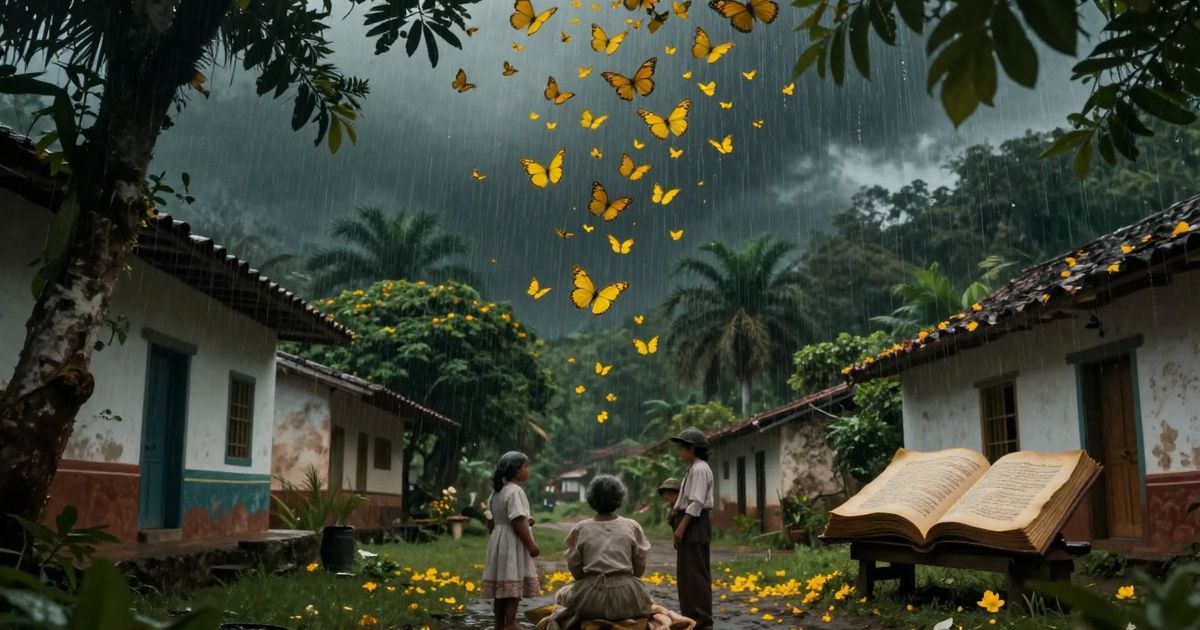

The Moment
Colonel Aureliano Buendía stands before the firing squad, but he is not thinking about death. He is thinking about ice. Not the ice of his old age, not the melted certainty of a world already known, but the ice his father showed him when he was a boy, when Macondo was so new that many things still lacked names and had to be pointed at. His father had paid a small fortune for that block of ice brought by gypsies, something miraculous pulled from the distant realms of science and wonder. The child pressed his hand against its surface and felt the burn of cold, the impossible hardness of frozen water under the tropical sun. “It’s the largest diamond in the world,” his father had whispered, and the boy believed him because everything then was capable of transformation, before the wars, before the thirty-two defeats, before he learned to make little golden fish in his workshop only to melt them down and begin again.
This is how García Márquez opens One Hundred Years of Solitude, with mortality pressed against marvel, with the end reaching back to touch the beginning. The colonel has lived through revolutions and betrayals, has fathered seventeen sons all named Aureliano, has become so famous that people have forgotten what he was fighting for. And yet, facing the bullets that will end him, he returns to that afternoon, to his father’s hand on his shoulder, to the moment before time folded itself into the endless repetitions that would consume his family for a century. The ice melted that day, as all miracles do. But the wonder of it, the cold burn on a child’s palm, remains intact in the instant before everything ends.
The Reflection
We all stand somewhere between the firing squad and the ice. The future presses close with its various endings while memory pulls us backward to moments when the world still felt newly made. What we choose to remember in our final moments says less about our past than about what remained innocent in us, what never calcified into habit or disappointment.
The colonel does not think of his wars or his lovers or even his sons. He thinks of his father, of wonder, of the afternoon when cold could still surprise him. Perhaps this is what inheritance really means: not the repetition of mistakes or the curse of familiar names, but the few moments of pure attention we received and carry forward, the small diamonds we press our hands against before we learned to call them merely ice.
You have these moments too. Not magical perhaps, not wrapped in the lush impossibilities of Macondo, but real enough. Someone showed you something once. Someone held your hand while you touched the world. And when your own endings come, in whatever form they take, you may find yourself returning there, to the instant before you knew what anything was called, when you could still be surprised by the cold burning beauty of the ordinary made strange.