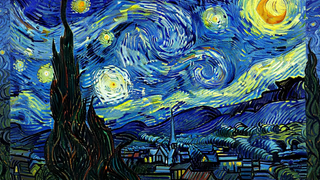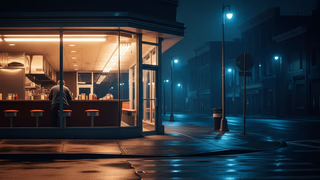


A waiter moves between the tables, a white smear against the cobblestones, balancing something on a tray. It is late. The other shops have shuttered their windows and pulled their awnings, but here the lamps are still burning, spilling yellow across the terrace like honey poured too fast. A few figures sit hunched over their cups, not speaking, not leaving. Above them the sky has gone the deep blue of ink diluted in water, and the stars are out, scattered without pattern. Someone walks past the edge of the frame and does not stop. The night is holding this place open a little longer, and no one seems ready to go home.
This is the world Van Gogh gave us in 『Café Terrace at Night』, painted in Arles in the autumn of 1888. He worked at it outdoors, in the dark, the canvas propped before the actual café while the actual stars turned overhead. What he made is not really a picture of a café. It is a picture of a certain hour, the one that arrives after the day has spent itself but before we are willing to admit it is over. You know the hour. It has a color, and Van Gogh found it. He painted the light we leave on when we are not ready to be alone with the silence.
Look at how the warmth pools on the terrace. The yellow is almost aggressive in its comfort, a color that insists you stay. Beyond it, the blue night presses in from every side, patient and enormous. The whole composition is a negotiation between these two forces, the small bright human circle and the vast indifferent dark that surrounds it. And the people sitting inside that circle are not doing anything remarkable. They are simply there, occupying chairs, letting the evening pass over them. They have chosen the light. They have chosen, for now, not to walk out into the blue.
There is a specific kind of relief that arrives when you sit alone in a public place at night. To be alone at home is to be reminded of your loneliness; to be alone in the glow of a café is to be gently absolved of it. The stranger two tables over lets you be quiet in peace, and in doing so gives you a companionship purer than conversation. You are not lonely. You are simply among the living, warmed by the same lamp, breathing the same cooling air.
Van Gogh understood this. He does not give us faces in the painting. The figures are turned away or dissolved into their coats, unreadable, anonymous. He is not interested in who they are. He is interested in the fact that they are here, together and apart at once, held in the same amber light. This is what the painting knows that we sometimes forget. Solitude and belonging are not opposites. They can occupy the same table.
Think of the last time you lingered somewhere longer than you needed to. You were not waiting for anyone. You were waiting for the reluctance to pass, the reluctance that comes when the day is over but the self is not yet ready to be put away. The lamp overhead did not judge this. It simply kept burning, and you stayed inside its circle a while longer, and that was enough.