
The Glass Between Us
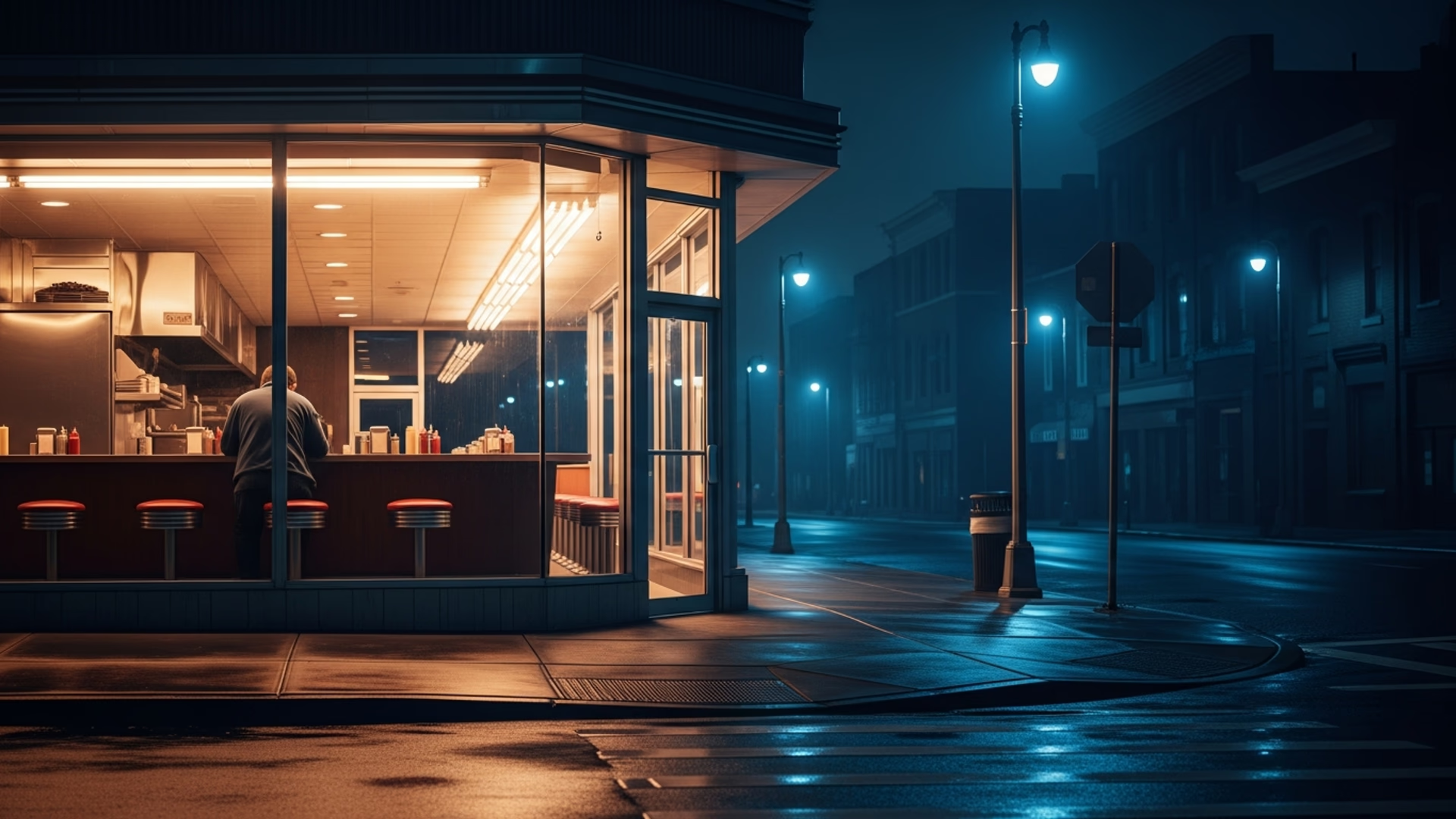
It is past midnight, and the city has gone quiet. Not silent, exactly. Cities never achieve true silence. But the traffic has thinned to occasional taxis, and the conversations have retreated behind closed doors, and what remains is a kind of held breath. In this stillness, a diner glows on a corner like a lantern set out for travelers who have lost their way.
Edward Hopper painted this scene in 1942 and called it 『Nighthawks』. The title alone tells us something. Nighthawks are not hawks at all but nightjars, sharp-eyed and solitary. But these are nighthawks, creatures who move through darkness, who find their clarity when others sleep. Four figures occupy the space: a man and woman sitting close but not quite touching, another man with his back to us, and a server in white who seems to be the only one with a purpose. The light inside is almost aggressive in its brightness, that particular yellow-green of fluorescent tubes that flattens shadows and exposes everything.
Look at the windows. They curve around the corner in one continuous sheet of glass, and there is no visible door. This detail unsettles something in the chest. The people inside are displayed like specimens, visible from all angles to anyone passing on the empty sidewalk. Yet they seem unaware of being watched, or perhaps they have simply accepted it. The buildings across the street show dark windows, blank faces. A cash register sits on a shelf. Coffee cups catch the light. The scene is so ordinary it aches.
What draws us to this painting, generation after generation? We have no shortage of images. We scroll through thousands each day, bright and loud and demanding. But Hopper’s diner stops us. It makes us lean closer. The warmth of the interior against the cold geometry of the street, the proximity of bodies that share no apparent intimacy, the hour itself, suspended between one day and the next. We recognize this place. Not because we have been to this specific corner in Greenwich Village, where Hopper found his inspiration, but because we have been to our own version of it. We have sat in fluorescent light at hours when we should have been sleeping. We have been among strangers who felt, for a brief window of time, like the only other people left in the world.
What the Silence Holds
 Photo by
 The longer we sit with this image, the more questions surface. What brought these four people to this particular corner at this particular hour? The couple might be returning from somewhere, a show or a dinner, though their body language suggests the evening has exhausted whatever spark began it. The solitary man hunches over his coffee with the posture of someone who has nowhere else to be. The server stands with the patience of a person who has learned to wait.
Hopper painted this during the Second World War, when the world outside the frame was loud with fear and urgency. But nothing in the painting acknowledges the conflict directly. No newspapers with headlines, no uniforms, no visible signs of the historical moment. Instead, Hopper gave us something that would outlast the news cycle: the ordinary loneliness of modern life, the way cities gather people together and isolate them simultaneously.
We can be surrounded by millions and still feel like the only person awake, the only one carrying this particular weight at this particular hour.This is what makes the painting feel contemporary even now, eight decades later. The technology has changed. We would be looking at our phones instead of staring at coffee cups. But the underlying condition remains. We live in structures designed for efficiency, not intimacy. We pass through spaces rather than inhabiting them. We share walls with neighbors whose names we do not know. The diner in Hopper’s painting is one of those threshold spaces, neither private nor truly public, where strangers coexist in temporary armistice.
Hopper’s wife Josephine modeled for the woman in the red dress. This small fact adds a layer of tenderness. The artist placed his life partner in a scene about disconnection, gave her a role as someone who sits beside a man without meeting his eyes. Did they discuss this? Did she understand what he was trying to capture? Marriage is its own kind of sitting side by side, being close enough to touch while remaining, in some essential way, separate.
The absence of a visible door haunts the composition. Art historians have debated whether this was intentional or simply a result of the composition Hopper chose. But the effect is unmistakable. The people inside are contained. They cannot easily leave, and we cannot easily enter. The glass becomes a membrane between worlds, and we stand outside, looking in, unable to help or disturb or join.
The Hours That Belong to No One
 Photo by
 There is a reason we speak of the small hours. The time between midnight and dawn has a different weight than other hours. The day’s momentum has stopped, but tomorrow has not yet begun. We enter a kind of suspension, unmoored from routine. In these hours, our thoughts take unfamiliar paths. Old griefs surface. Future worries sharpen. We remember people we have not thought about in years. The mind, without its usual tasks, wanders into territory we normally keep fenced.
Anyone who has stayed up too late knows this landscape. The kitchen at three in the morning. The glow of a laptop in a dark room. The quiet negotiation with insomnia, when we give up fighting and simply accept that sleep will not come. We make tea or pour whiskey. We read the same paragraph three times. We stand at windows and watch the street for signs of life.
Hopper understood that these hours reveal us. The social masks we wear come off when there is no one to perform for. Or almost no one. The strangers in the diner are not performing for each other. They have relaxed into their separateness. This is, in a strange way, a kind of honesty. They do not pretend to be having a wonderful time. They do not manufacture conversation. They simply exist in the same space, each absorbed in private weather.
There is loneliness in this scene, yes. But there is also something that might be called companionship, even if it asks nothing and offers nothing beyond presence. The server is there. The coffee is hot. The light holds back the darkness outside. Sometimes this is enough. Sometimes being alone together is the most honest form of connection we can manage.
The Question That Stays
 Photo by
 We leave the painting eventually. We return to our lives, to daylight and obligations and the noise of being among others. But something from Hopper’s corner diner travels with us. It surfaces at unexpected moments, when we find ourselves in a late-night airport terminal or a quiet car on an empty road or the kitchen after everyone else has gone to bed.
The painting does not offer solutions. It does not tell us how to bridge the distances between ourselves and others. It simply shows us the distances exist, that they are part of the architecture of modern life, built into the glass and concrete and fluorescent light. This is not despair. It is recognition.
Perhaps the question Hopper leaves us with is not how to escape loneliness but how to be present within it. How to sit with the discomfort of separation without numbing ourselves or pretending it away. The nighthawks do not seem to be suffering, exactly. They have found a place to be, a light to sit beneath, a cup to hold. They have made it through to this hour, and they will make it through to morning.
What would happen if we stopped fleeing from our solitude and simply sat down beside it? What might we see in the glass if we let ourselves look?