The Window and the Sky
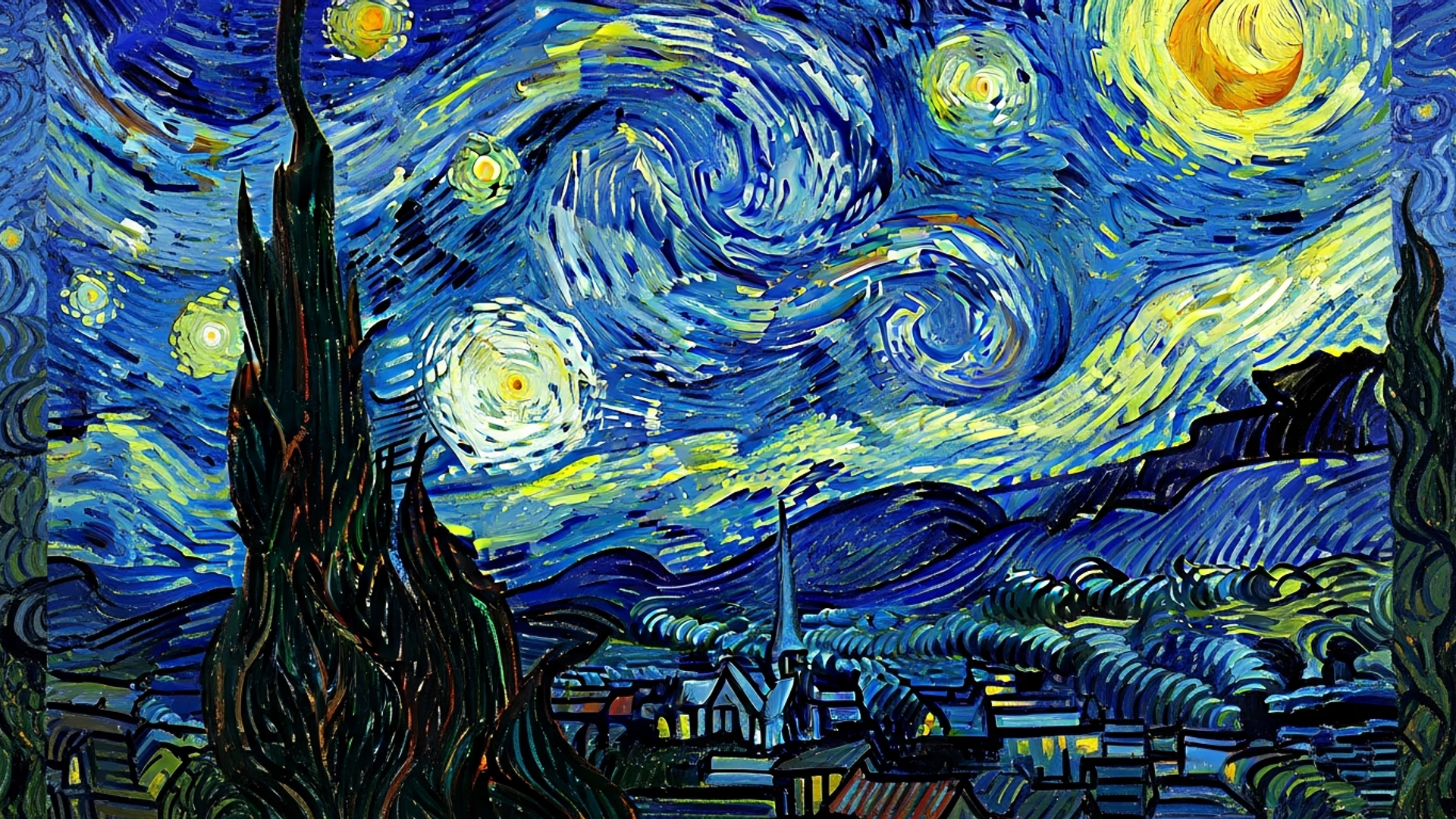
Look at the sky. Not the real one outside your window, but the one Vincent van Gogh painted from a room in the Saint-Rémy asylum in 1889. In 『The Starry Night』, a scatter of stars burn like small fires against a deep blue expanse. A crescent moon blazes in the corner, too bright, too alive, refusing to be merely celestial. Below, a village sleeps in neat rows of orange-lit windows, and a church steeple reaches upward like a single dark finger pointing toward something it cannot touch. But it is the sky that holds you. The sky that will not stay still.
The cypress in the foreground twist like green-black flames, reaching toward the heavens with a hunger that feels almost desperate. And above everything, the night moves. It coils and spirals in waves of cobalt and ultramarine, each brushstroke visible, each swirl of paint carrying its own momentum. This is not a peaceful night. This is not the quiet darkness we imagine when we close our eyes. This is a night that breathes, that churns, that refuses to be silent.
Van Gogh painted this scene during one of the most difficult periods of his life. He had committed himself to the asylum after the breakdown that cost him part of his ear. His days were marked by seizures, hallucinations, periods of profound despair. And yet, from that small room, looking out at the Provençal landscape, he created something that has moved millions of people for over a century. He painted a night sky that somehow feels more real than any photograph, more true than any observation.
The strange thing is, he painted it during the day. He worked from memory and imagination, combining what he saw from his window with what he felt in his chest. The village below did not actually exist in that configuration. The village below belongs to another view entirely. What we see is not a record of the world but a translation of it, filtered through a mind that could not stop seeing beauty even when beauty seemed impossibly far away.
The Turbulence Within
 Photo by
 There is something about this painting that catches in the throat. We look at it and feel, somehow, understood. Not in the way of words or explanations, but in the way that music sometimes reaches into us and names what we could not name ourselves.
The swirling sky has been analyzed countless times. Art historians speak of stylistic influences, of Japanese prints, of the bold colors of Post-Impressionism. But when we stand before this canvas, or even look at a reproduction on a screen, we are not thinking about art history. We are thinking about ourselves. About the nights when our own minds would not settle. About the times when emotion moved through us in waves we could not control, when the world felt too large and too small at once.
Van Gogh’s genius was not in escaping his suffering but in translating it into something that could be shared.He did not paint a calm night to comfort himself. He did not pretend the darkness was less dark than it was. Instead, he poured his turbulence onto the canvas and, in doing so, transformed it into something that speaks to our own. The painting does not say: everything is fine. It says: the night is wild and strange and overwhelming, and look, there are stars.
This matters because we so often hide our inner storms. We present calm surfaces to the world, afraid that our real selves, the churning and desperate parts, would be too much for others to witness. We apologize for our intensity. We dim ourselves to fit into rooms that were built for steadier souls. But Van Gogh reminds us that the storm and the beauty are not opposites. They are the same motion, the same energy, the same life force moving through us in patterns we cannot always predict.
The cypresses in the painting have always struck me as the most honest part. They do not stand straight and proper like trees in a botanical illustration. They writhe. They reach. They mirror the movement of the sky as if the boundary between earth and heaven has become permeable, as if everything is caught in the same great wind. And perhaps this is what happens when we stop pretending to be stable: we discover that the whole world was moving all along, and we were simply trying not to notice.
What the Light Remembers
 Photo by
 We all know nights like this, even if we have never seen them painted so beautifully.
There are nights when sleep will not come, when the mind replays old conversations, old mistakes, old fears in an endless spiral. There are nights when we feel utterly alone, as small as the village below Van Gogh’s great sky, as fragile as those tiny lit windows in the dark. There are nights when the weight of simply being ourselves feels like more than we can carry.
And yet, in those same nights, something else is also true. The stars do not disappear because we are suffering. The moon does not dim because our hearts are heavy. The universe continues its vast indifferent dance, and somehow this is not cruel. Somehow, this is comfort. Our pain, enormous as it feels, is held within something larger. We are small, yes. But we are held.
Van Gogh understood this paradox. His letters are filled with references to the night sky, to the consolation he found in looking upward. He wrote to his sister Willemien that the night often seemed to him even more richly coloured than the day. “It often seems to me that the night is much more alive and richly colored than the day,” he wrote. For someone drowning in darkness, this is a remarkable statement. It suggests that even in his worst moments, he remained capable of wonder. The darkness was not empty. It was full of something he could barely name, something he spent his whole short life trying to capture in paint.
This is, perhaps, the most radical thing the painting offers us. Not a denial of suffering, not a promise that everything will be okay, but something stranger and more durable: the insistence that beauty does not require perfect conditions. That the most profound visions sometimes emerge from the most broken places. That our wounds do not disqualify us from seeing the stars.
We carry this knowledge without always knowing we carry it. Every time we look up at the night sky and feel something shift in our chest, every time we find unexpected peace in difficult circumstances, every time we create something true from a place of pain, we are living what Van Gogh painted. We are discovering that the night is alive and richly colored, even when we cannot see clearly, even when we are lost.
What the Darkness Asks
 Photo by
 The church steeple in the painting never quite reaches the stars. It points upward, straining toward the swirling sky, but there remains a gap, a distance that cannot be crossed. I have looked at this detail many times, and I am never sure whether it is tragic or simply true.
Perhaps both. Perhaps that is the condition of being human: to reach toward something we cannot fully grasp, to long for a wholeness that always exceeds our reach. Van Gogh did not live to see his work celebrated. He died thinking himself a failure, never knowing that this single painting would become one of the most recognized images in the world. The stars he painted continue to burn long after his hand stopped moving.
So here is the question that will not leave me, the one that surfaces every time I encounter this painting:
What do we make of the gap between what we feel and what we can express, between who we are and who we hope to be, between the life we have and the one we imagine? Do we close our eyes to it? Do we pretend it does not exist? Or do we do what Van Gogh did, and paint the distance itself, make art of the reaching?
The night does not answer. The stars continue their ancient burning. And somewhere, in an asylum room, in a city apartment, in whatever small space we have claimed as our own, we look upward and feel the old pull toward something larger than ourselves.
The painting does not tell us what to do with this feeling. It simply shows us that we are not alone in having it. That the turbulence is not a flaw but a feature. That the night, for all its darkness, has never been empty.