

A waiter moves between the tables, a white smear against the cobblestones, balancing something on a tray. It is late. The other shops have shuttered their windows and pulled their awnings, but here the lamps are still burning, spilling yellow across the terrace like honey poured too fast. A few figures sit hunched over their cups, not speaking, not leaving. Above them the sky has gone the deep blue of ink diluted in water, and the stars are out, scattered without pattern. Someone walks past the edge of the frame and does not stop. The night is holding this place open a little longer, and no one seems ready to go home.
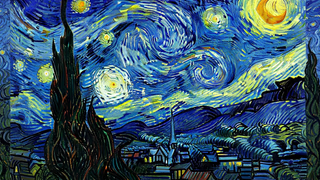
This is the world Vincent van Gogh gave us in 『Café Terrace at Night』, painted in Arles in the autumn of 1888. He worked at it outdoors, in the dark, the canvas propped before the actual café while the actual stars turned overhead. What he made is not really a picture of a café. It is a picture of a certain hour, the one that arrives after the day has spent itself but before we are willing to admit it is over. You know the hour. It has a color, and Van Gogh found it. He painted the light we leave on when we are not ready to be alone with the silence.
Look at how the warmth pools on the terrace. The yellow is almost aggressive in its comfort, a color that insists you stay. Beyond it, the blue night presses in from every side, patient and enormous. The whole composition is a negotiation between these two forces, the small bright human circle and the vast indifferent dark that surrounds it. And the people sitting inside that circle are not doing anything remarkable. They are simply there, occupying chairs, letting the evening pass over them. They have chosen the light. They have chosen, for now, not to walk out into the blue.
That choice is the quiet drama of the painting, and it is a drama each of us performs more often than we notice.
What the Lamp Knows
Consider what it means to sit alone in a public place at night. The café at that hour is a peculiar kind of room. It is neither home nor away, neither solitude nor company. You are among people, but you owe them nothing. No one expects you to speak. No one knows the shape of your day, the argument you left unfinished, the news you received that morning and have not yet told anyone. You carry all of it silently to your table, and the light receives you without asking a single question.
There is a specific relief in this. To be alone at home is to be reminded of your loneliness; to be alone in the glow of a café is to be gently absolved of it. The presence of strangers does something that the presence of loved ones cannot. It asks nothing. A friend at your table would want to know why you were quiet. The stranger two tables over lets you be quiet in peace, and in doing so gives you a companionship purer than conversation. You are not lonely. You are simply among the living, warmed by the same lamp, breathing the same cooling air.
Van Gogh understood this, and it may be why he painted the scene the way he did. He does not give us faces. The figures are turned away or dissolved into their coats, unreadable, anonymous. He is not interested in who they are. He is interested in the fact that they are here, together and apart at once, held in the same amber light. This is what the painting knows that we sometimes forget. Solitude and belonging are not opposites. They can occupy the same table.
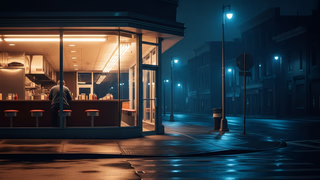
Think of the last time you lingered somewhere longer than you needed to. A diner that stayed open past midnight. A train station bench. A bar where you nursed one drink for an hour because leaving meant returning to a room that would be too quiet. You were not waiting for anyone. You were waiting for the reluctance to pass, the reluctance that comes when the day is over but the self is not yet ready to be put away. The lamp overhead did not judge this. It simply kept burning, and you stayed inside its circle a while longer, and that was enough.
Van Gogh painted this one outdoors, at night, under the gaslight, because he believed the darkness held more color than the day, not less. He wrote to his sister Willemien that it often seemed to him the night was even more richly coloured than the day, in the most intense violets, blues and greens. What a strange and generous thing to believe, that the hours we associate with emptiness are in fact the fullest. He looked at the dark and did not see absence. He saw a blue so deep it was almost a substance, and against it, the small stubborn human insistence on light. He saw that we build these glowing rooms not to keep the dark out, but to have somewhere to be while the dark does its slow work around us.
The Rooms We Keep Lit
 Photo by
 Every town has them. The window that glows when every other window has gone dark. The all-night pharmacy, the gas station, the late café. They are unremarkable in daylight and quietly sacred at night, because they announce a promise. Someone is awake. Someone left the light on. If you cannot sleep, if you cannot bear your own rooms, there is a place that will take you without asking your name.
We are creatures who need this more than we say. The whole architecture of human evenings is built around the refusal to be swallowed by nightfall alone. We gather in kitchens after the dishes are done. We text a friend a single word at eleven at night just to know someone is on the other end. We leave the porch light burning for a family member who is still out. These are small gestures, hardly worth mentioning, and yet they are the same gesture Van Gogh painted, the same one the café performs. They all say the same thing. Stay a little longer. The dark can wait.
What moves me about the terrace is that the people there do not need to be friends to serve this purpose for one another. Their togetherness is accidental and therefore honest. No one arranged it. They simply drifted toward the light at the same hour, drawn by the same reluctance, and their mere presence makes the night survivable for each other. This is community in its most elemental form, prior to conversation, prior to knowing. It is the community of the awake, the lingering, the not-yet-ready.
We spend so much of our lives believing that belonging requires being known. That to matter to others we must be seen, understood, chosen. But the café terrace suggests something humbler and kinder. Sometimes it is enough to be near. To share a light with people whose names you will never learn. To be a warm shape at a table that tells the strangers around you that they are not the last ones awake in the world. You give them this simply by staying, and they give it back to you, and none of you ever speak of it.
 Photo by
 The Light We Leave On
 Photo by
 The painting has no clock in it, but you can feel the time. It is late, and getting later, and eventually even this café will close. The waiter will stack the chairs. The lamps will go out one by one. The blue night will fill the space the yellow light had held open, and the last figures will rise and step out into the dark and walk home along streets that have finally gone silent. This is coming. Van Gogh knew it was coming. He painted the hour precisely because it does not last.
And that is the whole of it, really. Nothing in the scene is permanent. The warmth is borrowed. The gathering will scatter. But for the length of one evening, in the glow of a lamp under an enormous sky, a handful of people chose not to be alone in the way that hurts. They chose the light. They stayed.
You will do this too, tonight or tomorrow or some evening soon. You will find yourself unwilling to turn off the last lamp in the house. You will sit at the kitchen table with a cup gone cold, not reading, not doing anything, just being awake in a lit room while the neighborhood sleeps. Or you will walk into some late-open place and take a seat near the window and feel, without being able to explain it, a little more able to face the day that is ending. The stranger at the next table will not look up. Neither will you. And in that quiet refusal to be swallowed by the dark, the two of you will keep each other’s company more truly than words ever could, in the last warm room the night allows.