Riiven Wild
How Sea Otters Keep Kelp Forests Standing
In the Aleutian Islands, a floating sea otter eating urchins decides whether a coastline grows a kelp forest or a barren rock plain.
The Scene
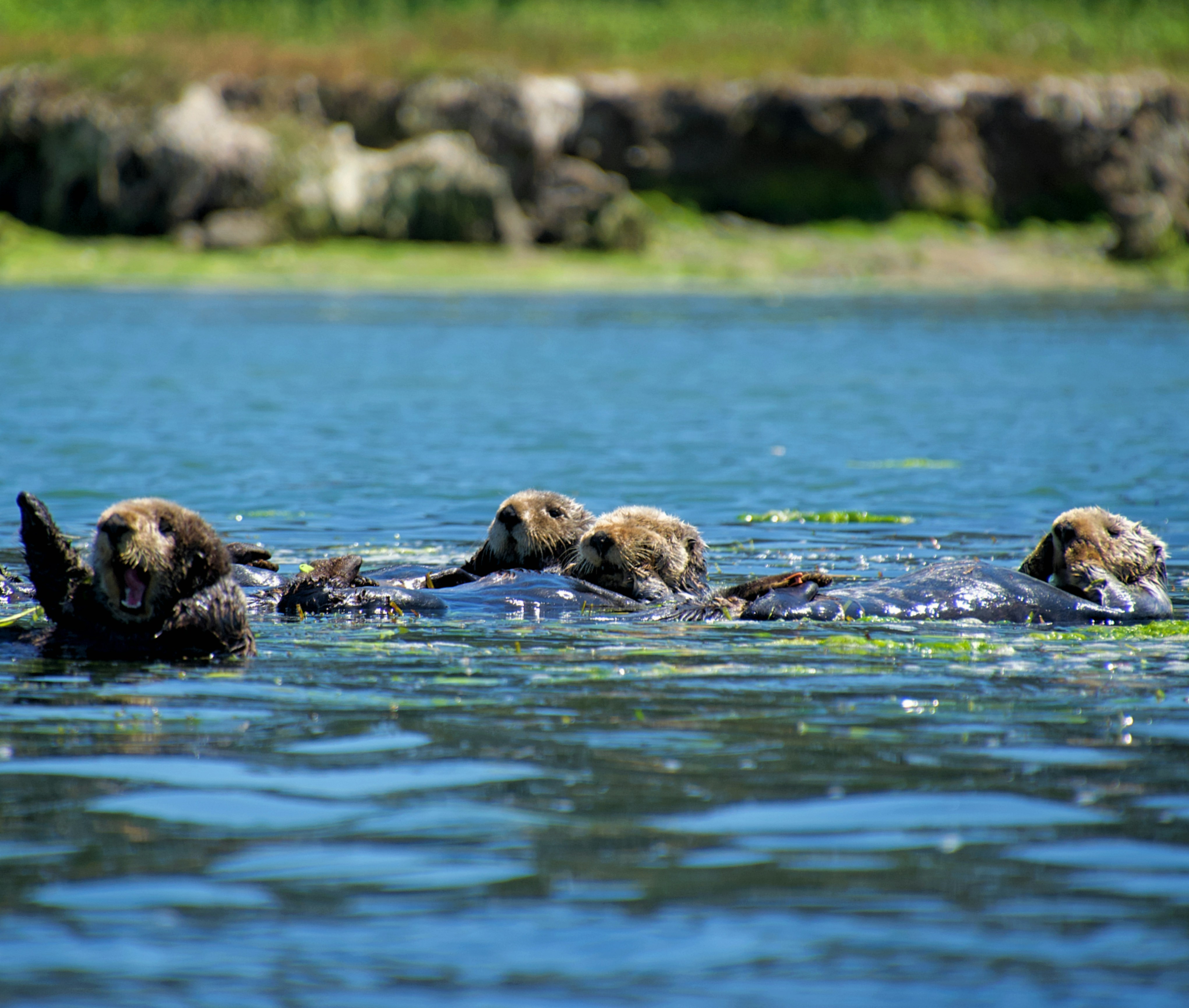
Off Adak Island in the central Aleutians, a sea otter floats on its back in cold gray water, a flat stone balanced on its chest. It pulls a purple sea urchin from the seafloor, cracks it against the stone, and eats the soft insides. Around it, blades of brown kelp rise from the rock and sway near the surface, a forest standing in salt water. A few hundred kilometers away, on islands where otters have vanished, the same seafloor is bare. The urchins there have eaten the kelp down to stubble. Researchers diving paired transects with scuba gear have measured the difference between these two coastlines for decades.
The Creature
The northern sea otter, Enhydra lutris, is a marine mammal that spends almost its whole life in the water along the Aleutian Archipelago. It has no blubber. Instead it keeps warm with the densest fur of any animal, and to fuel that insulation it eats roughly a quarter of its body weight each day. Much of that diet is sea urchins, spiny grazers that feed on kelp. Estes and Duggins, working in Alaska through the early 1990s and published in 1995, described the otter as a keystone species, one whose presence reshapes the conditions every other species nearby depends on. By holding urchin numbers down, the otter lets kelp grow. The Aleutians gave researchers a natural experiment: islands with otters and islands without, side by side in the same cold water. Comparing those paired sites with scuba transects, scientists found kelp canopy cover was about 3 to 8 times greater at islands where sea otters were present than at islands where they were absent.
How It Works
The link runs through the urchins. Across the paired islands of the Aleutian Archipelago, Estes and Duggins found that where sea otter densities are high, urchin biomass sits far below what the same seafloor carries without otters. With the grazers held back, kelp biomass climbs several fold and primary production rises. Remove the otters and the cascade reverses. Estes and colleagues documented the marine mammal declines that swept southwest Alaska through the late twentieth century. Following the sea otter declines across the Aleutians in the 1990s, herbivorous sea urchin densities increased by roughly an order of magnitude, and kelp forests were largely replaced by sea urchin barrens across hundreds of kilometers of coastline. Rasher and colleagues, in work summarized by Bigelow Laboratory in 2020, found that grazing by urchins on coralline algal reefs is now 30 to 60 percent higher than in preindustrial times. They attribute that change to the combined pressure of ocean warming and reduced sea otter predation.
Watch
The Ripple
The structurally complex stands that otters allow to grow shelter many other species. NOAA's 2020 Aleutian Islands Ecosystem Status Report notes that sea otter predation on urchins increases kelp abundance and complex habitat, which in turn supports higher densities of coastal fishes and even shifts foraging behavior in birds such as Glaucous Winged Gulls. The kelp itself feeds the system as it grows and breaks down. When otters disappear and urchin barrens spread, that whole architecture flattens. The fish lose their cover, and the coralline reefs underneath face heavier grazing than they did before industrial whaling and warming entered the picture. The Wildlife Society reported in 2020 that the lack of sea otters is hurting Alaskan reefs, and the Elakha Alliance, citing Aleutian studies in 2023, traces the same ecosystem wide effects back to a single predator and its appetite for urchins.
Why It Matters
The Aleutian coastline holds two stable states. One is a kelp forest full of fish and growing algae. The other is a barren of urchins on scraped rock. Which one appears comes down largely to whether sea otters are present to eat the grazers. Estes and Duggins recorded that shift playing out across dozens of islands simultaneously, and subsequent surveys have tracked it continuing as otter populations fluctuate across the archipelago.
Sources
- Estes & Duggins, Sea Otters and Kelp Forests in Alaska, 1995 (1995) · study
- Estes et al., Causes and consequences of marine mammal population declines in southwest Alaska: a food-web perspective, Philosophical Transactions of the Royal Society B 364(1524):1647, 2009 (2009) · study
- NOAA Alaska Fisheries Science Center, Ecosystem Status Report 2020, Aleutian Islands (2020) · study
- Sea Otters Are Ecosystem Superheroes (2016) · context
- Rasher et al., Loss of Sea Otters Accelerating the Effects of Climate Change, 2020 (Bigelow Laboratory summary of peer reviewed work) (2020) · context
- The Wildlife Society, Lack of sea otters hurts Alaskan reefs, 2020 (2020) · context
- Elakha Alliance, Ecosystem Effects of Sea Otters, citing Aleutian kelp forest studies, 2023 (2023) · context


