A midfielder jogs off the pitch after ninety minutes, peels off a small vest, and hands it to a team technician on her way to the showers. The vest looks like ordinary kit. Inside it, her heartbeat, her sprint count, and the slow droop of her fatigue across the second half have already left the stadium, copied to a server she will never see. She owns her legs. The record of what they did belongs, in practice, to someone else.
A Body Turned Into Data
Modern sport quietly rewrites the athlete as a stream of numbers.
 Photo by
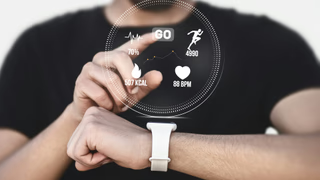
 GPS vests, heart-rate straps, and motion sensors log movement and effort second by second. Overhead cameras pin a player’s position to the field dozens of times each minute without anyone wearing a thing. Newer wearable patches can read skin temperature, hydration, and muscle-oxygen levels simultaneously, building a portrait detailed enough to flag an injury before it happens.
None of this stays on the body for long. The data leaves with the kit. The person on the field and the file in the cloud are now two versions of the same athlete, and only one of them goes home after the match.
How Much Gets Collected
The volume has grown past the point of casual oversight.
 Photo by
 A single professional generates millions of individual readings across one season, much of it gathered off the pitch entirely: sleep quality, recovery scores, morning resting heart rate.
Volume alone is not the worry. Intimacy is. A sprint distance is a fact about a game. A heart rhythm or a hormonal proxy is a fact about a person. European law already treats biometric data, meaning body-derived measurements like heart rate and hormonal signals, as a special category requiring explicit consent to process [Lewis Silkin]. That consent question is exactly where the disputes begin.
Who Legally Owns the Numbers
Here is the part that surprises most people: in much of the world, no law gives the athlete primary ownership of data their own body produced.
 Photo by
 UK data protection rules, for instance, do not grant property rights in personal data at all. They give the person rights to access, correct, or erase it, while practical control sits with whoever collects and stores it [Lewis Silkin]. As a rule, the club is treated as the data controller for its sporting activity [Advant NCTM].
Contracts fill the gap, and they rarely favor the player. Standard agreements often bundle in broad data-sharing clauses signed without line-by-line negotiation. Fair terms tend to include at least three things:
-
Clear ownership of raw data, derived insights, and pooled datasets
-
A stated plan for any revenue the data generates
-
Explicit deletion and retention rights for the athlete [Lewis Silkin]
Ownership currently defaults to whoever holds the server, not whoever owns the body.
Competing Interests
Several industries reach for the same data, each for its own reason.
 Photo by
 Clubs use performance numbers for tactics and transfer valuations, turning a dataset into a financial asset. Leagues and broadcasters monetize aggregated player data through gambling partnerships, fantasy platforms, and richer broadcasts. Over 75% of professional teams now run real-time analytics during games, driven by exactly these sensors [Appinventiv].
Athletes have started to push back. In the UK’s Project Red Card, former footballers challenged the commercial use of their performance data by betting and analytics firms without consent or compensation [Sagar Chandra].
“Athlete performance data may soon become the most valuable and contested asset in sports.” (Sagar Chandra Associates)
Many parties profit from these numbers while the athlete who produced them has no guaranteed share.
Seeing the Athlete Differently
Framed this way, playing a match is also producing a product. Every logged sprint feeds models that keep working for years, including injury-prediction tools still drawing on data from players who retired long ago. Sleep scores and off-season recovery extend the relationship past the locker room door. The body becomes a form of intellectual property, continuously made and continuously extracted.
The athlete is no longer only a performer. They are an ongoing data producer whose output outlasts the career that created it.
Go back to the midfielder handing over her vest. She returned a piece of hardware, but what traveled out of the stadium was a record of her body under stress: every acceleration and every fatigue curve, now living in a database she cannot reach. A single sprint she ran last season may still be shaping an injury algorithm watching over a teenager training today, and she will never be told. The kit comes off in the shower. The athlete in the data stays on the clock.