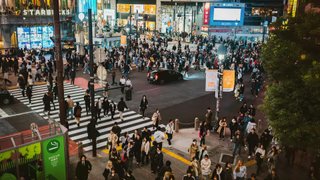
Two children live ten miles apart in the same city, under the same weather and the same forecast. One walks home through a leafy street and plays outside until dinner. The other lives beside a highway on-ramp, where trucks idle in the afternoon heat, and on bad days she stays behind a closed window. They breathe the same regional air on paper. By the time they turn ten, their lungs tell two different stories.
We tend to think of air pollution as a shared sky, something that settles over everyone equally. It does not. Where you live, where you work, and how your body is already faring decide how much of that air actually reaches you, and how much harm it does once it arrives.
A Neighborhood Breathes Differently
Air quality is often reported as a single number for a whole city, which quietly suggests everyone is breathing the same thing.
 Photo by
 Step from one neighborhood to another and the reality shifts block by block.
Decades of land-use decisions placed highways, warehouses, and industrial facilities disproportionately in lower-income areas. “People of color are more likely than white people to live near highways, industrial facilities and other sources of pollution, leading to higher rates of asthma, heart disease and other health problems.” [Harvard]
Proximity is only part of it. Diesel particulate matter from freight corridors can push local pollution well above the city-wide average, so the reported number understates what a resident near the trucks actually inhales. These same neighborhoods also tend to have less green space, the trees and parks that filter air and cool streets.
For most readers, this means your ZIP code is one of the strongest predictors of the air you breathe each day, often more telling than the daily forecast.
The Myth of Equal Exposure
Here is the belief worth examining: because national air quality standards set one threshold for everyone, everyone must be equally protected.
 Photo by
 The threshold is genuinely equal. The exposure is not.
Consider time-activity patterns, the simple question of where a body spends its hours. A warehouse worker or outdoor laborer accumulates far more high-pollution hours than someone at a sealed office desk in the same city. The regulation treats their air as identical; their lungs do not.
Housing adds a second layer. Older, drafty homes let outdoor pollutants slip indoors far more readily than newer, well-sealed buildings, so staying inside offers uneven shelter. One health equity expert put it plainly: “This is fundamentally a question of human dignity and equity… the worst indoor air quality is often found where people are most vulnerable: children in poorly ventilated schools, patients in overcrowded clinics.” [Health Policy]
A single regulatory number can hide the cumulative burden carried by people who live, work, and sleep inside the same high-pollution zone. Equal rules do not produce equal protection when the starting conditions are so different.
Why the Same Air Does More Damage
 Photo by
 The unfairness runs deeper than dose. The same lungful of polluted air can do more harm in a body already under strain.
Chronic stress from financial and neighborhood pressure keeps the body in a low, steady state of inflammation. Airways and blood vessels held in that state respond more sharply to the same pollutants. Layer on uneven healthcare access, and a problem that could be caught early instead escalates.
Three factors tend to compound one another:
-
Chronic stress raises baseline inflammation, priming the lungs and heart to react
-
Limited care access means asthma and COPD (chronic obstructive pulmonary disease, a condition that restricts airflow) go under-managed, so pollution-triggered episodes worsen faster
-
Pre-existing conditions like diabetes and hypertension, themselves shaped by inequity, lower the threshold at which polluted air can trigger a cardiac event
Recently updated global data tracking air pollution and related disease showed progress stalling, with gaps in exposure and illness holding stubbornly wide. [IntechOpen] The pattern holds from a highway ramp in one city to an industrial zone in a rapidly growing one abroad. The harshest pollution harms fall on people through stress, thin healthcare, and prior illness. None of those are personal choices.
One Practice You Can Apply
Understanding the inequity is one thing; acting on it in daily life is another.
 Photo by
 There is a small move that bridges the two.
Free tools such as AirNow and community sensor networks like PurpleAir report air quality at the sensor level, sometimes block by block. That granularity matters, because it reveals the local gap that a city-wide average smooths over. Many previously unmonitored lower-income neighborhoods now appear on these maps.
Knowing your block’s number only helps if it changes a small decision:
- Check your specific street, not the city average, before outdoor exercise
- Time a run or a child’s outdoor play to a lower-pollution window rather than peak traffic
- Decide when to open windows and when to keep them closed
Shifting a thirty-minute run away from rush hour can meaningfully cut how much fine particulate you inhale. The first actionable step is checking your block’s real-time reading and, just as usefully, showing one neighbor who has never seen the map.
Return to the two children ten miles apart. The one behind the closed window is not making a different lifestyle choice from her leafier-neighborhood peer. She is living inside a different air quality reality, shaped by roads and housing and health long before she was born. You cannot move the highway today. You can open a free map, search your own street, and learn the number the city average was hiding. Then share it with someone on your block who does not know it exists. The sky looks the same from every window. What reaches the lungs beneath it does not.