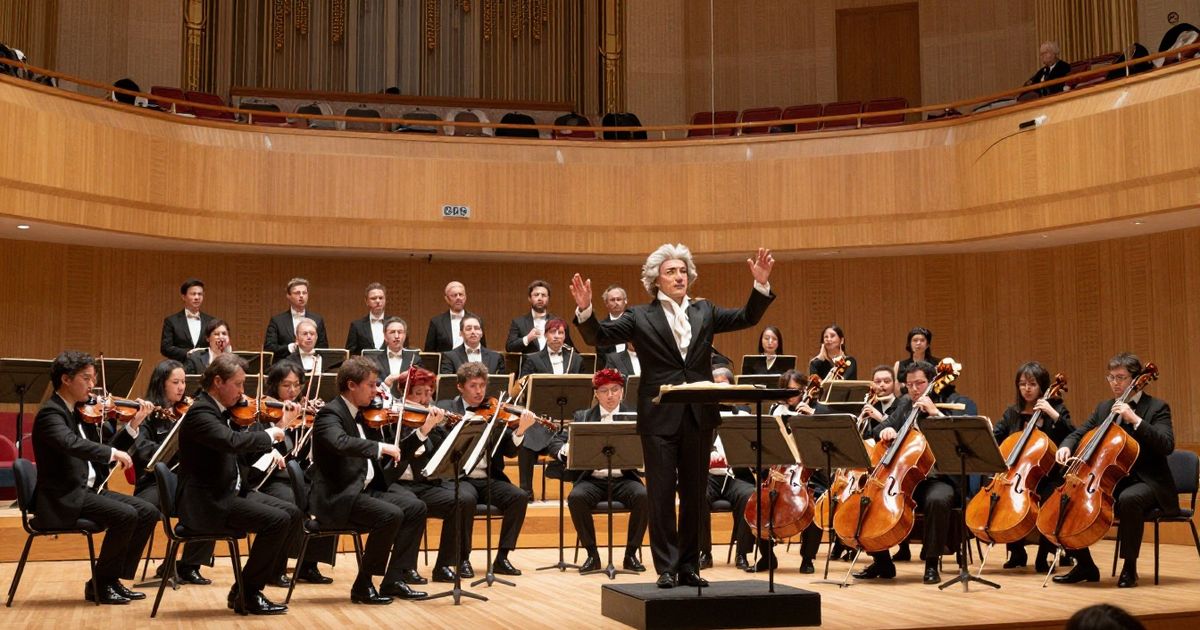

Vienna, May 7, 1824. A man stands with his back to a thousand people, his arms still moving through the last vibrations of something enormous. He cannot hear the silence that precedes the eruption. He cannot hear the eruption itself - the roar that climbs the gilded walls, the boots stamping, the programs thrown into the air like small white birds. For Ludwig van Beethoven, there is only what there has always been in these final years: the interior. The imagined sound. The private cathedral where the music lives complete and whole, untouched by the imperfect acoustics of any real room.
He stands there, chest heaving, facing the orchestra, unaware that behind him an entire theater has risen to its feet. And then a hand - Caroline Unger’s hand, the contralto who sang his notes into the air he could not hear - touches his arm. Gently. The way you might touch someone who is very far away and very close at the same time. She turns him by the shoulders, degrees of rotation so small and so enormous, until he is facing them. All those open mouths. All those hands colliding in the dark. All those faces doing the unguarded thing that faces do when something has broken through their ordinary armor.
He sees it. He cannot hear a note of what his music has done to these strangers, but he can see what it has done. And his eyes fill.
We tell ourselves that the point of making something is the reception. The response. The proof, arriving from outside, that what we poured ourselves into was real and mattered. We wait for the turn. We wait to be rotated by gentle hands toward the evidence.
But Beethoven composed the Ninth in a sealed room. Every choral swell, every moment where the soloists and orchestra fuse into that declaration of brotherhood - all of it existed first and only in a mind that could no longer verify its own imaginings against the physical world. He trusted that what he heard in silence would still be true when it reached the air. He had to. He had no other option.
What if that constraint was not his tragedy but his strange and terrible freedom - the discovery that the making had always contained its own completion, whether or not he ever heard the room respond?Most of us will never know if the truest things we offered actually landed. The honest words, the years of quiet effort, the love directed at someone who may only understand it much later, in a room we will never enter. We send these things out and then we stand with our backs to whatever happens next.
Maybe the point was never the applause. Maybe the symphony was always the one playing inside, full and unsilenceable, already enough.