The kettle has not boiled yet. You are standing at the kitchen window in your socks, and the glass is cool where your forehead almost touches it. Outside, the street is not quite a street. It is a set of suggestions. A darker mass that will become a parked car. A paler stripe that will become the fence. Somewhere a bird tries one note, stops, and tries it again. The sky over the rooftops has gone from no color to a color you could not name if someone asked you, something between ash and the inside of a shell. You are not thinking anything in particular. You are only watching the world arrive in pieces, before it has decided what it is going to be today.
Most of us know this hour only by accident. We meet it on the way to an early flight, or after a night of a crying child, or on one of those mornings when sleep simply leaves and does not come back. And because we meet it by accident, we rarely trust what we see. We wait for full daylight to tell us what is really there.
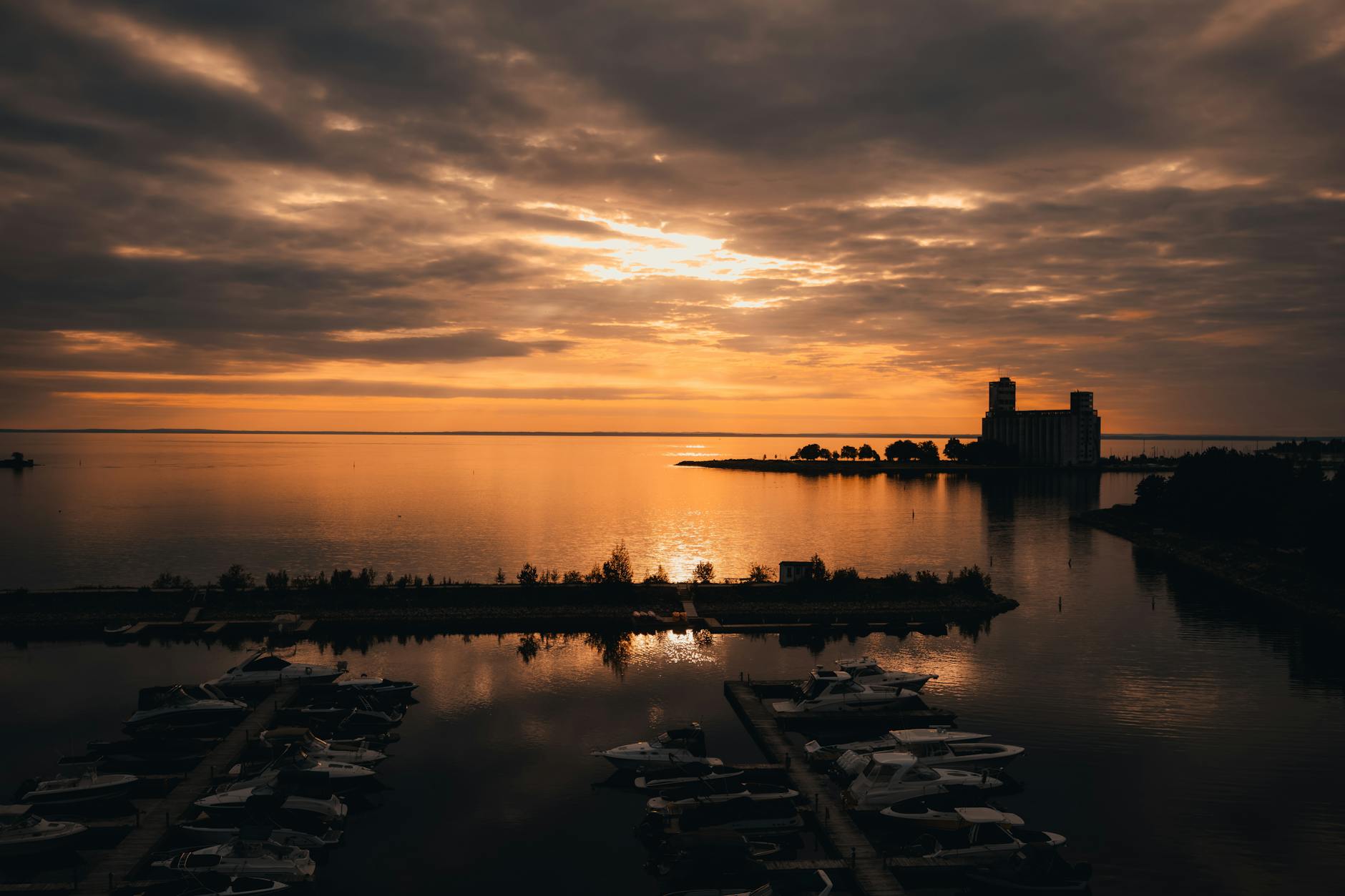
In 1872, Claude Monet painted a harbor at Le Havre at sunrise and called it 『Impression, Sunrise』. It is not a large painting, and it is not a crowded one. What most people carry away from it is simple. There is a small, intense orange sun, a disc that seems almost too bright for the muted world around it. Beneath it, a broken trail of that same orange lies on the water. There are boats in the foreground, dark and low, rendered with so few strokes that they are more like the idea of boats than boats. Behind them, the shapes of the harbor dissolve into a blue-grey haze where water and air are hard to tell apart.
That is nearly all. And yet it is enough to stop people in front of it for a long time, the way you stopped at your kitchen window, not because something dramatic is happening, but because something is beginning and has not finished beginning yet.
The Courage of the Unresolved
The painting gave its name to a movement. When it was shown publicly a couple of years after it was made, a critic seized on the word in its title and used it against the painters exhibiting alongside Monet, calling them impressionists as a kind of insult. The charge, more or less, was that these were not finished paintings. They were sketches. Notes. Impressions, as opposed to the real thing.
It is worth sitting with how reasonable that complaint must have sounded. A painting, by the expectations of the time, was supposed to resolve the world. Edges were supposed to hold. Things were supposed to be fully themselves. A harbor should look like a harbor you could navigate by. Here instead was a harbor you could barely make out, held together by a sun and its reflection.
But look at what the painting refuses to pretend. At that hour, in that light, the harbor genuinely is not resolved. The boats genuinely are dark shapes. The water and the sky genuinely do blur. To paint them crisply would have been to paint what one knows rather than what one sees, to fill in the morning with the memory of noon. The painting reads as an act of honesty about a particular moment: this is what it looked like before it became clear.
We spend much of our lives filling in mornings with the memory of noon. We decide what a new job will be like before the first week is over. We decide who a person is after one conversation. We decide what kind of year it is going to be by the second of January. The mind is impatient with blur. It wants edges, and if the world will not supply them, it draws them in itself.
There is a quiet bravery in letting a thing stay unresolved while it is still unresolved. In saying, I don’t know yet what this is, but I can see that there is light in it. The orange sun in Monet’s harbor does not explain the scene. It does not illuminate the boats into detail or burn off the haze. It simply sits there, small and certain, and lets everything around it remain as uncertain as it actually is.
That might be what a beginning feels like from the inside. Not clarity. One clear point, and everything else still forming.
Think of the first days after any real change. A move to a new city, where you do not yet know which streets connect, and the neighborhood is a scatter of shopfronts with no map behind them. The weeks after an ending, when the shape of your days has not yet reassembled. The opening pages of a project that matters to you, when you have one sentence you believe in and nothing else. In each of these, there tends to be a single bright thing you can point to. A reason. A feeling. A small conviction. And around it, a great deal of grey-blue water you cannot yet read.
The temptation is to treat that blur as failure, the way the critic treated the painting. To assume that because we cannot see the whole thing, we are doing it wrong.
What the Light Does Not Promise
 Photo by
There is something easy to miss about a sunrise, which is that it is almost entirely about change. Every sunset painting is, in a sense, a picture of something ending gracefully. A sunrise is a picture of something that will not look like this for long. Within the hour, Monet’s harbor would have looked different. The orange would have paled. The boats would have acquired detail, the haze lifted or thickened, the water changed its mind about its color. What the painting holds is a few minutes that were already disappearing as they were seen.
This is the gentle paradox of new beginnings. They are the most hopeful moments we have, and they are also the most fleeting. The particular quality of the first morning in a new place, the strange brightness of the first week of something, does not survive. It is not supposed to. It turns into ordinary daylight, which is where most of life is actually lived.
We tend to mourn this, or to chase it. We keep starting over because we love how starting feels. Or we grow cynical about beginnings because we have watched so many of them fade into routine. Both responses miss something. The light of a beginning was never meant to last; it was meant to show us, for a moment, that the world is still capable of arriving new.
And it does arrive new. Every day, in the most literal sense. The same harbor, the same boats, the same water, and yet a morning that has never happened before. The hour you stood at your window will not come again in that form. Neither will tomorrow’s. This is not a sentimental idea. It is simply how light works, and how time works, and the painting, by catching one small instance of it, lets us notice what is true of all the others.
Noticing is the real gift here. Not the sun itself, which rises whether or not anyone paints it, but the willingness to look at it before it becomes familiar. To see the shape of things before we have named them. Children do this without trying. Travelers do it for the first few days. The rest of us mostly do it by accident, at windows, in kettles’ silences, on the way to early flights.
 Photo by
What Monet’s harbor suggests is that we could do it on purpose. That fresh eyes are not only something that happens to us when circumstances change, but something we can practice. To look at the street we walk every day and see, for a moment, a set of suggestions rather than a set of facts. To look at someone we have known for years and let them be slightly blurred, slightly unfinished, still becoming.
The Small Orange Point
 Photo by
The word that was meant as an insult became the name people now say with affection. That reversal is worth holding onto. What looked like incompleteness to one set of eyes looked like truth to another, and over time, the second way of seeing won. Not because the painting changed, but because people learned to look at it differently.
Our own unfinished seasons might be read the same way. The blurred months. The beginnings that have not resolved into anything recognizable. The plans that are, for now, only one bright conviction sitting above a harbor full of shapes we cannot identify. From close up, and from inside, these can feel like failures of clarity. From a little further away, they might simply be what mornings look like.
You do not have to see the whole harbor to know the sun is up. You do not have to understand every boat. You only have to find the one point of warmth and let the rest of the picture take its time.
So tomorrow, or whichever morning next finds you awake a little early, try something small. Before you turn on the overhead light, before you reach for your phone to tell you what the day holds, stand at the window for the length of one breath longer than you normally would. Let the street stay unnamed. Let the shapes stay shapes. Find whatever is brightest out there, a lit window across the way, a pale streak above the rooftops, the first glint on a wet car roof, and look at only that. Then go and fill the kettle, and let the rest of the day come into focus on its own.