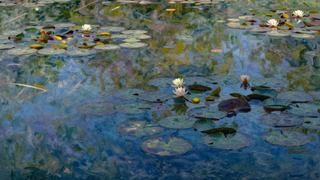
A green wooden bridge arcs over still water. Beneath it, lily pads drift in loose constellations, pale pink and white against a surface so reflective it seems to hold two skies. Willows drape from the banks like curtains half-drawn. Everything is soft, saturated, trembling at the edge of focus, as though the scene might dissolve if you looked too hard. This is the world Claude Monet painted in 1899, in 『The Japanese Bridge』, one of several canvases devoted to a small arched footbridge in his garden at Giverny. But what strikes the eye first is not the beauty alone. It is the collision hiding inside the calm. Here is a bridge designed in the Japanese tradition, planted in the French countryside, surrounded by European water lilies and weeping willows, yet framed with the sensibility of ukiyo-e woodblock prints. East and West occupy the same canvas, and neither dominates. The tension is quiet, almost invisible. You have to know what you are looking at to feel it pull.
And yet the tension is everywhere. A bridge, by its very nature, exists because of separation. It spans a gap. It admits that two sides are apart. This one connects two banks of a narrow pond, a crossing so short that it barely qualifies as a journey. Still, Monet returned to it obsessively, painting the same bridge in morning light and afternoon haze, across seasons and years, as though trying to capture a single moment of unity that kept slipping away. The bridge held something for him that went beyond landscape. It was a threshold between the designed and the wild, between the imported and the indigenous, between what the eye sees and what the mind completes.
We live with these kinds of tensions every day, though we rarely stop to name them. The pull between discipline and spontaneity. The negotiation between the life we build deliberately and the life that simply happens to us. Monet’s garden was not an accident. He diverted a tributary of the River Epte, hired gardeners, imported plants, and fought with local authorities who feared his exotic species would poison the water. The paradise on the canvas was the product of years of labor, bureaucratic battles, and stubborn vision. And then, having constructed it all, he stood before his easel and tried to paint it as though it had always existed, as though nature herself had dreamed it into being.
Where the Cultivated Meets the Wild
Look closely at the painting, and you begin to see how Monet orchestrates this paradox. The bridge itself is the most architectural element in the frame, the most human. Its curved railing and green paint declare intention, craft, geometry. Below it, the pond resists all geometry. The water moves in no straight lines. Reflections warp and blend. The lilies float where they please. The vertical strokes of the willows mingle with the horizontal drift of the surface, creating a weave of color that obeys no blueprint.
This is not a painting about nature. It is a painting about the conversation between human will and the world’s refusal to be fully tamed. We know this conversation well. Think of that moment when you plant a garden in early spring, placing seeds in careful rows, and then watch over the coming weeks as the garden becomes its own thing, shoots veering sideways, volunteer plants appearing uninvited, the rain doing what the rain wants. The rows blur. Something better than your plan begins to emerge, or something worse, but always something unplanned. The beauty of a mature garden is never the beauty of the original sketch.
Monet understood this deeply. His Impressionist method was itself a negotiation between control and release. Each brushstroke was deliberate, placed with a lifetime of technical mastery, and yet the cumulative effect is one of dissolution, of forms melting into atmosphere. He painted not objects but the light bouncing off objects, not the bridge but the idea of the bridge as it existed for a single unrepeatable instant. The technique demands precision in service of imprecision. It is the most disciplined way of being free.
And the cultural dimension of this bridge adds another layer. By the late 19th century, Japanese art had flooded into Europe, igniting a fascination that reshaped painting, design, and decorative arts. Monet collected Japanese prints. He admired their flat planes of color, their asymmetry, their willingness to leave space empty. When he built a Japanese-style bridge in his French garden, he was not simply decorating. He was grafting one aesthetic tradition onto another, testing whether two very different ways of seeing the world could share a root system.
The bridge does not erase the distance between two shores; it makes the distance beautiful enough to cross.This is what the best acts of cultural exchange accomplish. Not the flattening of difference, but the honoring of it. The bridge at Giverny does not pretend to be in Kyoto. It stands among irises and willows that belong to northern France, under a sky unmistakably Atlantic. Yet its curve carries a memory of other skies, other gardens, other philosophies of beauty. The painting holds both without asking us to choose.
Bridges We Build Across Centuries
 Photo by
 The impulse to create harmony from disparate elements is ancient and recurring. Persian gardens combined geometry with flowing water, imposing mathematical order on the chaos of growth. Chinese scholars’ gardens placed craggy stones beside smooth pools, embracing roughness and refinement in the same breath. The English landscape garden of the 18th century tried to erase every visible sign of human interference, engineering wildness with meticulous care. Each tradition grappled with the same question Monet’s bridge poses silently: how much of paradise do we build, and how much do we allow?
We grapple with this in our own lives, far from any garden. Consider how we arrange a home, the shelves organized just so, the couch placed to catch the afternoon light, and then the daily entropy of living undoes the arrangement. Shoes pile by the door. Books migrate to unexpected surfaces. A child’s drawing gets taped to the refrigerator, breaking the careful aesthetic, and somehow making the kitchen more alive. The homes we love most are the ones where intention and accident have reached a truce.
Or consider the way we navigate relationships. We enter them with plans, expectations, mental blueprints for how love should unfold. Then the other person arrives with their own weather, their own tides, and the blueprint floods. The couples who endure are rarely the ones who force the plan. They are the ones who learn to build bridges flexible enough to sway.
Monet painted The Japanese Bridge more than a dozen times over the years. The later versions grew darker, more abstract, the forms nearly lost in thickets of pigment as his eyesight deteriorated. What began as a luminous, almost photographic rendering of a specific place became something closer to pure emotion, the memory of a bridge rather than the bridge itself. Time did to his paintings what time does to everything: it stripped away the details and left the feeling. The early versions say, “Look at this beautiful place.” The late versions say, “Remember what beauty felt like.”
This progression mirrors something we all experience. The places and people we love become, over time, less about their precise features and more about the quality of light they cast inside us. A childhood home shrinks when revisited, its rooms smaller than memory made them, its colors less vivid. But the sense of safety it gave us, that warmth survives long after the wallpaper fades.
 Photo by
 Returning to the Water
 Photo by
 So we come back to the bridge, and the still water beneath it. The contrast that seemed so quiet at first, East and West, control and wildness, architecture and nature, turns out to be the very engine of the painting’s peace. Without the bridge, the pond would be merely pretty. Without the pond, the bridge would be merely functional. Together, they create something neither could alone: a place where the eye rests because it senses that opposing forces have found their balance.
We spend much of our lives trying to resolve our contradictions, to be one thing or another, disciplined or free, rooted or wandering, faithful to tradition or hungry for the new. Monet’s painting suggests another possibility. The contradictions do not need resolving. They need a bridge.
Not a bridge that collapses the distance, but one that lets us walk back and forth, that makes the crossing itself a kind of home. The garden at Giverny still exists. Visitors walk across the same bridge, or its careful reconstruction, and look down at the same water. The lilies still drift. The willows still lean. And the light still falls in that particular way that made a painter stand in one spot for decades, trying to hold the unholdable. We go to such places not to escape our divided lives, but to remember that division, handled with enough patience and care, becomes design.
The most peaceful places we will ever know are not the ones where tension has been eliminated. They are the ones where tension has been given a shape, a color, a bridge to cross, and the freedom to remain.