
Someone drew a line between aspiration and infiltration. The question worth sitting with is not whether that line exists, but who had the authority to draw it, and whether the rest of us ever agreed to its terms.
This is not a question about morality. It is a question about architecture. About the literal and figurative structures we move through every day without noticing how they tilt the ground beneath our feet. In 2019, Bong Joon-ho released 『Parasite』, a film that earned four Academy Awards and became the first non-English language picture to win Best Picture. The world celebrated the achievement as a barrier broken, a ceiling shattered. But the film itself is about something more unsettling than barriers. It is about the ones we cannot see, the ones built into the slope of a street or the depth of a basement, the ones that smell like something we can’t quite name.
The question Parasite poses is not “why do the poor suffer?” That’s too easy, too comfortable. The question is closer to this: if you found a door that led into someone else’s life, one with warm light and clean surfaces and the particular silence that only money can buy, how far would you walk through it before you stopped recognizing yourself?
We like to imagine we know the answer. We don’t.
The Rain Falls Differently Here
The story begins with the Kim family, four people living in a semi-basement apartment in Seoul. Their windows sit at street level, which means they watch the legs of passersby and receive the runoff of the city when it rains. They fold pizza boxes for a living and steal Wi-Fi from the coffee shop upstairs. They are not desperate in the cinematic sense. They laugh, they scheme, they love each other with a scrappy loyalty that feels more real than anything the wealthy Park family, living high on a hill in a modernist mansion, will display over the course of the film.
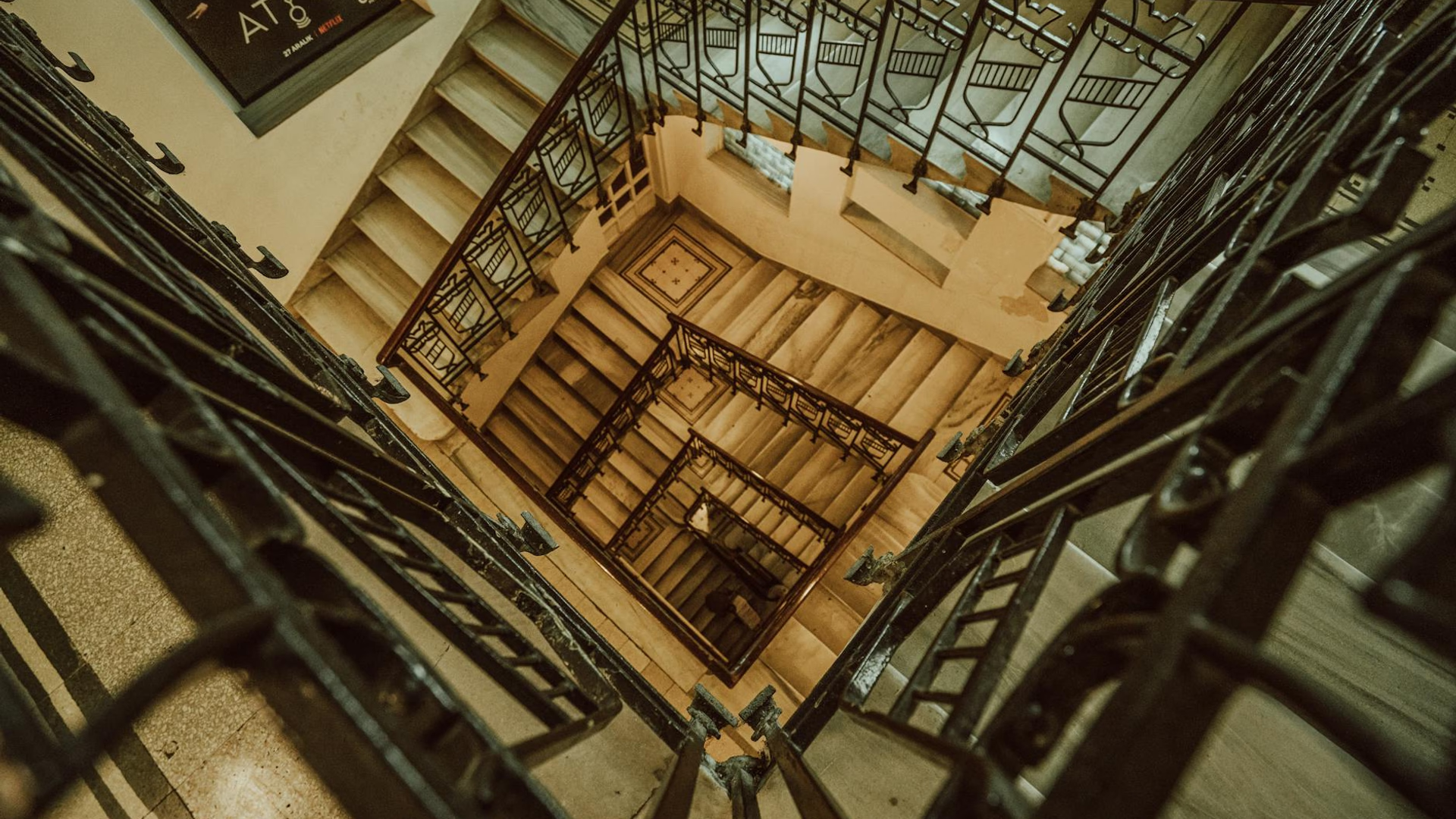
Bong Joon-ho built his story around stairs. The Kims climb. The Parks descend, but only ever to their manicured lawn. The geography of the film is the argument. Every scene draws the eye up or down, measuring the vertical distance between two families who share a city but inhabit different planets.
Through a chain of deceptions, each member of the Kim family infiltrates the Park household. The son becomes an English tutor. The daughter becomes an art therapist. The father becomes a chauffeur. The mother becomes a housekeeper. Each role is performed with skill and conviction, because here is the uncomfortable truth the film holds up to the light: the Kims are good at these jobs. They are competent, intelligent, resourceful. The system that placed them in a semi-basement did not do so because they lacked talent. It did so because systems rarely care about talent.
Bong spent years developing the screenplay, sketching the architectural plans of the Park house himself, designing each room so that the camera could track movement between levels the way a seismograph tracks tremors. He wanted the house to function as a character, its clean lines and hidden corners revealing something about the people who built it and the people who served within it. The result is a film that feels less directed than engineered, every shot load-bearing.
And then there is the night it rains. A torrential downpour that the Parks, safe on their hill, experience as a pleasant backdrop to a night in the backyard. The Kims, fleeing the mansion, descend through the city in a sequence that follows the water downhill, through narrowing streets and overflowing gutters, until they reach their semi-basement, now flooded. They sleep in a gymnasium with hundreds of others. The next morning, Mrs. Park calls to plan an impromptu birthday party. She mentions how lovely the rain was, how it cleared the air. The same storm that washed one family’s world away gave another family a nice evening.
This is the scene people remember. Not because it is the most dramatic, but because it is the most honest.
What Rises, What Sinks
 Photo by
 Think of your own commute, or your walk through a neighborhood that isn’t yours. There is a moment, subtle and almost physical, when the texture of things changes. The sidewalks get wider or narrower. The trees are older or younger or missing entirely. The sounds shift. You have crossed an invisible boundary, and your body registers it before your mind does.
We all live in stratified spaces. The genius of Parasite is that it makes the stratification literal, turning economic reality into something you can see and feel and, in one of the film’s most devastating details, smell. Mr. Park wrinkles his nose at his driver. Later, in a moment of drunken honesty with his wife, he describes the smell as something that “crosses the line.” Not a moral judgment, he insists. Just a fact. Just a smell.
But smell is memory. Smell is identity. And when Mr. Kim overhears this assessment of his existence, something breaks in him that the film never repairs.
We recognize this. Not necessarily from wealth and poverty, though many of us know those coordinates well. We recognize it from every moment we have been weighed by something we could not control: an accent, a postal code, the wrong shoes, the particular weariness that clings to people who work too hard for too little. We recognize it from every time we adjusted ourselves, smoothed an edge, performed a version of ourselves designed to pass through someone else’s gate.
The Kims are called parasites. But the film complicates this label until it dissolves. The Parks depend on others to drive them, teach their children, cook their food, manage their home. They live in a kind of luxurious helplessness. Who feeds on whom? The answer, Bong suggests, is less interesting than the question of who built the host-parasite framework in the first place and declared it natural.
 Photo by
 A Door You Walk Past Tomorrow
 Photo by
 Parasite does not end with resolution. It ends with a letter, written by a son to a father trapped underground, promising that he will one day earn enough money to buy the house above and free him. The camera pulls back to reveal the son, still in the semi-basement, writing by dim light. The dream is the only warm thing in the frame.
Bong Joon-ho has said that the film is not about good and evil. It is about the way capitalism organizes people into arrangements that feel inevitable, even though someone designed them. The stairs are not natural formations. Someone poured the concrete. Someone decided who would climb and who would descend.
This is not a call to revolution, and I am not delivering one. But the film leaves behind a small, persistent disturbance, like a pebble in a shoe. It asks us to notice the architecture. Not the grand, abstract “systems” we invoke in political arguments, but the actual, physical shapes of the spaces we move through. The height of a window. The width of a hallway. Who enters through the front door, and who enters through the side.
The next time you walk up or down a flight of stairs, in a building you know well, you might pause for half a second. Not to feel guilty, and not to feel righteous. Just to notice the grade of the ground. To register how differently the rain falls depending on where you stand. That half-second of noticing is small and probably useless. But it is the beginning of seeing, and seeing is the one thing the film insists we owe each other, even when what we see makes us flinch.