The Question No One Wants to Ask First
Who will say your name when you are gone?
Not your full legal name, the one on documents and databases. The name someone uses when they call you to the table for dinner, or whisper it half-asleep, or shout it across a crowded room because they spotted you and felt a small, involuntary joy. That name. The one that lives in the mouths of people who love you. When the last person who carries that name in their memory also dies, what happens to you then?
This is the question that sits at the center of 『Coco』, the 2017 animated film directed by Lee Unkrich and co-directed by Adrian Molina. On its surface, the film follows twelve-year-old Miguel, a boy in a small Mexican town who dreams of becoming a musician despite his family’s generations-old ban on music. But beneath the marigold petals and the luminous skeleton faces and the soaring guitar melodies, the film is asking us something raw, something we tend to avoid at dinner parties and in our daily routines. It is asking: what does it cost to be forgotten? And what does it take to remember?
The question lands differently depending on where you are in life. If you are young, it might feel abstract, almost philosophical. If you have recently lost someone, it can feel like a hand pressed against a bruise. And if you are somewhere in the middle of your years, old enough to have lost people but young enough to still be building your own story, it hovers. It stays. It refuses to become background noise.
A Bridge Built from Marigolds and Music
 Photo by
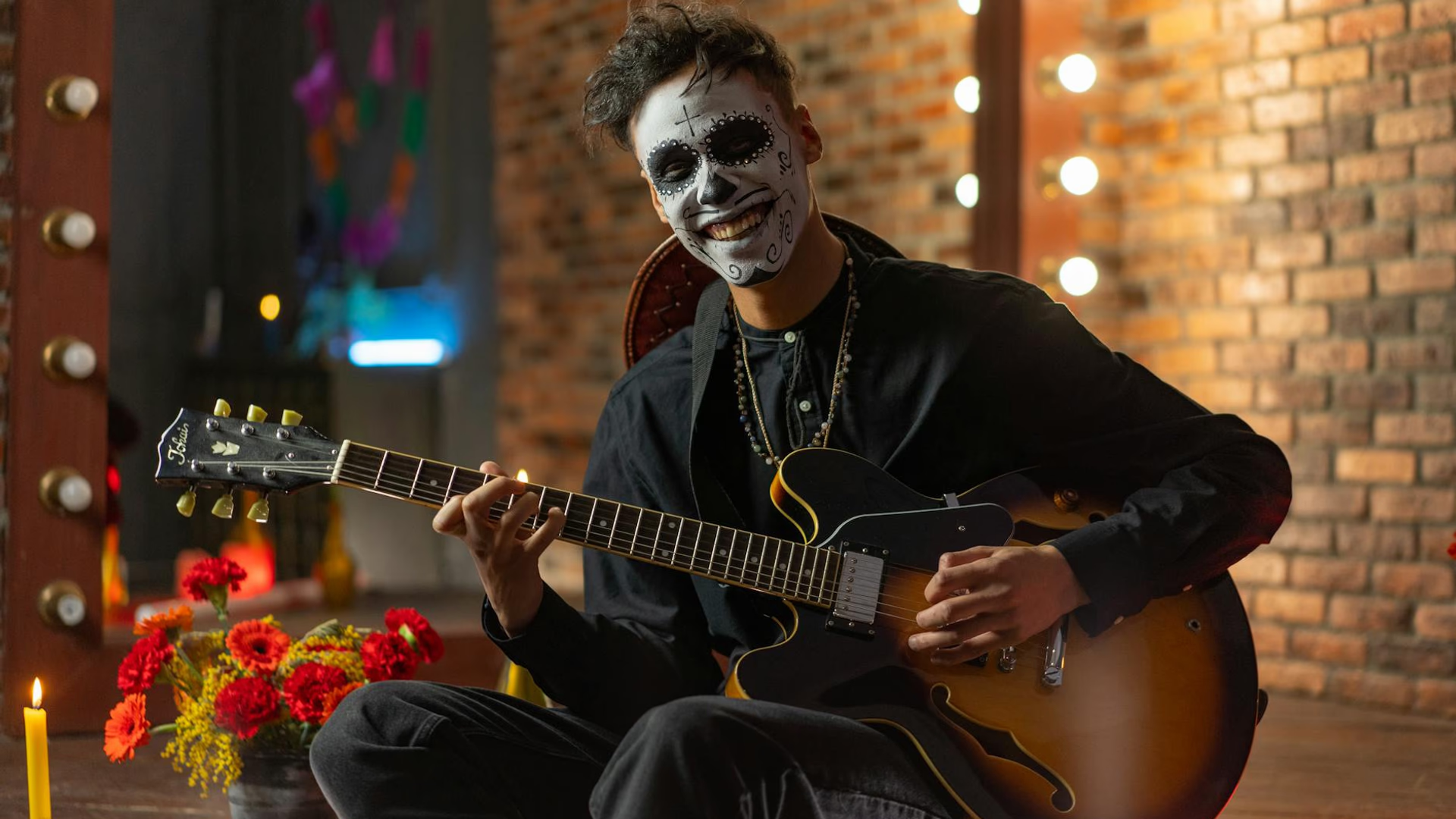
 Pixar spent nearly six years making Coco. The filmmakers traveled repeatedly to Mexico, visiting family homes, workshops, cemeteries, and celebrations during Día de los Muertos, the Day of the Dead. They spoke with families. They ate at their tables. They watched grandmothers arrange ofrendas, the altars piled with photographs and candles and bread and the favorite foods of the deceased. What the filmmakers found was not a culture fixated on death but one deeply, almost stubbornly committed to the idea that love does not stop at the grave.
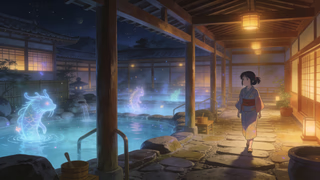
The film takes this commitment literally. When Miguel accidentally crosses into the Land of the Dead, he discovers a world where the departed continue to exist as long as someone in the living world remembers them. Photographs on the ofrenda are not mere decoration. They are lifelines. Remove a photo, and the dead person cannot cross back to visit during the holiday. Let the last living person who remembers them die, and they experience what the film calls “the final death,” a dissolution into nothingness.
This mythology is invented, but it carries the weight of something deeply felt. Every culture on earth has its own way of negotiating the boundary between the living and the dead. The Japanese celebrate Obon, lighting lanterns to guide ancestors home. Koreans perform Chuseok ancestral rites. In many West African traditions, the ancestors are understood to be present, consulted, honored. What Coco captures is not a single culture’s practice but the universal ache behind all of them: we do not want the people we love to disappear.
At the heart of the story is the character who gives the film its name, not the ambitious young Miguel, but his great-grandmother, Mamá Coco. She is ancient, wheelchair-bound, fading. She barely speaks. Her family moves around her with love but also with a kind of gentle resignation. She is slipping away. And yet she holds the key to everything, because she is the last living person who remembers her father, Héctor, the musician who left home and never came back. Her memory is the thread by which an entire truth hangs.
The film’s climax is not a battle or a chase. It is a boy sitting with his great-grandmother, singing her a song she heard as a child, watching her eyes light up with recognition. She remembers. She calls him Papá. And in that moment, Héctor is saved from the final death, and a family’s broken story begins to heal.
There is something almost unbearably tender about this. The filmmakers understood that the most powerful thing they could put on screen was not spectacle but specificity: a very old woman, a very young boy, and a song that belongs to both of them.
What We Carry Without Knowing
 Photo by
 Think of the oldest person you have ever known well. A grandparent, maybe. A great-aunt. A neighbor who seemed to have been old forever. Think of the things they said, the habits they had, the foods they cooked. Now think about how many of those things you still carry. The way you fold a towel. A phrase you use without thinking. A melody you hum while washing dishes, not quite sure where you first heard it.
We are, all of us, composites of the people who came before us. Not just genetically, though that too. We carry gestures, preferences, superstitions, recipes, silences. We carry the shape of someone’s laugh in our own. We carry fears we did not choose and strengths we did not earn. The inheritance is invisible until someone points it out, and then it becomes so obvious we wonder how we missed it.
Coco knows this. The film’s most radical argument is not that we should remember the dead for their sake, though that matters. It is that we need to remember them for our own sake. Miguel’s family banned music because of a wound they didn’t fully understand. They passed down the prohibition without passing down the story. They remembered the pain but forgot its origin. And so the wound kept shaping them, generation after generation, like a river carving a canyon in the dark.
The things we refuse to remember do not disappear; they simply lose their names and become the unnamed forces that govern our choices.How many families carry something like this? A rift no one can quite explain. A career path that was never an option, though no one says why. A relative whose photograph has been turned face-down, or removed from the wall entirely. We inherit these silences along with the silverware. And sometimes it takes a child’s stubbornness, a child’s refusal to accept “because that’s how it’s always been,” to crack the silence open and let air in.
The film suggests that following your passion is not a selfish act. Miguel’s desire to play music is not a rebellion against his family. It is, in the deepest sense, a return to his family, a recovery of something they lost. His dream and his heritage turn out to be the same thing. This is a quietly revolutionary idea: that honoring who you are and honoring where you come from are not opposing forces.
The Altar We Build Every Day
 Photo by
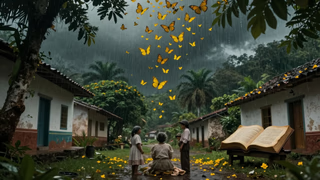
 We do not need marigold petals or candles or a holiday on the calendar to practice remembrance. We do it constantly, in small unconscious ways. Every time you cook a meal the way someone taught you, you are placing a photograph on the ofrenda. Every time you tell a story about someone who is gone, laughing at the punchline they would have delivered better, you are lighting a candle. Every time you pass along a piece of advice you received years ago, crediting it to the person who gave it, you are keeping someone alive in the only way that matters after the body is gone.
But Coco also asks us to be more intentional. To ask the questions before it is too late. To sit with the elderly relative and say, “Tell me about when you were young.” To write things down. To keep the photographs where they can be seen. Not out of obligation or duty, but because these acts of remembrance complete us. They fill in the parts of our story we cannot access alone.
The film ends with a new ofrenda in the Rivera household, one that includes Héctor’s photograph, restored to its rightful place. The family is whole again. Not because the pain never happened, but because the truth has been recovered. The story is complete. And Mamá Coco, whose fading memory held the entire narrative together, is now among the remembered dead herself, smiling in the Land of the Dead, surrounded by the people she loved.
Somewhere tonight, in a house you might walk past without noticing, a very old woman is humming a song she learned from her father. A child is listening, not because anyone told them to, but because the melody is beautiful and strange and feels, somehow, like it belongs to them. No marigold bridge connects the living and the dead. But that song does. It crosses the border without a passport, carrying a name, keeping it warm, holding it steady in the air a little longer.