
You are parked in the driveway. The engine is off. The house is lit from inside, and through the window you can see the ordinary shapes of your life - a lamp, a doorframe, someone moving past. But you have not yet turned the key. Not yet. Because there is something that needs one more turn, one more slow rotation in the dark before you carry it through the door.
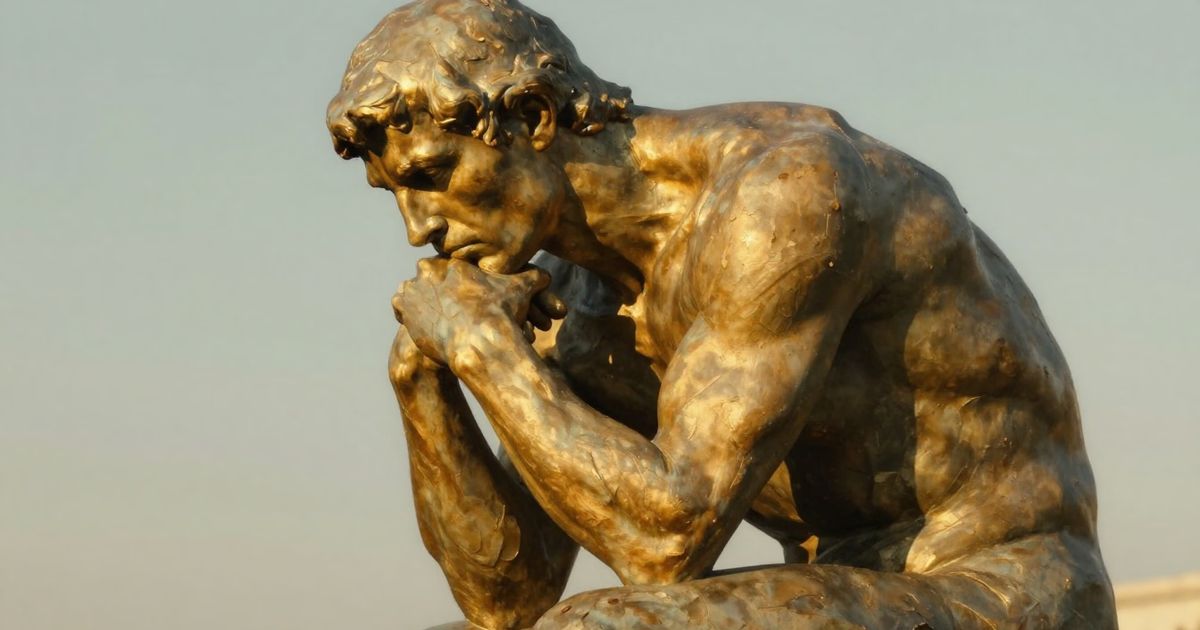
This is the posture Rodin caught in bronze, and held forever.
The figure sits on a rough stone pedestal, right elbow driven into the left knee, chin pressing down into the back of the hand so hard you can almost feel the knuckles go white. The torso curls forward like a question mark. The toes grip the edge of the base as though the ground itself might give way. His back is not relaxed. It is a landscape of locked effort, the muscles along the spine bunched and knotted, the broad shoulders rounding inward as if the man is folding himself around something that burns. He has the body of someone who could break stone, and he is using all of it simply to stay with what he cannot yet resolve.
The surface of the bronze is rough, almost agitated - Rodin never smoothed it to a polish. Light catches unevenly. The eyes are hidden, turned downward into shadow. You cannot meet his gaze. Whatever he is looking at, it is not you. It is the thing inside him that has no name yet, no shape, no answer. Just weight.
We have been taught to distrust this posture. To read it as stalling, as weakness, as a problem in need of fixing. We are supposed to decide, act, move. The culture around us worships the moment after this one - the breakthrough, the clarity, the confident stride through the door. But Rodin had the strangeness to call this moment heroic. He cast it in bronze six feet tall and placed it in public squares, as if to say: the world should see this. The world should stop.
Real thought is not efficient. It is heavy, physical, and slow, and it bends the body around itself like gravity bends light.The thinking you cannot skip, the kind that costs you sleep and posture and appetite, is not a detour from your life. It is some of the most alive you will ever be. Sitting alone with a question too large to rush, refusing the premature answer, staying in the driveway one minute longer because something in you is still working - that is not paralysis. That is the labor the sculpture is honoring.
You will go inside. You always do. But the body will remember this hour, the particular weight of it, long after the decision has been made and the consequences have settled into ordinary days. Something in the shoulders carries what the mind has labored over.
The bronze figure will never stand. That is the gift it gives us. It holds the struggle still, so we can recognize ourselves in it, and rest there a moment, before we rise.