
The Moment
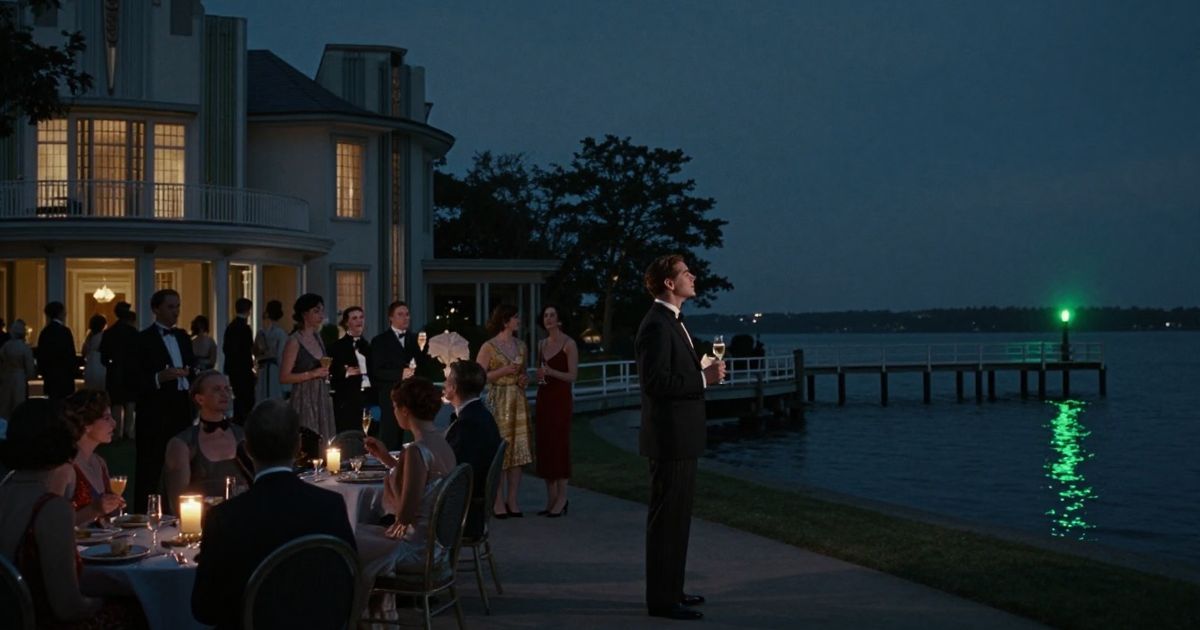
There is a man standing alone on his lawn at midnight, arm stretched across the darkness toward something he cannot touch. The grass beneath his feet is perfect, manicured by hands he has hired. The mansion behind him glows with chandeliers and imported marble, every room a carefully constructed sentence in a story he is telling to no one in particular. But he is not looking at any of this. He is looking across the black water at a single green light, small as a firefly, pulsing at the end of a distant dock.
This is Jay Gatsby in the only posture that matters: reaching. Everything else, the parties thrown for strangers who will never know his real name, the silk shirts in colors that have no names, the library filled with books whose pages have never been cut, all of it exists only to justify this moment. The reaching. The distance between his outstretched hand and that small green promise across the bay.
The light is green, the color of spring things not yet arrived, of money, of envy, of go. It belongs to Daisy Buchanan, the woman he loved five years ago, before the war, before the money, before he became Gatsby at all. He believes, with a faith that has no rational foundation, that if he accumulates enough, performs enough, builds a grand enough illusion, he can close that distance. He can unmake the years between them. He can return to the moment before she made choices that did not include him and live there forever.
The water does not care about his belief. It remains, black and patient, an ocean of time he cannot cross no matter how bright his mansion glows.
The Reflection
We all have our green lights. Those fixed points across our own dark waters that organize our longing, that give shape to the shapeless ache of being human and finite and always reaching toward something just beyond our grasp. The promotion that would finally prove our worth. The person who got away. The version of ourselves we imagined at twenty that has not quite materialized at forty.
The distance is not an obstacle to be overcome - the distance is the thing itself. Take it away, and what remains? Gatsby finally gets his reunion with Daisy, finally brings her to his mansion, and something dies in that moment. The light, seen up close, is just a light. The dream requires the water between.
This is not a counsel to stop reaching. The reaching matters. But perhaps Gatsby’s tragedy teaches us to hold our longings more lightly, to understand that the light across the water is not a destination but a direction. That what we are really reaching for is not any particular person or achievement, but the human capacity for hope itself.
Somewhere tonight, someone is standing at the edge of their own private pier, looking across their own dark water at their own patient light. And they are reaching. And perhaps that is enough.