
The Moment
I remember the first time I truly looked at someone and felt seen in return. Not the social seeing we perform daily, the acknowledgment of presence that smooths our passage through crowded spaces. This was different. I was young, sitting across from someone I barely knew, and for a moment the ordinary machinery of conversation stopped. We simply looked at each other. The world contracted to the space between us.
Nothing dramatic happened afterward. We talked, we parted, we went on with our separate lives. But that moment of mutual recognition stayed with me, a small stone I’ve carried in my pocket for years. It taught me that intimacy can happen in an instant, that two people can share something profound without exchanging a single word.
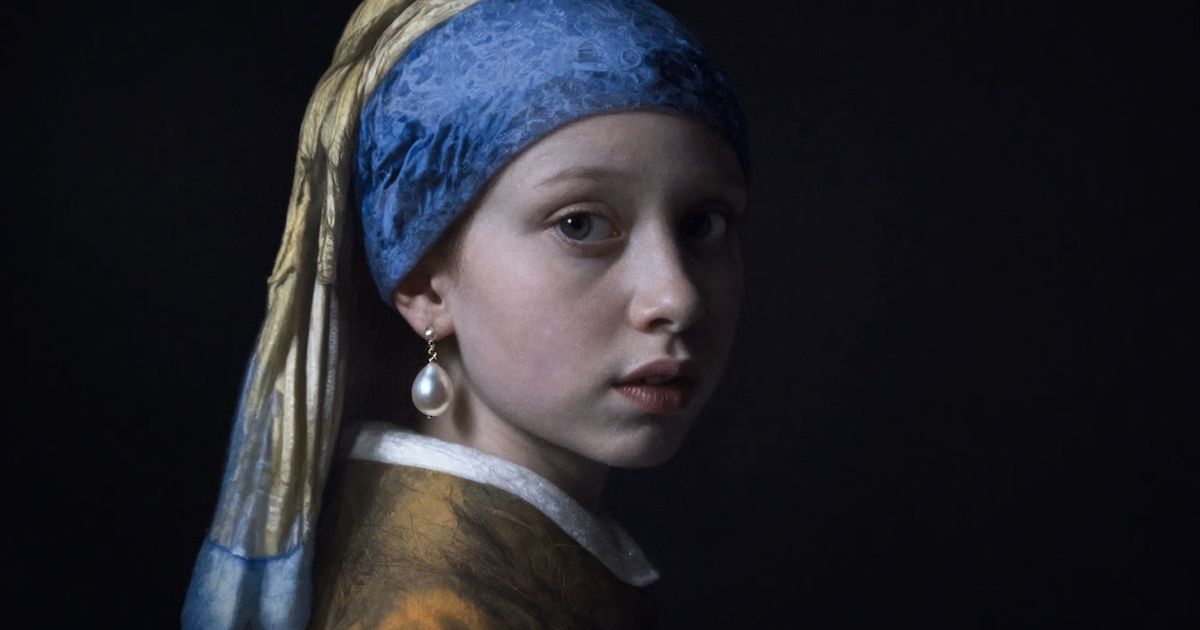
This is what Vermeer’s girl offers us across three and a half centuries. She turns toward us, lips slightly parted, that impossible pearl catching light from some unseen source. Her eyes hold a question we’ve been trying to answer since 1665. Not a stare, not a glance, but something more tender and more unsettling. She creates a private space, a room within the room where viewer and subject meet. She gives us her attention without condition or reservation, asking nothing except that we look back.
And looking back, we bring ourselves to that meeting. Whatever we’ve lost, whatever we’re seeking, whatever we hope to find in another person’s eyes, we carry it with us when we look at her.
The Reflection
We live in an age of constant visual noise. Faces scroll past us by the hundreds each day on screens we carry in our pockets. We see without seeing, look without witnessing. Yet occasionally, something stops us cold. A stranger’s expression across a crowded room. A photograph that makes us pause mid-scroll. The face of someone we love caught in a moment of unguarded thought.
These encounters remind us what it feels like to be fully present with another being. They call us back to the rare moments when we set aside our own preoccupations and simply witness another person’s existence. These are the encounters that mark us, that change the texture of our days.
Perhaps Vermeer’s painting is not asking us anything after all. Perhaps it is offering something instead: permission to dwell in uncertainty, to embrace the not-knowing that lies at the heart of every genuine encounter. The girl looks back at us, and her gaze remains open, patient, waiting.
What do we find there?
Only what we bring. Only what we’re willing to see.