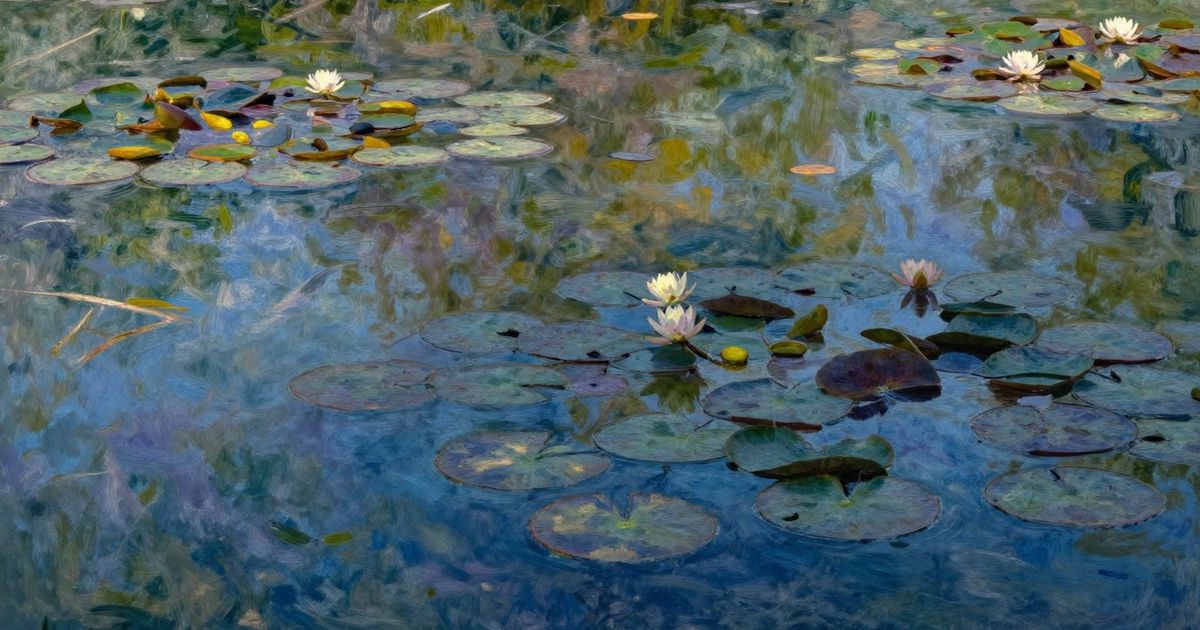

He is an old man standing at the edge of his own pond, and he can no longer see it clearly. The cataracts have done their slow work. The sharp contours he once chased across the water’s surface - the precise curl of a petal, the clean edge where reflection meets sky - have softened into something he cannot quite name. His brushes are in his hands anyway. They are always in his hands.
It is an afternoon in Giverny, and the light is doing what light does in the late hours: collapsing. The clouds have shifted. The lilies float in a surface that is no longer water exactly, but not sky exactly either. Something in between. Something that refuses to be catalogued. Monet lifts his brush and does not paint what he sees. He paints what it feels like to stand here, breathing, with the world trembling just beyond the reach of certainty.
This is the image I keep returning to. Not the young painter chasing impressions with a sharp and hungry eye, but the older one, vision blurred, still showing up to the same pond he has sat beside for decades. Still finding it changed. Still finding it enough. The enormous canvases from these years do not describe the water. They become it. Stand before one and your peripheral vision disappears. There is no horizon to anchor you, no solid ground beneath the frame. There is only color dissolving into color, light folding into its own reflection, the suggestion of depth without the demand that you measure it.
We are taught to see loss in diminishment. Fading sight, softening certainty, the blurring of edges we once held crisp - these feel like failures of a life lived precisely. But Monet kept returning to his pond after the cataracts came, and what he made there was not lesser work. It was a different country entirely.
Perhaps what we call confusion is sometimes just the world being more honest with us than we are ready to accept.There are seasons when we need the sharp eye, when drawing clean lines keeps us upright. But there are other seasons - grief, love, the long middle passages of becoming - when the truest thing we can do is stop insisting on edges. To sit with the blur. To let the lily pad and its reflection and the sky above it all run together into something that cannot be separated without being destroyed.
Monet did not move on from his pond. He moved deeper in. And what waited there, past the need for precision, was not confusion but a different kind of seeing - one that holds more, asks less, and leaves room for the world to be exactly as fleeting and whole as it actually is.