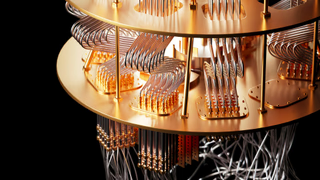


Quantum computers were supposed to replace classical machines. They haven’t. The teams actually shipping quantum workloads in 2025 have stopped pretending they will anytime soon. The real story is messier and more interesting: hybrid quantum-classical systems are doing the heavy lifting, and they’re starting to post numbers worth paying attention to.
This pivot matters now because funding cycles and engineering reality have finally synced up. Governments are writing checks for fault-tolerant quantum that won’t arrive until the 2030s. Meanwhile, researchers and enterprises are quietly deploying hybrid pilots on noisy, intermediate-scale hardware available today. IBM frames the last decade of cloud quantum access as the moment the field became a “growing, real-world industry,” and the workloads driving that growth are almost entirely hybrid [IBM].
What Hybrid Actually Means
A hybrid quantum system isn’t a single machine.
 Photo by
 It’s a pipeline. A classical CPU or GPU handles control flow, parameter optimization, and error mitigation. A QPU, or quantum processing unit, the chip that actually runs quantum calculations, executes the narrow subroutines where quantum mechanics offers an edge. Current QPUs top out around 1,000 physical qubits with significant error rates, so offloading everything else to classical silicon isn’t a compromise. It’s the architecture.
Three patterns dominate production work:
-
Variational algorithms such as VQE, short for Variational Quantum Eigensolver, a method that finds the lowest-energy state of a molecule, and QAOA, the Quantum Approximate Optimization Algorithm used for combinatorial problems, where a classical optimizer iteratively tunes a parameterized quantum circuit
-
Quantum-classical feedback loops for sampling and simulation
-
Quantum-accelerated ML pipelines that embed a QPU call inside an otherwise classical training loop
As one industry analysis puts it bluntly:
“Quantum vs classical computing is best understood as specialized acceleration vs general-purpose dominance.” [Blockchain]
That framing, quantum as accelerator rather than replacement, is how the hybrid camp has won the architectural argument.
The Plumbing: Middleware and Latency
Hybrid is viable in 2025 in ways it wasn’t in 2020 largely because of middleware, the software layer that coordinates communication between classical and quantum hardware.
 Photo by
 Platforms like Qiskit Runtime, Amazon Braket Hybrid Jobs, and PennyLane collapse the round-trip between classical optimizer and QPU from seconds to milliseconds. That latency reduction is what makes variational algorithms converge before decoherence, the tendency of quantum states to collapse due to environmental interference, eats the signal.
Compiler-level co-design matters too. Modern stacks dynamically remap circuits to a specific QPU’s topology and noise profile. Error mitigation techniques like Zero-Noise Extrapolation, which estimates what a circuit’s output would be with zero noise by running it at multiple noise levels, now ship as default options rather than research curiosities. The marketing pitch is “quantum advantage.” The reality is closer to: the classical layer got good enough at managing the quantum layer that useful work fits inside the coherence window.
Benchmarks Worth Believing
Honest benchmarking in this space is hard.
 Photo by
 Quantum Volume, the most-cited system-level metric, only validates that a device can run square circuits of a given size above a two-thirds heavy-output threshold. It says nothing about whether your workload runs faster [Quantum Volume]. So the useful question isn’t “is quantum winning?” It’s “where, specifically, is hybrid beating a tuned classical baseline?”
The near-term answer keeps landing in the same two buckets: chemistry simulation and combinatorial optimization. Hybrid VQE has hit chemical accuracy on small molecules with materially fewer resources than brute-force classical methods. QAOA variants are competitive on certain portfolio and routing problems. A hybrid quantum neural architecture search paper on arXiv notes that results are “highly sensitive” to encoding strategy, qubit count, and circuit depth [arXiv], which is a polite way of saying your mileage will vary, a lot.
Who’s Actually Deploying This
Industrial pilots have moved past press-release theater.
 Photo by
 Quantinuum and BMW Group expanded their hybrid collaboration into a multi-year partnership in 2025, targeting materials, chemistry, and optimization workflows tied to real manufacturing problems [Quantinuum]. On the volume side, Boson Quantum reports delivering more than 100 real-world hybrid application cases across 20-plus industries [Boson Quantum].
The sectors leading adoption share a profile: high-value optimization or simulation problems where even a modest speedup pays for the pilot.
-
Finance: derivatives pricing, portfolio risk, Monte Carlo replacement
-
Pharma and materials: molecular simulation, catalyst design
-
Logistics and manufacturing: routing, scheduling, supply chain
None of these workloads need fault-tolerant quantum to justify the budget line. They need a measurable edge on a problem that’s already expensive to solve classically.
Strategic Implications
Cloud providers are positioning quantum the way they positioned GPUs a decade ago: a premium accelerator tier behind a managed API. AWS, Azure, and IBM Cloud all offer hybrid job orchestration as a standard service, which means enterprise procurement teams can buy quantum capacity without standing up a cryogenics lab.
The talent gap is the binding constraint. Quantum-aware software engineers, people who can write a circuit, profile it, and integrate it into a classical pipeline, are scarce. The skill stack covers linear algebra, classical optimization, hardware noise modeling, and a framework like Qiskit or PennyLane. It doesn’t map neatly onto existing computer science curricula. Organizations building this competency now are accumulating algorithmic IP that compounds as hardware improves.
What Comes Next
Software standardization is quietly happening underneath the hype. OpenQASM 3.0 and Microsoft’s Quantum Intermediate Representation, or QIR, a cross-platform format that lets quantum code run on different hardware backends, are emerging as execution standards. QIR is now supported across multiple hardware vendors. That portability matters: hybrid code written in 2025 has a plausible path forward as qubit counts scale and error correction comes online later this decade.
The likely trajectory isn’t a clean handoff from hybrid-NISQ, meaning Noisy Intermediate-Scale Quantum hardware, to pure fault-tolerant quantum. It’s hybrid all the way down, just with progressively more capable QPUs sitting behind the same classical orchestration layer.The quantum revolution isn’t arriving in a single benchmark-shattering moment. It’s being deployed incrementally, one hybrid workload at a time, by teams who treat the QPU as a specialized accelerator rather than a magic box. For anyone evaluating where this technology fits, it’s worth benchmarking an end-to-end hybrid workflow against a well-tuned classical baseline on a problem you actually care about. The frameworks are free, the cloud access is metered, and the window for building real expertise is narrower than the roadmaps suggest.
Sources
- Quantinuum and BMW Group expand hybrid quantum-classical partnership
- Boson Quantum reports 100+ real-world quantum application cases
- Blockchain Council on quantum vs classical performance benchmarks
- Quantum Volume benchmark definition
- IBM reflects on a decade of cloud quantum access
- Hybrid Quantum-Classical Neural Architecture Search framework