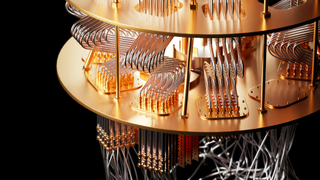


Hybrid quantum systems are doing real work today by pairing classical CPUs with quantum processors rather than replacing them. Chemistry simulation and combinatorial optimization show the clearest near-term advantages. The biggest bottleneck is not hardware but talent: engineers who can write quantum circuits and integrate them into classical pipelines are scarce.
What Hybrid Actually Means
A hybrid quantum system is a pipeline, not a single machine. A classical CPU or GPU handles control flow, parameter optimization, and error mitigation. A quantum processing unit executes the narrow subroutines where quantum mechanics offers an edge. Current QPUs top out around 1,000 physical qubits with significant error rates, so offloading everything else to classical silicon is not a compromise. It is the architecture.
The marketing pitch is “quantum advantage.” The reality is closer to: the classical layer got good enough at managing the quantum layer that useful work fits inside the coherence window.
Middleware platforms like Qiskit Runtime and Amazon Braket Hybrid Jobs have cut the round-trip between classical optimizer and QPU from seconds to milliseconds. That latency reduction is what makes variational algorithms converge before decoherence eats the signal.
Where Hybrid Is Winning
Honest benchmarking is hard, but the near-term wins keep landing in two areas: chemistry simulation and combinatorial optimization. Hybrid methods have hit chemical accuracy on small molecules with fewer resources than classical approaches. QAOA variants are competitive on portfolio and routing problems.
Results are highly sensitive to encoding strategy, qubit count, and circuit depth, which is a polite way of saying your mileage will vary, a lot.
Industrial pilots have moved past press-release theater. Finance, pharma, and logistics lead adoption because high-value optimization problems justify the pilot budget even without fault-tolerant hardware.