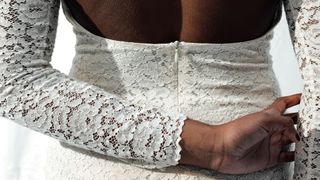
Nearly 40% of online fashion purchases get sent back [Rewarx], and 2025 became the year brands could no longer absorb that cost quietly. New regulations tightening around overproduction waste and sustainability reporting changed the calculus. Virtual try-on technology, rolling out at scale across 2025 and 2026, is turning the screen into a fitting room. The timing isn’t coincidental. It’s urgent.
The Return Crisis Nobody Could Ignore
For years, online fashion ran on a quiet agreement: shoppers would over-order, and brands would eat the logistics.
 Photo by
 The apparel return rate hit 24% globally in 2025, climbing to nearly 40% for online fashion purchases [Rewarx]. That’s not a minor inefficiency. It’s a systemic breakdown.
The root cause was never careless shoppers. It was a visualization gap. Flat product photography on standardized models gave no reliable sense of how a silhouette would sit on a real body. Proportions looked different. Textures felt wrong. The curated image on-screen rarely matched the garment that arrived at the door.
Serial returning, ordering several sizes to keep one, became normalized behavior. It strained supply chains and pushed sustainability goals further out of reach. Returns weren’t a people problem. They were a design-of-the-experience problem.
The Dressing Room Goes Digital
Augmented reality fitting tools changed the equation by letting shoppers see garments on their own bodies before clicking “buy.” Zalando SE introduced a virtual fitting room pilot as early as April 2023 [OpenPR], and by 2026, 42% of brands use augmented reality for virtual try-ons [Business].
 Photo by
 The technology works through several layered systems:
-
Computer vision maps body keypoints from a photo or camera feed, creating a skeletal model that anchors garment placement
-
Physics-based cloth simulation models how different fabric weights fall, stretch, and wrinkle against a specific body shape
-
AI size-recommendation engines analyze measurements and purchase history to predict the best-fit size
Together, these tools create something close to a physical fitting room experience. You can sense whether a flowy chiffon blouse will drape the way you want, or whether a structured cotton blazer hits your proportions right. Products with AR and 3D content see conversion rates up to 94% higher [Shopify], suggesting shoppers don’t just tolerate virtual try-on. They trust it.
A Confidence Shift for Every Body
Beyond the logistics savings, something more personal is happening.
 Photo by
 Virtual try-on is rebuilding the emotional relationship between shoppers and their wardrobes.
Shoppers using AI try-on have 38% lower return rates on average. For women’s dresses specifically, the reduction reaches 40%. Those numbers reflect more than better algorithms. They reflect buying confidence. When you can see a garment on your actual frame, the guesswork dissolves.
This shift matters most for shoppers historically underserved by standard sizing. Inclusive body-scanning tools allow people of all proportions to visualize garments accurately, reducing the anxiety that comes with shopping outside narrow size ranges. The effortless browsing experience that straight-size shoppers have long enjoyed is finally expanding, not through better marketing language, but through better technology.
For budget-conscious shoppers, fewer returns also mean fewer wasted shipping costs and less time spent in the return cycle. Whether you’re curating a capsule wardrobe on a tight budget or investing in statement pieces, seeing the real fit before purchasing protects every dollar.
What This Means for Fashion’s Future
Virtual try-on isn’t a novelty feature bolted onto checkout pages.
 Photo by
 It’s becoming foundational infrastructure for how fashion gets made and sold.
As the technology matures, it enables on-demand production models, where garments are manufactured only after a confident, confirmed purchase. Luxury brands are already pioneering digital-first showrooms where virtual try-on replaces physical samples during the design and wholesale process. The convergence with social commerce means shoppers may soon try, share, and purchase directly within platforms like TikTok and Instagram.
The sustainability implications are significant. Fewer returns mean less transportation waste, less packaging, and fewer garments ending up in landfill. For an industry under increasing regulatory pressure, virtual try-on aligns commercial incentives with environmental responsibility in a way few other innovations have managed.
Fashion’s return crisis was never about indecisive shoppers. It was about a broken visualization experience. Virtual try-on technology, powered by AR, AI, and cloth simulation, is closing that gap by restoring confidence at the moment of purchase. The result is less waste, more satisfaction, and a shopping experience that finally respects every body and every budget.