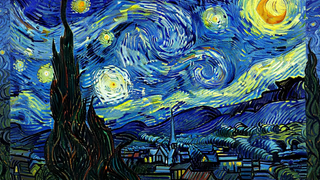


Most dreams carry emotional content, and most of that content shows up during REM sleep, the stage when the brain is nearly as active as it is while awake [NIH]. That undercuts the whole idea of dreams as secret messages waiting to be decoded. What the sleeping mind appears to be doing is closer to rehearsal than to concealment.
Ask anyone to describe last night’s dream and you get the same shape of answer: a house that was also a school, a person who was your brother but looked nothing like him, a room that changed while you stood in it. The plot never quite holds together. The emotional tone almost always does. You may forget who was chasing you. You rarely forget that you were afraid.
Waking From a Strange Dream
That lopsided memory, vivid feeling paired with a fuzzy plot, is the first real clue about what dreams are for.
 Photo by
 Feeling is the sturdy part of a dream, and the story is the improvisation built around it.
Our habit is to go hunting for the story anyway. Disjointed images feel uncomfortable, and a hidden meaning would tidy them up. But that discomfort doesn’t prove a code exists. It just proves waking logic doesn’t like loose ends.
The Myth of Hidden Messages
The idea of the dream as encrypted text has an impressive pedigree, which is part of why it survives.
 Photo by
 Freud’s model gave us a vocabulary that outlived the theory: manifest content on the surface, latent content buried underneath, and an analyst holding the key. From there it was a short walk to the paperback dream dictionary, where teeth mean anxiety about aging and water means the unconscious, for everyone, always.
That’s where the theory breaks down. A fixed symbol table only works if images mean the same thing across different people, different lives, different cultures. Dream researchers haven’t found that consistency. A review in the British Psychological Society’s magazine puts it plainly:
“The imagery of dreams is not a mysterious language that can only be decoded by an expert, but rather a metaphorical or direct representation of what concerns us emotionally in our waking life.” [The Psychologist]
In plain terms, a dream isn’t written in a foreign language. It’s written in yours, in the shorthand of whatever is currently pressing on you. Decades of research on dream content don’t support the idea that dreams disguise forbidden wishes behind symbols.
So why do the dictionaries still sell? Because they offer closure. A dream that means something specific is finished business. A dream that reflects a vague worry about your job is not.
Rehearsing Feelings, Not Symbols
Here’s the alternative picture: nobody is encoding anything.
 Photo by
 The sleeping brain is doing maintenance on emotional memory, and the dream is what that maintenance looks like from the inside.
The biology fits. During REM sleep, the brain’s emotional centers run hot while the prefrontal regions that enforce logic and continuity quiet down. You get intense feeling with no editor, which describes most dreams pretty well. People who report dreaming show greater processing of emotional memory, with negative memories getting priority over neutral ones. A separate study describes dreaming as active emotional processing, holding onto what matters emotionally while letting the trivia go [Nature].
The clearest evidence comes from fear. If dreams simply leaked distress, more frightening dreams should mean more frightened people. The opposite shows up instead. People whose dreams contain more fear show lower emotional arousal while awake, along with weaker brain responses to frightening images in the amygdala, insula, and midcingulate cortex, the brain regions that process threat [NIH]. Frightening dreams seem to work like graded exposure therapy, the kind where a nervous flier who talks through turbulence a hundred times finds the real thing smaller each time.
One proposed mechanism is a kind of overnight desensitization: negative events get replayed in the safety of sleep, where nothing can actually happen to you, and the emotional charge drops. Other research describes dreams pairing potential threats with harmless contexts, which loosens the link between the trigger and the alarm response [Frontiers]. Both descriptions point at rehearsal rather than translation.
Where Interpretation Still Helps
None of this makes reflection useless.
 Photo by
 It just changes the question worth asking.
The symbol approach asks what an object stood for. The emotional approach asks what the night felt like, then whether that feeling has an address in your waking life. Two questions, very different answers:
-
Symbol-first: “What does a missed flight mean?” Leads to a generic answer that could belong to anyone.
-
Feeling-first: “What was I feeling in that airport, and where else have I felt it this week?” Leads to something only you could answer.
The second question tends to land somewhere specific: the deadline you’ve been avoiding, the conversation you keep postponing. The dream didn’t hide that from you. It practiced it, using whatever set dressing happened to be lying around in memory.
Recurring dreams read differently under this lens too. A dream that returns for years is less likely a message you’ve failed to decrypt and more likely a rehearsal that hasn’t resolved, because the underlying feeling hasn’t resolved either.
Returning to the Morning After
That makes the morning after a source of information rather than a puzzle to solve. You’re not looking for what the airport represented. You’re noticing which emotion your mind spent the night practicing, and how much charge it still carries at breakfast.
Dreams reflect our waking emotional states and help process the ones with potential to disturb wellbeing [NIH]. The useful information is usually sitting right on the surface, in the feeling you woke up with, rather than buried under it.
It’s a humbler account of dreaming than the encrypted-message version, and arguably a more generous one. Nothing is being withheld from you, and something is being worked on while you’re unconscious and unable to interfere.
Next time your hand goes for the phone in the dark, the dream dictionary will still be there. It might be worth sitting with a simpler question instead: what did that feel like, and where have I felt it lately? The missed flight was never a symbol standing in for something else. It was your mind running a drill in the dread of being late and left behind, so the real version, when it shows up on some ordinary Tuesday, feels like something you’ve already met.
Sources
- Dreaming is linked to improved memory consolidation and emotion regulation
- Emotional content in dreams and REM sleep
- Dreams and emotion regulation in non-clinical populations
- Dreaming and complex emotional processing
- Dreams and their relationship to waking life
- Fear in dreams and reduced waking fear responses
- Dreams, mood regulation and desensitization
- Dreams and waking emotional states