Riiven Threads
Contactless Payment
The Tap Nobody Owns
The story you know
Contactless payment was invented when NFC chips got small and cheap enough to put in a card, sometime in the 2000s.
What the record shows
The physics of inductive power transfer dates to Faraday in 1831 and the error-correcting codes needed to read a moving card reliably date to 1948; what actually arrived around 2003 was the economic and regulatory scaffolding, spectrum allocation and merchant fee models, that made deploying the already-mature physics worthwhile.
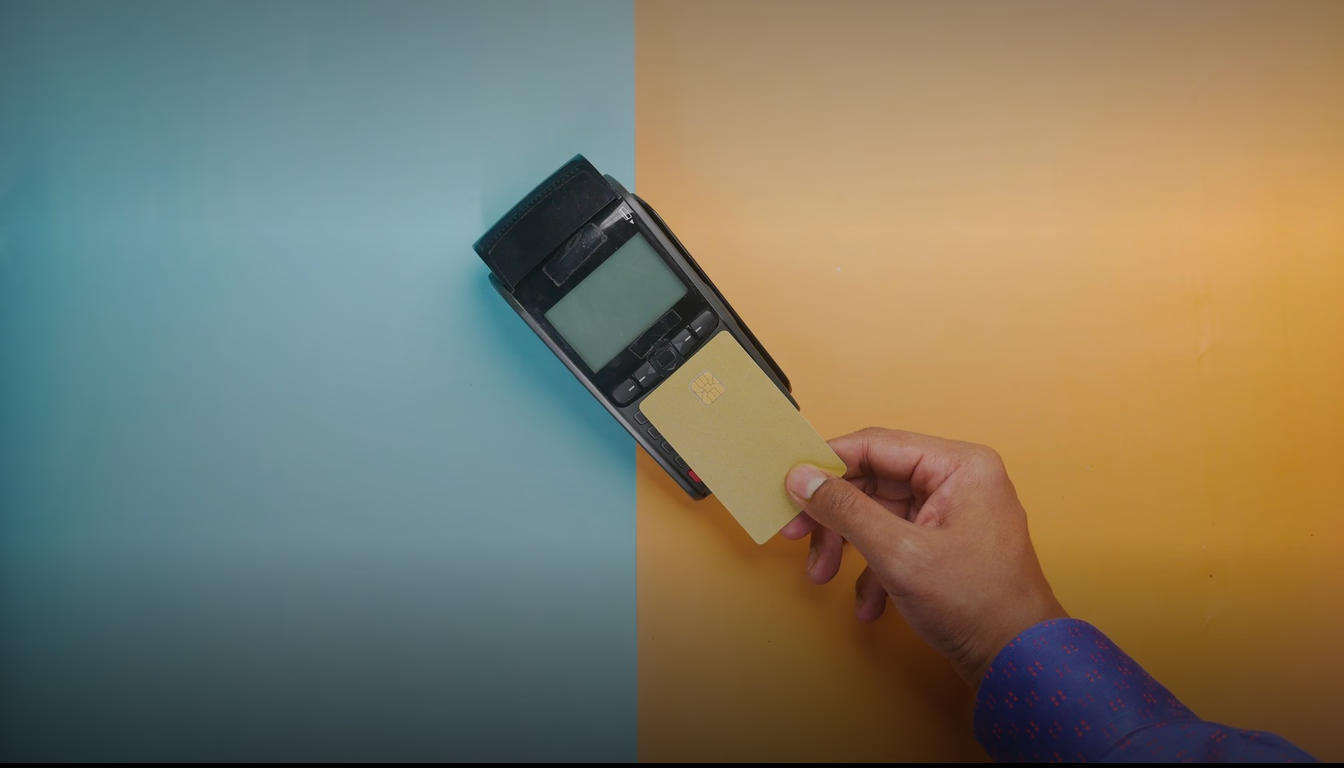
A subway turnstile reader has no slot, no keypad, no moving part you can find. Tap your card or phone on a reader like it, or on the one by the coffee shop till, and the gate opens before your hand is fully back at your side. The card had no power a second earlier. It is a coil of wire, a chip, and no battery. It borrows energy from the reader, checks its own message against an error-catching scheme published in 1948, works in a band that treaty writers fenced off in 1979, and reaches your pocket at all because someone settled in 2003 who pays for the terminal. The question is not who invented the tap. It is why those four had to meet.
- 5cm
- Typical ISO/IEC 14443 range: how far a card can borrow power and talk.
- 1.1mA/m
- Interference field at the reader reported as enough to wreck an HF RFID transaction.
- 16CRC bits
- Redundancy in EPC Gen-2 that catches errors before they become wrong payments.
- 200USD
- Floor price of a payment terminal upgrade; the ceiling runs to $1,000.
When the fields matured
Each field had to produce a specific result before Contactless Payment could exist as you know it. The timeline below shows when each one arrived.
Pull any thread, and the same story unravels.
In the order the story needs them, not the order they happened. Each card carries the year its field matured.
Keystone
The card with no battery in it
Michael Faraday moved a magnet past a loop of wire in 1831 and current appeared with nothing touching.
Cut open a contactless card and you find a chip and a flat loop of wire running around the edge. There is no battery, because there is nowhere to put one. The reader drives an alternating magnetic field, and the card's loop sits in that field and harvests enough energy to wake its chip. That borrowed power is what gives ISO/IEC 14443 systems their roughly 5 cm working range, close enough that the card is effectively inside the reader's field. The same shared field carries the conversation. The card varies how hard it pulls on the field, and the reader feels the tug as data. Power and message travel the same path, in both directions, without a contact anywhere.
Without this field
With no inductive coupling across the air gap, a passive card could neither harvest operating power from the reader nor use mutual inductance to send data back. Payment would require physical electrical contact.
Without near-field coupling, the roughly 5 cm ISO/IEC 14443 range delivering both power and data to a passive card would not exist.
How we know
The technique on the card side is load modulation: switching a load across the antenna coil changes the mutual inductance the reader sees. Klaus Finkenzeller's 2011 RFID Handbook presentation covers active load modulation, where the card generates its own answering field rather than passively damping the reader's, which matters when the card's antenna is very small.
Source: Active Load Modulation (2011) · tier2
A shared field only works if everyone shares the same frequency, a problem being fought over in treaty rooms with no interest in cards.
A frequency fenced off for nobody in particular
Every reader on every counter in every country runs at the same frequency: 13.56 MHz. That was a regulatory decision, made in 1979.
A card bought in Berlin has to open a gate in Tokyo, and the only way that happens is if both readers listen at the same spot on the dial. International allocation set 13.56 MHz aside as an industrial, scientific and medical band, a slice of spectrum where equipment can radiate without holding a broadcast licence. That decision made the band predictable, and predictability is what lets one card work everywhere. It also came with limits on how much noise nearby equipment may spill. NIST measurements found an interference field of just 1.1 mA/m rms at the reader was enough to break a typical HF RFID transaction.
Without this field
Without coordinated allocation of 13.56 MHz, terminals and cards would have no predictable shared band, and cross-border interoperability would collapse. Without compatibility limits, neighbouring equipment could disrupt transactions, and national authorisation rules could block devices from sale outright.
An interference field of 1.1 mA/m rms at the reader was reported as enough to disrupt a typical HF RFID transaction.
How we know
The same body of rules governs whether a reader can be legally marketed at all. Short-range device authorisation and electromagnetic compatibility limits vary by jurisdiction, so a terminal that passes in one national regime may be unsellable in another even when the radio design is identical.
Source: HF Proximity RFID Electromagnetic Emissions and Performance (2007) · tier1
Even a clean band carries some noise, and the fix for that had been sitting in a Bell Labs paper for thirty-one years.
Who pays for the reader on the counter
The physics of 1831 has no opinion about who buys the terminal. That question stalled contactless longer than any technical problem did.
Look at the reader by the till and picture the invoice for it. A shopkeeper will not pay for hardware no customer has asked to use, and a customer will not carry a card that nowhere accepts. Merchants faced point-of-sale upgrades of $200 to $1,000 per device, which is a real barrier when the demand does not exist yet. Payment-systems economics is the study of breaking exactly this deadlock. Interchange fees and merchant pricing spread the cost of the network across the two sides that need each other, and acquiring margins make it worth wiring a terminal up at all. Marc Bourreau and Marianne Verdier have examined how those fee structures shape whether payment innovations get deployed.
Without this field
Without an economics of two-sided payment networks, contactless would sit in a coordination failure: no consumer demand without acceptance, no merchant investment without demand. Interchange and acquiring economics are what allocate the cost between them.
Merchants faced point-of-sale device upgrade costs from $200 to $1,000 each, a substantial barrier to accepting contactless.
How we know
Bourreau and Verdier, writing in the Review of Industrial Organization in 2019, analyse interchange fees as a lever on innovation in payment systems rather than merely a transfer between banks: the fee level influences which side of the market absorbs investment in new acceptance technology.
Source: Interchange Fees and Innovation in Payment Systems (2019) · tier2
None of that money moves unless the terminal can tell a good message from a corrupted one, which is a problem from 1948.
Extra bits that catch the wrong answer
Claude Elwood Shannon showed in 1948 that a noisy channel can carry a message reliably if you send it with deliberate redundancy.
A hand moving past a reader garbles bits. ISO/IEC 14443 transactions carry check bytes so the terminal can tell a mangled command from a real one. In EPC Class-1 Generation-2 UHF RFID, 16 CRC bits correct all single-bit errors and 79% of possible double-bit errors. That redundancy is why a half-tap fails cleanly instead of charging you wrongly.
Without this field
Without channel coding and error detection, interference and timing slips in a near-field link could corrupt commands, identifiers or payment data with no reliable way to notice.
Without the 16 CRC bits in EPC Gen-2 RFID, a decoder loses the redundancy that fixes all single-bit and 79% of double-bit errors.
How we know
A 2014 Sensors paper, A Secure RFID Authentication Protocol Adopting Error Correction Codes, goes further than integrity checking: it builds error-correcting codes into the authentication step itself, using the coding structure as part of the security scheme rather than only as a guard against channel noise.
Source: A Secure RFID Authentication Protocol Adopting Error Correction Codes (2014) · tier1
Watch
A visual companion to the fields above.
Takeaway
Nothing about the physics changed in 2003. Faraday's coupling worked as well in 1831 as it does at the turnstile, the error-checking math was 55 years old, and the 13.56 MHz band had been legally usable for 24 years. What was missing was a reason for a merchant to buy a $200 reader for a gesture no customer had yet made. The EMV contactless specification and the interchange economics that came with it turned a solved physics problem into a business a merchant would fund. That last piece is the one still in dispute. Interchange fees are argued in courtrooms and regulators' filings in a way the 5 cm coupling range never will be. So the tap has a strange split personality: the part that moves the money is settled science, and the part that decided you would ever be offered it is still being renegotiated every few years.
References
- Active Load Modulation (2011) tier2
Klaus Finkenzeller, RFID Handbook presentation, 2011
- HF Proximity RFID Electromagnetic Emissions and Performance (2007) tier1
NIST, HF Proximity RFID Electromagnetic Emissions and Performance
- Interchange Fees and Innovation in Payment Systems (2019) tier2
Bourreau and Verdier, Review of Industrial Organization, 2019
- A Secure RFID Authentication Protocol Adopting Error Correction Codes (2014) tier1
A Secure RFID Authentication Protocol Adopting Error Correction Codes, Sensors, 2014