Riiven Threads
QR Code
The Boring Revolution
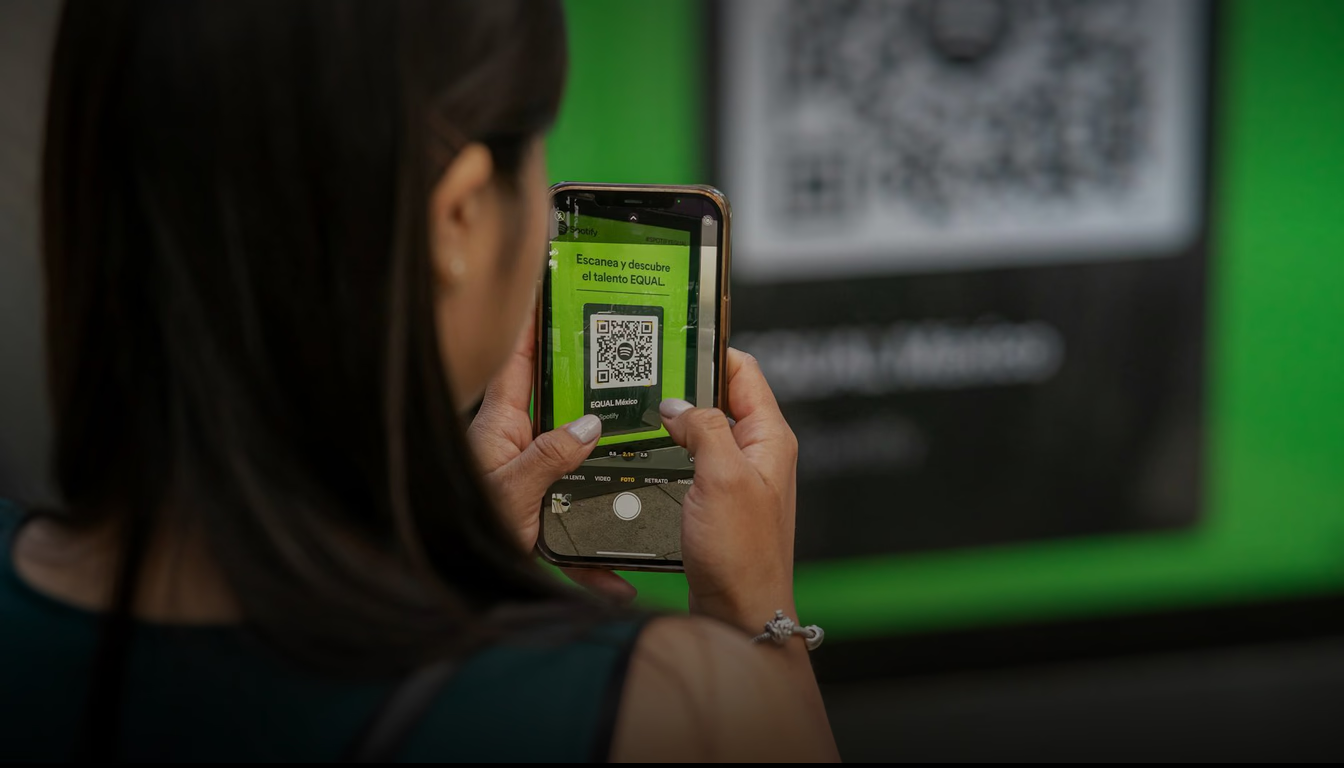
You scanned a QR code this week without thinking about it, maybe to see a restaurant menu, maybe to board a plane. You did not notice it work. That is the whole story. In 1994, a Denso Wave engineer named Masahiro Hara was trying to solve a Toyota parts tracking problem and ended up borrowing from Cold War sensor physics, projective geometry old enough to predate calculus, and a Japanese standards process that would not finish for six more years. The black squares on your screen are not a barcode. They are six separate engineering problems, each solved on its own, that line up on one printed grid.
- 270%
- How much more data a QR code carries in the same label area as a 1D barcode.
- 40% accuracy lost
- Decoding accuracy shed when perspective distortion goes uncorrected on tilted codes.
- 99.8% success rate
- Decoding ceiling on difficult images, only reachable with adaptive thresholding.
- 0.4ANSI grade
- Symbol quality lost when print geometry tolerances are not locked by standard.
When the fields matured
Each field had to produce a specific result before QR Code could exist as you know it. The timeline below shows when each one arrived.
Pull any thread, and the same story unravels.
In the order the story needs them, not the order they happened. Each card carries the year its field matured.
Keystone
The factory floor problem that started everything
QR Code exists because a linear barcode could not fit a Toyota part number. Masahiro Hara fixed that in 1994.
Before QR, a Toyota kanban label could only hold so much. A linear barcode is one dimensional, so to track more parts you needed more labels or bigger labels, both of which broke just-in-time inventory. Hara's team at Denso Wave needed a code that carried up to 270% more information per unit area on the same sticker. The business case came from the factory floor, not the consumer.
Without this field
Without economic pressure for denser labels, no one would have paid to invent or standardize a 2D code at all. Linear barcodes were good enough for groceries, and the just-in-time accounting that made density valuable only existed inside Toyota's supplier network.
A QR symbol carries about 270% more data than a linear barcode on the same sticker. Without that density, traceability needs bigger labels or more of them.
How we know
QR Code 1.0 in 1994 packed up to 7,089 numeric characters into a single symbol versus roughly 20 for a Code 39 barcode. The 270% density gain was what made parts-level traceability cheaper than the labor of attaching multiple labels, which is the only reason Denso funded the project at all.
Source: Economic Analysis Traceability Two Level Perishable Food Supply Chain (2017) · tier2
But a denser code is useless if no sensor can read it cleanly under a warehouse's uneven light.
Silicon learning to count photons precisely enough
Your phone camera is a Cold War instrument. Willard Boyle and George Smith invented its core in 1969 at Bell Labs.
A QR code only works if a sensor can resolve tiny black and white modules in bad light. The CCD, invented in 1969, taught silicon how to count photons cleanly enough that edges stayed sharp. Modern CMOS sensors in your phone inherited that lineage. It also made the counting measurable, which is why a sensor can be characterized for how much of the light it actually converts before anyone trusts it to tell a dark module from a shadow.
Without this field
Without solid-state imaging, the sensors in phones and handheld scanners would be too noisy and too coarse to resolve QR modules under everyday lighting. Edges blur, timing patterns vanish, and decoding fails far more often in low light or glare.
How we know
Boyle and Smith shared the 2009 Nobel in Physics for the CCD. The relevant trick is charge transfer efficiency above 0.99999 per pixel shift, which is what keeps a finder pattern from smearing across columns.
Source: Optical characterization methods for solid-state image sensors (2001) · tier2
Sharp pixels are only half the problem: the decoder still sees a trapezoid whenever the phone tilts.
Seventeenth-century geometry unwrapping your camera's tilt
You almost never hold your phone flat over a QR code. Seventeenth-century geometry fixes the angle before the decoder ever sees it.
When you scan a code at a tilt, the camera sees a trapezoid, not a square. The decoder uses a homography, a projective transform with eight parameters, to warp that trapezoid back into a clean square grid. Karrach and colleagues showed in 2020 that without this correction, decoding accuracy on strongly tilted codes drops by about 40 percentage points.
Without this field
Without homography-based rectification, any QR code viewed off-axis would fail to decode. Finder pattern detection and module sampling collapse the moment the code is not nearly parallel to the sensor plane.
Without projective geometry based perspective distortion identification and correction, decoding accuracy on highly tilted QR codes drops by about 40 percentage points compared to corrected images
How we know
A planar homography is a 3x3 matrix with 8 degrees of freedom, solved from the four QR finder and alignment patterns. The math traces to Desargues in the 1600s and was formalized in projective geometry by the 19th century. Your phone runs that solver in milliseconds every time you tilt the camera.
Source: Identification of QR Code Perspective Distortion (2020) · tier2
Even a geometrically corrected image fails if uneven lighting turns its gray pixels into guesswork.
Deciding, patch by patch, where black ends
A QR code is binary, but a camera image never is. Something has to decide what counts as black.
The raw image from your phone is millions of gray pixels under uneven lighting. Adaptive thresholding decides, region by region, where black ends and white begins. Lin and Fuh's 2013 work on 2D barcode decoding showed that without this step, decoders cannot hit the 99.8% success rate they otherwise achieve on difficult images. Shadows and glare would defeat most scans.
Without this field
Without adaptive binarization, QR codes in shadow, glare, or low light would frequently fail to decode. Warehouse scanners and phone cameras would constantly need users to reposition or relight the code.
Adaptive binarization is what lets decoders reach about 99.8% success on difficult images. Without it, shadow and glare defeat a large share of scans.
How we know
Global thresholding fails on QR codes because a single brightness cutoff cannot survive a shadow falling across half the symbol. Local adaptive methods, like Sauvola or Niblack windows, compute a threshold per neighborhood. The reported 99.8% ceiling on challenging images is the entire reason scanning feels instant rather than fiddly.
Source: 2D Barcode Image Decoding (2013) · tier2
Reliable decoding also demands that the physical symbol itself print to tight tolerances in the first place.
Locking the geometry so any printer can comply
Every QR code on Earth is printed to the same tolerances. ISO/IEC 18004 is why a code on a receipt and a code on a billboard both scan.
The quiet zone, finder patterns, and timing modules need to print at consistent size and contrast on everything from thermal receipt paper to factory steel. ISO/IEC 18004, finalized in 2000 with Denso Wave engineers, locks in the geometry. Without those tolerances, typical printed symbols would lose about 0.4 of an ANSI quality grade, sliding from acceptable B to marginal C or D.
Without this field
Without standardized geometric and contrast tolerances, codes printed on cheap stock or displayed on low-resolution screens would frequently fall below readable quality grades. Many symbols that scan today would be rejected as marginal.
Without strict control of module geometry and print contrast as codified in QR and barcode standards, typical printed symbols would lose about 0.4 of an ANSI quality grade, pushing many from acceptable B grade toward marginal C or D performance
How we know
ANSI/ISO barcode print quality grading runs A through F across parameters like modulation, axial nonuniformity, and unused error correction. A 0.4 grade loss is the difference between a code that scans on the first try and one that fails on a worn label. The standard specifies a quiet zone of 4 modules and module dimension tolerances tight enough to survive 600 dpi printing.
Source: The influence of printing technologies on QR-code recognition (2013) · tier2
Precise tolerances only spread everywhere once the code was declared free for anyone to print and read.
Royalty-free by choice, global by consequence
Denso Wave owned the patent and gave it away. Japanese standards policy turned a factory tool into a global one.
QR Code could have stayed proprietary, locked inside Toyota's supplier network. Instead, Denso Wave declared it royalty-free and pushed it through Japanese Industrial Standards in 1999 and ISO/IEC 18004 in 2000. Masahiro Hara and Naoto Ikeda worked the committee process. Without that move, payment terminals, airline gates, and phone cameras would each speak a different dialect.
Without this field
Without standardization, QR Code would have remained a Denso Wave format for car parts. Phones, payment terminals, and scanners would each support incompatible dialects, and the global mobile payment ecosystem built on QR would not exist.
Shared symbol structure and error correction are worth up to 95 points of decoding success in uncontrolled lighting, the gap between one ecosystem and many dialects.
How we know
ESP32-CAM based verification systems today reach reliable decoding only because every chip implements the same Model 2 symbol structure and Reed-Solomon error correction defined by ISO/IEC 18004. Without that shared spec, decoding reliability in real lighting conditions could lose up to 95 percentage points of success rate, the gap between a working ecosystem and a fragmented one.
Source: Patient Centric EMR via QR Code in Japan (2024) · tier2
Watch
A visual companion to the fields above.
Takeaway
QR Code is the rare invention that looks dumber the closer you get to it. A grid of squares. High school geometry. A camera. But the reason your phone reads it in a dim restaurant, at a tilt, through a smudged screen, is that six separate fields had to mature first and then arrive at the same 21x21 grid in 1994. Boyle and Smith building image sensors in 1969. Projective geometry from the seventeenth century. A binarization paper from 2013 doing the cleanup. A standards committee in Tokyo finishing in 2000. Toyota's just-in-time accountants pricing the whole thing into existence. The lesson is that the most invisible interfaces have the deepest basements, and a code nobody noticed for two decades only became invisible because every floor below it was already load-bearing.
References
- Economic Analysis Traceability Two Level Perishable Food Supply Chain (2017) tier2
Yu and Nagurney, Sustainability 2017, Economic Analysis of a Traceability System for a Two Level Perishable Food Supply Chain
- Optical characterization methods for solid-state image sensors (2001) tier2
Willemin, Blanc, Lang et al., Optics and Lasers in Engineering, 2001
- Identification of QR Code Perspective Distortion (2020) tier2
Karrach, Pivarčiová, Božek, Journal of Imaging, 2020
- 2D Barcode Image Decoding (2013) tier2
Lin and Fuh, Mathematical Problems in Engineering, 2013
- The influence of printing technologies on QR-code recognition (2013) tier2
Miletic et al, Int J of Computer Science and Technology, 2013
- Patient Centric EMR via QR Code in Japan (2024) tier2
Nomura et al, J Med Internet Res, 2024