Riiven Threads
Electric Toothbrush
Cleaning Without Touching
The story you know
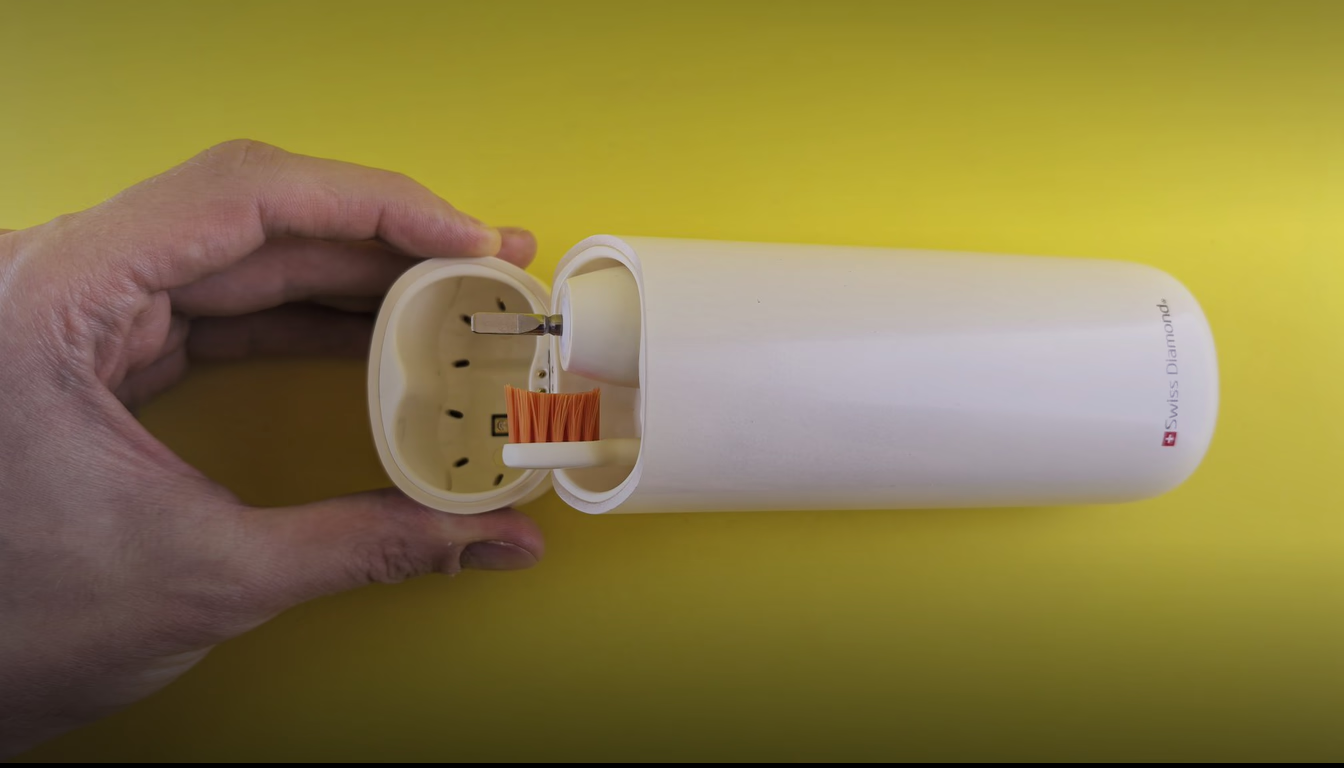
The electric toothbrush is just a manual toothbrush with a motor bolted on, so the clever part was making the motor small enough.
What the record shows
Compact motors and resonant actuators were only one requirement. The cleaning benefit depends on fluid motion beyond bristle contact, on plaque biofilm research showing what must be disrupted, and on behavioral research behind timers and prompts that make people brush long enough.
Tonight, the two-minute timer on your toothbrush buzzes and pauses every thirty seconds. That small stutter is the most honest part of the machine. The motor humming under your thumb was never the hard problem, because compact drives that shake a brush head tens of thousands of times a minute are ordinary engineering. The harder problems sat elsewhere. Plaque is a living film of bacteria glued to enamel, and much of it hides between teeth where no bristle lands. Even a perfect brush fails if you put it down early. So the question here is how a buzzing handle learned to clean surfaces it never touches, and how it learned to keep you holding it long enough to matter.
- 57%
- Biofilm reduction from fluid flow alone, up to 5 mm from the bristles.
- 73.7%
- Lab biofilm bacteria dislodged by a running brush, versus 3.66% switched off.
- 34%
- Logged brushing sessions that actually lasted the instructed two minutes.
- 40,000strokes/min
- Top of the typical sonic range. The low end is 24,000.
When the fields matured
Each field had to produce a specific result before Electric Toothbrush could exist as you know it. The timeline below shows when each one arrived.
Pull any thread, and the same story unravels.
In the order the story needs them, not the order they happened. Each card carries the year its field matured.
Keystone
The current that scrubs where bristles miss
Foam churns in the gap between two molars, where no bristle fits. That moving liquid does real cleaning on its own.
Hold a running sonic brush a few millimeters from a tooth and the toothpaste and saliva around it start to churn. Fast bristle motion drives that fluid into the gaps between teeth, where it drags across plaque like a current scouring a riverbed. Engineers call this drag shear stress, meaning the sideways push a moving liquid applies to a surface. A 2015 study comparing a sonic brush against an oral irrigator estimated shear stresses of 0.5 to 0.9 pascals for side-to-side brushes, a push too faint for your skin to feel. At distances of 0 to 5 millimeters, that flow came with biofilm reductions of up to 57%. The bristles did not need to touch plaque to move it. Design could now aim at the liquid instead of the bristle tip.
Without this field
Without fluid motion and shear, a powered brush would clean little beyond direct bristle contact, especially in the spaces between teeth. The evidence does not support the stronger claim that electric toothbrushes would fail altogether.
Fluid shear of 0.5 to 0.9 Pa from side-to-side brushes cut biofilm by up to 57% at 0 to 5 mm.
How we know
Microbiologists, meanwhile, were growing plaque on lab surfaces for their own reasons, asking what it took to pry bacteria loose.
Proof that a switched-off brush does almost nothing
Run your tongue over unbrushed teeth and you feel a fuzzy coat. That coat is alive, and it is anchored.
The fuzzy coat on unbrushed teeth is a biofilm, a city of bacteria held in place by its own sticky glue. It does not rinse off, so designers needed proof that moving fluid could break it apart. A 2003 in vitro test, meaning bacteria grown on lab surfaces rather than in a mouth, supplied that proof. An activated electric brush dislodged 73.70% of viable biofilm bacteria, against 3.66% for an inactivated brush. That gap gave engineers a measurable target for what the brush should disturb.
Without this field
Without plaque biofilm research, toothbrush designers would have had less direct evidence about how brush-generated fluid forces detach bacteria beyond bristle contact. In an in vitro model, an activated electric toothbrush dislodged 73.70% of viable biofilm bacteria, compared with 3.66% for an inactivated brush, showing a measurable removal mechanism that could inform design.
How we know
Source: Effects of dynamic fluid activity from an electric toothbrush on in vitro oral biofilms (2003) · tier1
Behavioral researchers had a separate worry: not what the brush removed, but whether anyone held it there long enough.
Why the timer needed its own evidence
A timer built into the handle looks like the habit problem solved. Recorders hidden inside brushes said otherwise.
A timer on the handle looks like proof that the habit problem is handled. It was not. In 2005 the British Dental Journal reported on data loggers, small recorders inside the brush that note every session, used to check whether people followed instructions. Only 34% of brushing events met the two-minute instruction. Timers alone did not deliver two minutes. That is why the buzz-and-pause had to be treated as a nudge worth testing, not a clock worth trusting.
Without this field
Without behavioral feedback and adherence research, timers and interactive prompts would lack evidence that they help people brush longer. A powered-toothbrush study found that timers alone did not ensure two-minute brushing, so the device could not solve the compliance problem by itself.
Data loggers found only 34% of brushing events met the two-minute instruction.
How we know
Source: Assessing adherence with toothbrushing instructions using a data logger (2005) · tier1
Motor engineers, building compact actuators for their own markets, needed none of this to make the drive work.
The part that was already solved
Inside the handle sits a small drive that swings the brush head. It was the least mysterious part.
Inside the handle, an electromagnetic drive swings the brush head back and forth. Resonant designs keep it moving like a plucked guitar string, oscillating near its natural frequency with little extra push. Sonic brushes generally run at 24,000 to 40,000 strokes per minute. Building that motion was the easy part.
Without this field
Without electromagnetic motors and resonant actuators, an electric toothbrush would lack a compact way to drive its head in rapid, controlled motion. Resonant designs sustain oscillation near the actuator's natural frequency, though the evidence does not set one required stroke rate for every brush.
Sonic toothbrushes generally vibrate at 24,000 to 40,000 strokes per minute.
How we know
Source: Cleaning performance of electric toothbrushes around the world (2024) · tier1
Takeaway
Hold a running sonic brush just off your teeth and the plaque between them still takes damage. The electric toothbrush rests on that result. The motor was ready long before anyone knew what to aim it at. Microbiology showed plaque was a glued, living film that a switched-off brush barely disturbed. Fluid mechanics showed that churned toothpaste and saliva could drag that film loose from up to 5 millimeters away, in gaps no bristle reaches. Habit research showed that only 34% of logged sessions met the two-minute instruction, so the timer had to be tested rather than trusted. Together they produced a brush designed around the liquid it moves and the minutes you give it, rather than the bristles you can see. The unresolved part still sits in your hand. The 2005 loggers found that timers alone did not deliver two minutes, and every pause at thirty seconds remains a request, not a guarantee.
References
- Interproximal biofilm removal by intervallic use of a sonic toothbrush compared to an oral irrigation system (2015) tier1
Adams et al., BMC Oral Health, 2015
- Effects of dynamic fluid activity from an electric toothbrush on in vitro oral biofilms (2003) tier1
Author details not shown in search result, PubMed, 2003
- Assessing adherence with toothbrushing instructions using a data logger (2005) tier1
McCracken et al., British Dental Journal, 2005
- Cleaning performance of electric toothbrushes around the world (2024) tier1
Rominger et al., Scientific Reports, 2024