Riiven Sparks
Humpback Whale Turbine
A humpback whale's flipper has rounded knobs along its front edge, where an aircraft wing would be smooth. A 2004 study found that the knobs delay stall.
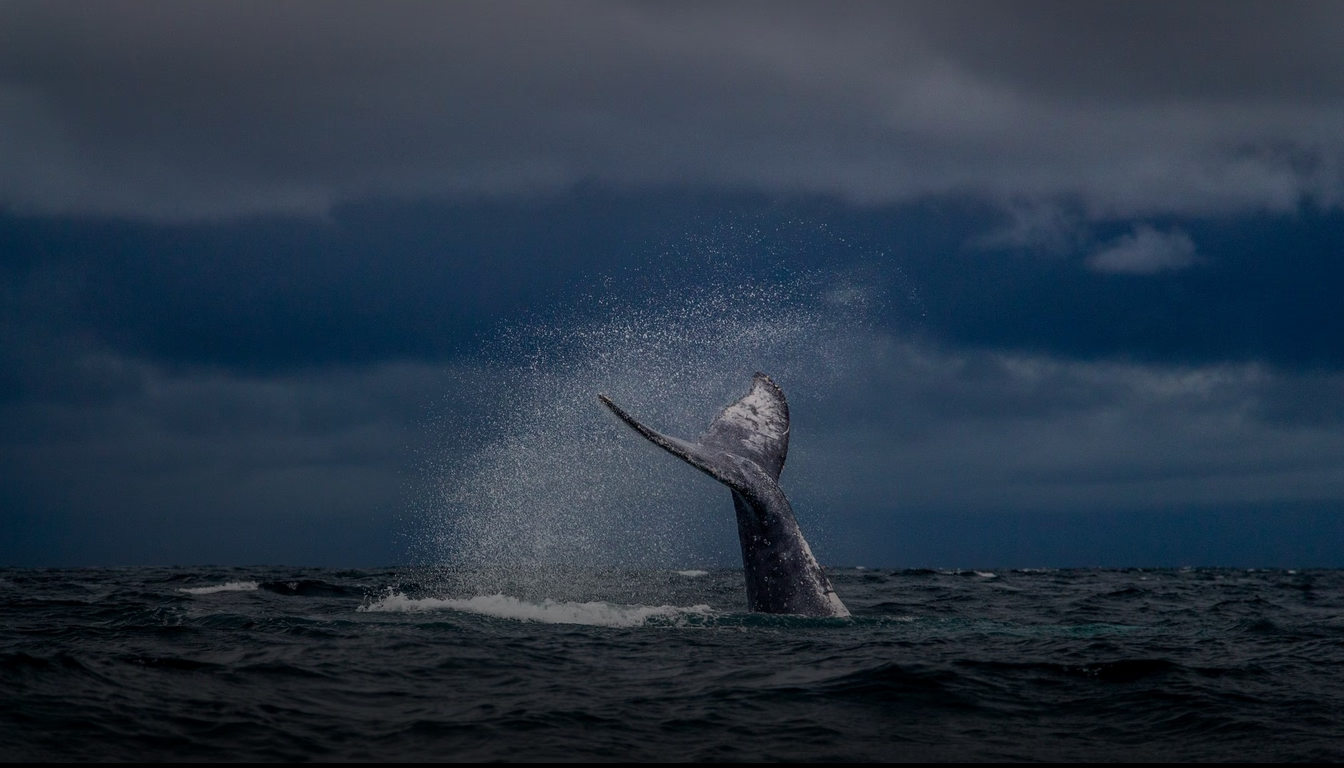
In 2004, Miklosovic, Murray, Howle, and Fish published a study on the tubercles, the rounded knobs along the front edge of humpback whale flippers. An aircraft engineer would have called those knobs a defect, since wings are supposed to be smooth and any bump is a place for trouble to start. The four authors tested the bumpy shape. Their title stated the result: the tubercles delayed stall.
The pivot
Intent
Explain why whale flippers have bumps
Outcome
Bumpy blades for wind turbines and fans
A humpback whale is enormous, yet it turns tightly in the water, and its long flippers do much of that work. A row of rounded lumps runs along the front edge of each flipper. Biologists call them tubercles. To an engineer trained on smooth wings, they looked like mistakes.
The problem the study looked at is stall. A wing or fin makes lift by meeting the flow at an angle. Tilt it too steeply and the flow stops following the surface, and lift collapses. For a plane that is dangerous, and for a turbine blade it means lost power.
The 2004 study examined how the leading edge tubercles affect stall on humpback flippers. It found that they delayed it, so the flipper kept producing lift at steeper angles than a smooth edge would allow.
Frank Fish later worked with Stephen Dewar and Philip Watts on blades shaped like the flipper. Their company, WhalePower, built turbine blades with a bumpy front edge. In 2008, a test report described those blades fitted to a 25 kW turbine at the Wind Energy Institute of Canada site in Prince Edward Island.
In 2018 the European Patent Office recognized Dewar, Watts, and Fish, and described their whale-inspired technology as developed for wind turbines and also for fans.
Watch
The angle
Before you smooth out the odd bump on something that works, ask what it is holding back.
Sources
- Miklosovic, Murray, Howle, and Fish, “Leading-edge tubercles delay stall on humpback whale (Megaptera novaeangliae) flippers,” 2004 (2004)
- “WhalePower tubercle blade power performance test report,” 2008 (2008)
- “Turbines and fans inspired by whales: Stephen Dewar, Philip Watts and Frank Fish,” European Patent Office, 2018 (2018)