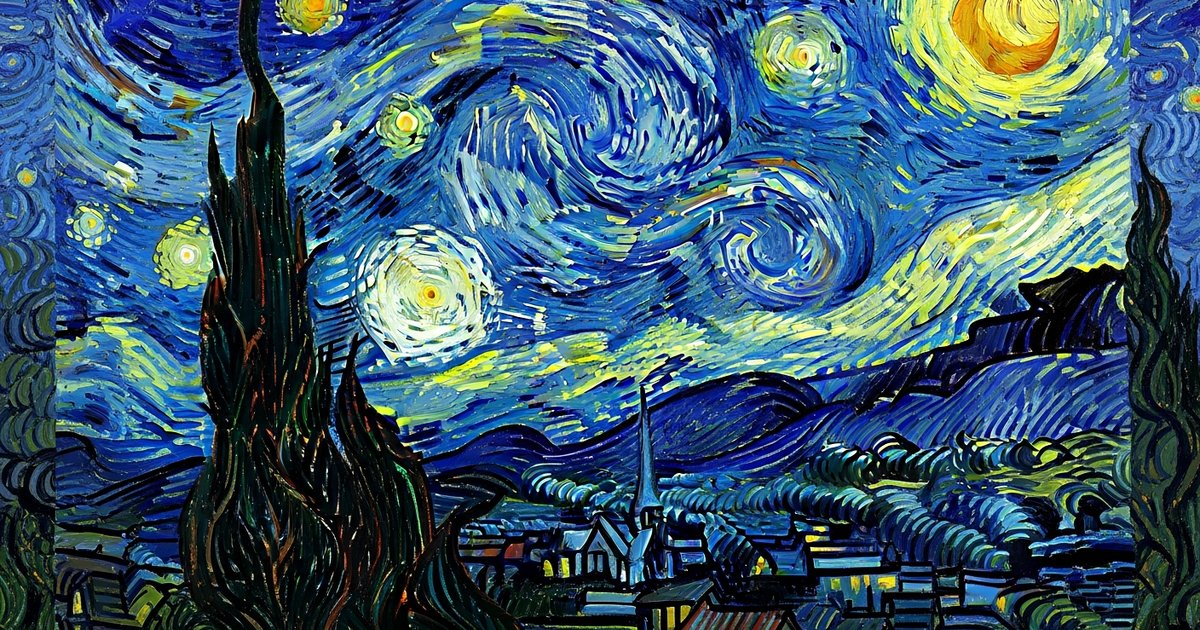

Look at the cypresses. Not as decorative elements framing a famous painting, but as what they truly are: dark flames twisting upward from the earth, writhing against that impossible sky. In The Starry Night, these trees do not stand with the dignified stillness we expect from landscape paintings. They contort. They reach. They mirror the coiling spirals above them as if the boundary between ground and heaven has dissolved, as if everything, tree and star and sleeping village, has been caught in the same wild current.
Van Gogh painted this from memory, during the day, in an asylum room where he had committed himself after his breakdown. The night he captured was not the one outside his window but the one inside his chest: turbulent, restless, refusing to be still. And what strikes me, looking at those cypresses straining toward the swirling cosmos, is their honesty. They do not pretend to be calm. They do not apologize for their intensity. They simply reach, desperately and beautifully, toward something they cannot quite touch.
The church steeple does the same: that single dark finger pointing upward, never quite closing the gap between earth and stars. There is something about this distance, this perpetual reaching toward what exceeds our grasp, that catches in the throat. Van Gogh knew he was painting from a broken place. He knew the world saw him as mad. And yet he poured his turbulence onto canvas and transformed it into something that would speak to millions of people for over a century. Not by hiding the storm, but by showing it in all its terrible beauty.
We spend so much energy presenting calm surfaces to the world, afraid our inner turbulence would be too much for others to witness. We apologize for our intensity. We dim ourselves to fit into rooms built for steadier souls. But those cypresses remind us of something we keep forgetting: the storm and the beauty are not opposites; they are the same energy, the same life force moving through us in patterns we cannot always predict.
What if we stopped pretending to be stable? What if we acknowledged that the whole world was moving all along, and we were simply trying not to notice? The night Van Gogh painted is not peaceful. It does not promise that everything will be okay. It offers something stranger and more durable: the insistence that beauty does not require perfect conditions. That the most profound visions sometimes emerge from the most broken places.
The stars continue burning above that twisting landscape, indifferent and eternal. And somewhere below, in whatever small room we have claimed as our own, we look upward and feel the old pull toward something larger than ourselves. The painting does not tell us what to do with this feeling. It simply shows us we are not alone in having it.