
The Moment
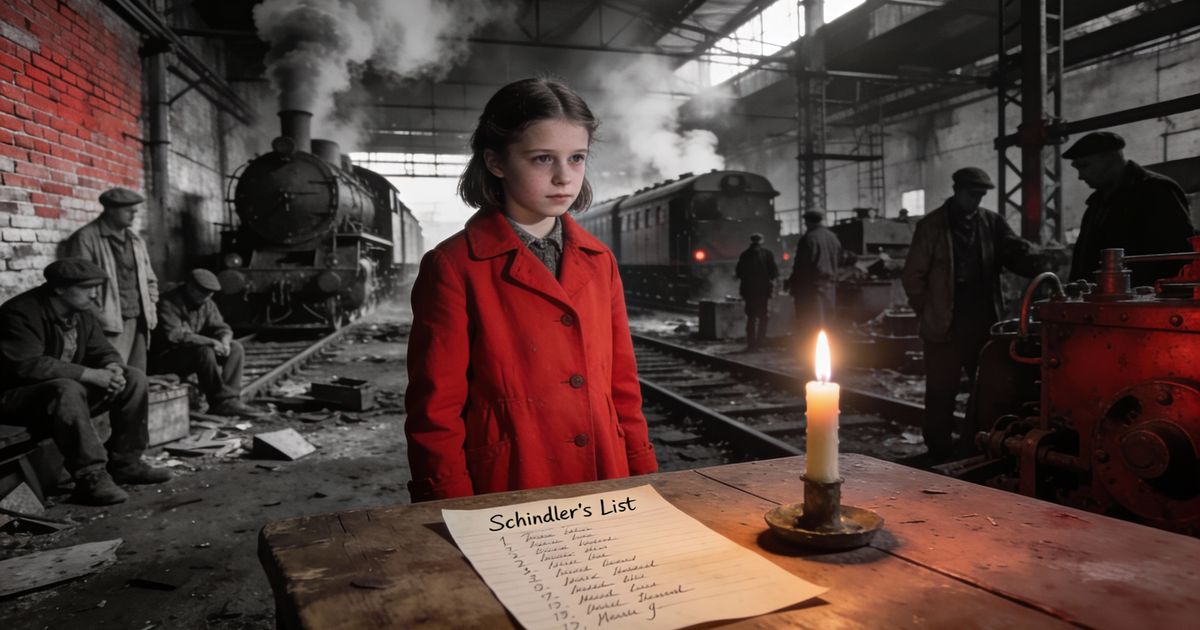
There is a ring made from gold fillings, passed from trembling hands to trembling hands. The war is over. The factory is empty now of its machinery, its false purpose, its cover story. Oskar Schindler stands among the people he has saved, 1,100 souls who will walk out of this place alive, and he is breaking apart.
He looks at his car. He looks at the Nazi pin still on his lapel. His hands move to these objects as if seeing them for the first time, as if only now understanding what they could have purchased. “I could have got more,” he says, and the words tear out of him. “I could have got more, I don’t know, if I’d just… I could have got more.”
The arithmetic of regret is impossible. How do you measure a life saved against a life that might have been saved? How do you stand in the space between extraordinary courage and the feeling that it will never, could never, be enough? The workers try to comfort him. They present him with the ring, inscribed with words from the Talmud: Whoever saves one life saves the world entire.
Steven Spielberg films this moment in stark black and white, no softness, no distance. We see a man who began as a profiteer, who saw human beings as cheap labor, who wore a Nazi pin as camouflage and opportunity. We see what he became. And we see that even in becoming someone who risked everything, who spent everything, who saved a thousand worlds, the weight of what was lost does not lift.
The ring sits in his palm. It is made from teeth. It is made from gratitude. It is made from gold pulled from mouths that chose to give this gift. One thousand one hundred people stand in that room because of decisions he made again and again, each time the cost rose, each time the danger grew.
And still, he weeps for the ones he couldn’t reach.
The Reflection
We want our moral reckonings to feel complete. We want the moment of awakening to erase what came before, the good deed to balance the ledger, the heroism to provide absolution. But Schindler’s breakdown teaches us something more truthful and more demanding. Conscience is not a destination where we arrive and rest, but a practice we return to, imperfect and insufficient, again and again.
I think about this when I encounter my own small moral reckonings. The times I spoke up and the times I didn’t. The faces I let become real to me and the ones I let remain abstract. None of my choices carry the stakes of occupied Poland, and yet the same question runs through them: Will I see, or will I turn away?
The ring made from gold fillings says: what you did mattered. Schindler’s tears say: it was not enough. Both truths exist together. We live in that tension, holding what is possible against what is necessary, our small actions against the scale of suffering, our awakening conscience against all the years we slept.
This is not despair. It is the opposite. It is the refusal to let doing something become an excuse to stop seeing. It is the understanding that moral life is not a single choice but a thousand choices, made and remade.
The workers he saved had children. Those children had children. Whole worlds branched out from that list of names, from those repeated decisions to see people as people. We cannot all save a thousand lives. But we can practice the small, repeated act of letting strangers become real to us. We can refuse to look away.
The ring sits in museums now, a circle of gold holding the weight of witness. What will we do with what we have seen?