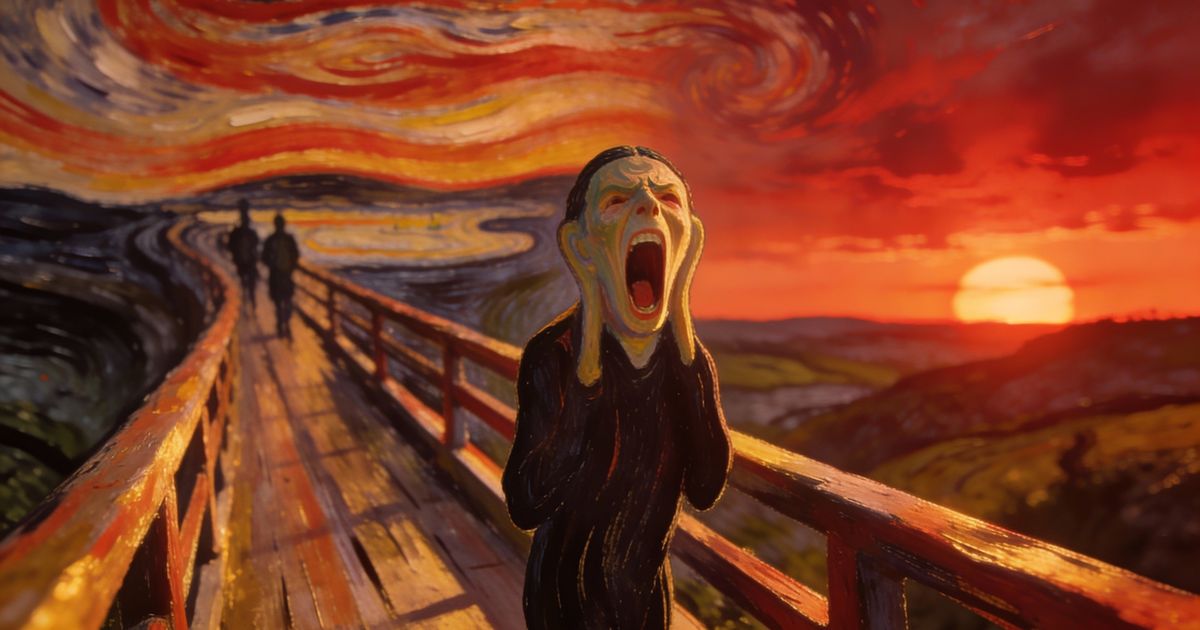

The Moment
It’s 3 a.m. and you are awake in the dark, your chest tight with a dread you cannot name. Beside you, someone sleeps, their breathing steady and unreachable. The room is ordinary. The same shadows on the ceiling, the same hum of the refrigerator down the hall. Nothing has changed in the physical world. But inside you, the sky has turned blood-red.
This is the moment Edvard Munch painted in 1893, though he set it on a bridge over the Oslofjord. A figure stands frozen, hands pressed against a skull-like face, mouth stretched into an oval of anguish. Behind it, two companions walk on, oblivious. They see nothing. They hear nothing. The scream exists in a frequency they cannot detect. And this is what makes the image unbearable in its honesty: the figure is utterly alone in its terror, while the world continues its evening stroll.
Munch wrote that he felt “an infinite scream passing through nature.” Not his own scream, but something larger, something that moved through him like a wave. The sky writhed in bands of red and yellow. The water below echoed the same sickening motion. Everything warped into the shape of panic. And his friends? They noticed nothing. They walked on.
We know this isolation. The meeting where your chest tightens while colleagues discuss projections. The family dinner where grief rises like bile and you pass the bread. The loudest screams are often the ones that never leave our bodies. The world refuses to mirror our distress. The fluorescent lights buzz on. The playlist continues.
The Reflection
What Munch understood, what makes his painting endure across more than a century, is that we contain both roles at once. We are the screaming figure and the oblivious walkers. Sometimes we switch between them in the space of an hour.
You sit across from someone at a coffee shop and see a person scrolling their phone, a bit tired, nothing remarkable. But inside that ordinary body, an entire weather system might be raging. Memories of a dead parent. The slow erosion of a marriage. The corrosive drip of inadequacy that started in childhood and never stopped. None of it shows on the surface. The face remains a face.
This is not pessimism. The scream is part of being human. It does not mean we are broken. It means we are alive, conscious, aware of our own mortality, capable of imagining futures that frighten us.
The painting does not show what happens next. The figure might lower its hands eventually. Take a breath. Continue across the bridge. Not because the scream was answered, but because even the worst feelings eventually change into other feelings. And those two figures walking ahead, they might turn around. They might not have the right words, but they might simply stand there, bearing witness to what they cannot fully understand.
We are all walking our own bridges, over our own dark waters, beneath skies that sometimes turn the color of alarm.