
The Moment
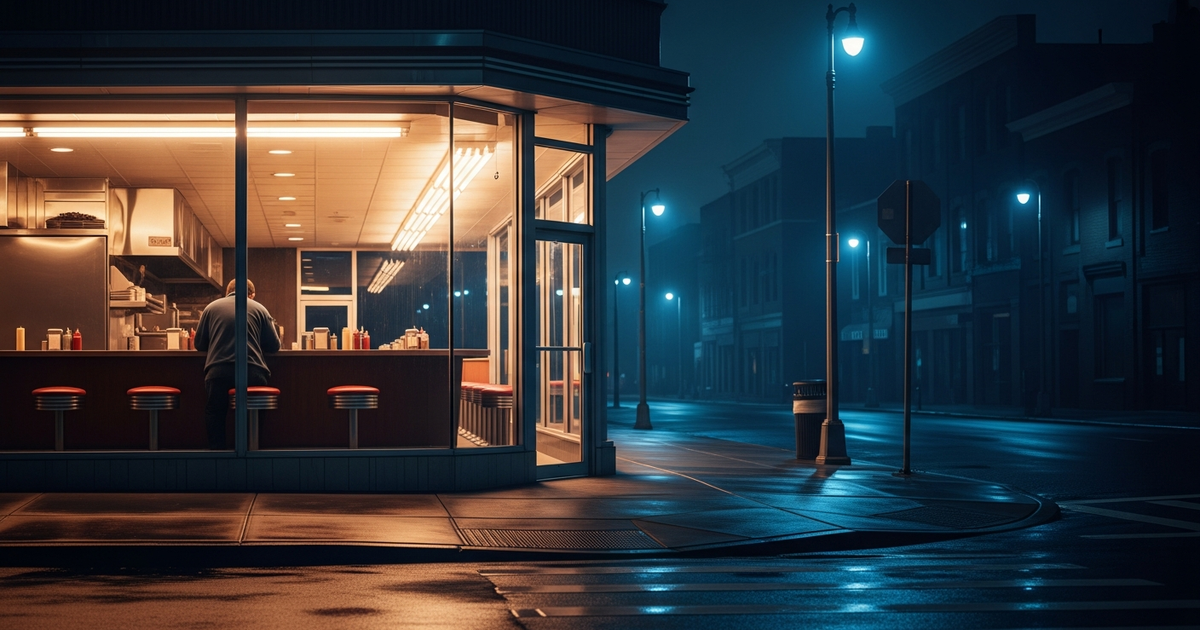
It is the hour when the city exhales, when the noise retreats and something else emerges from underneath. A diner glows on a corner, its light almost violent against the darkness: that particular fluorescent yellow-green that erases shadows and makes everything stark, exposed. Inside, four figures occupy the space like pieces in a puzzle that doesn’t quite fit together.
A couple sits at the counter, close enough that their sleeves nearly touch, yet the distance between them could span continents. The woman in the red dress stares down at something we cannot see. The man beside her looks forward, his face caught in the flat brightness. Whatever conversation brought them here has long since exhausted itself. They are together in the way strangers on a train are together: sharing space, sharing time, sharing nothing else.
Across from them, another man hunches over his cup, his back to us, his solitude so complete it seems to radiate outward. The server stands in white, patient, suspended in the posture of someone who has learned to wait through these small hours, who understands that what people need at midnight is not conversation but simply a place to land.
And the glass, the glass curves around the corner in one unbroken sheet, displaying everything, hiding nothing. There is no visible door. This detail catches in the throat. The people inside are contained and exposed simultaneously, held in a bright box while the city outside goes dark and silent. The buildings across the street show only blank windows. The sidewalk is empty. They are alone together, and we stand outside looking in, separated by something transparent and absolute.
The Reflection
We recognize this place not because we have stood on that Greenwich Village corner, but because we have inhabited our own versions of it. We have all sat in fluorescent light at hours when we should have been sleeping, surrounded by strangers who felt, for a brief suspended moment, like the only other people left in the world.
The painting stays with us because it names something we feel but rarely acknowledge: that proximity is not intimacy, that cities gather us together and isolate us in the same breath, that we can share space without ever truly meeting. The nighthawks are not suffering, exactly. They have found a place to be, a light to sit beneath. They have made it to this hour.
Perhaps what Hopper offers is not comfort but recognition, the quiet honesty of seeing loneliness acknowledged rather than hidden. The glass between us is real. Sometimes the most we can do is sit on our side of it, hold our coffee, and know that others are sitting on theirs. Sometimes being alone together is enough to carry us through until morning.