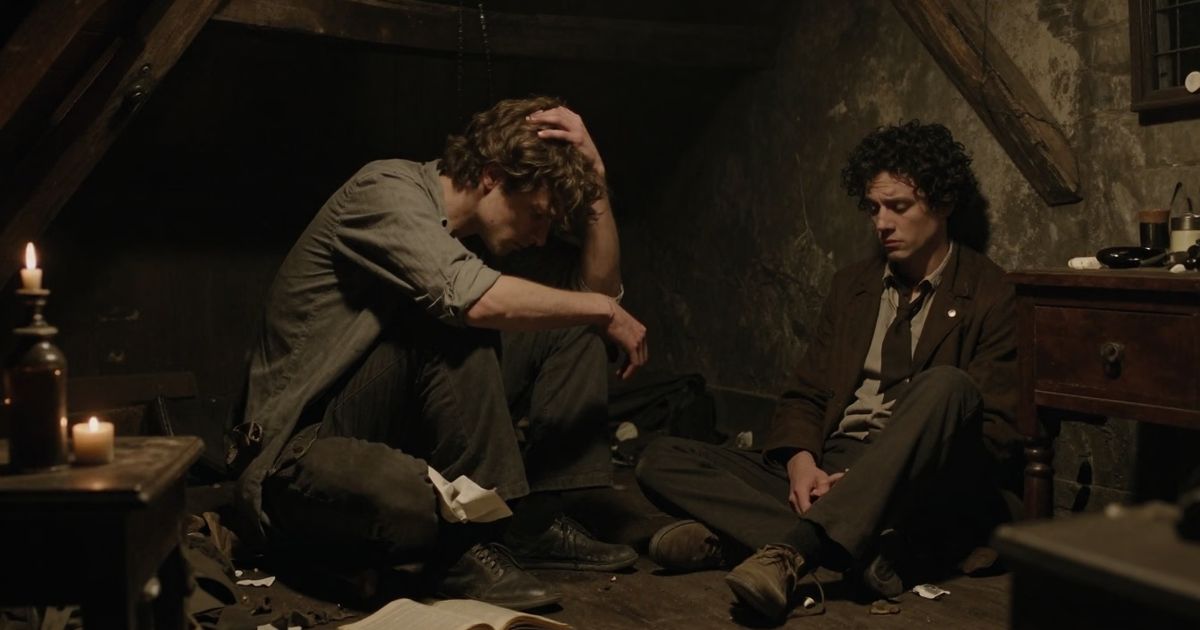

The Moment
The murder takes only a few pages. Raskolnikov has rehearsed it in his mind, constructed his philosophy of the extraordinary man, convinced himself that some people exist above conventional morality. He climbs the stairs to the pawnbroker’s apartment, his heart pounding, the axe hidden beneath his coat. The elderly woman opens the door. What follows is not the cold, rational act of a superior being. It is panic and violence and chaos.
He strikes her. Then he strikes her again. Her innocent sister appears at the wrong moment, and he kills her too. He fumbles through drawers, his hands shaking, barely taking anything of value. He escapes by pure luck, nearly running into neighbors on the stairs.
And then he is back in his tiny room, and the real punishment begins.
He lies in fever, talking to himself, his mind fragmenting. He wanders the streets of St. Petersburg like a ghost, half-confessing to strangers, drawing suspicion through his bizarre behavior. The extraordinary man who was supposed to stride forward unburdened cannot even stand upright. His conscience, it turns out, did not receive the memo about his special status. The theory was elegant, airtight, perfect in its logic. But the body keeps score in ways the mind cannot legislate away. He is being crushed not by the police, not by evidence, but by the simple, terrible fact of what he has done, and by the chasm between who he told himself he was and who he actually is.
The Reflection
We will not murder pawnbrokers. But we will construct our theories, our elaborate justifications for why our particular transgression sits outside the rules. The sharp cruelty we deliver because someone deserved it. The corner we cut because we were stressed, because the system was unfair, because our case was genuinely different this time.
What Dostoevsky understood, what makes his vision so uncomfortable, is that the lie we tell others is survivable. The lie we tell ourselves will crack us open from the inside. We can be thought villains by the world and keep walking. We cannot insist on our own heroism while knowing the truth and remain whole.
Somewhere in each of us, a voice is constructing a theory about why the ordinary rules bend slightly in our direction. The question is not whether we will be caught by others. It is whether we can stand to go uncaught by ourselves, living in that narrow room with what we know, building towers of logic that grow taller and more precarious with each day, waiting for the fever to begin.