
The Moment
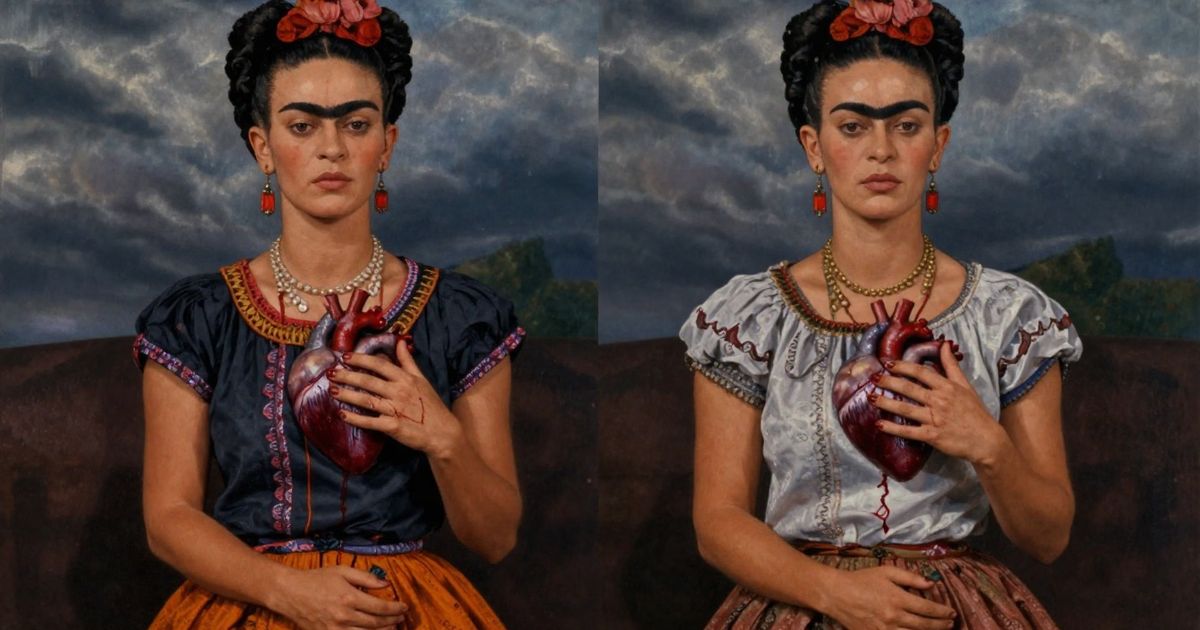
There is a detail at the center of Frida Kahlo’s painting that could be mistaken for tenderness. Two hands, clasped together. Both belong to the same woman, and yet they reach across a distance that has nothing to do with the inches of canvas between them.
On the left, a Frida in white Victorian lace sits with her chest split open, her heart exposed like something pinned in a medical theater. She holds surgical forceps in one hand, clamping an artery that refuses to stop bleeding. The blood falls in dark drops onto her white skirt, each stain a small violence that will not be undone. This is the rejected Frida, the one dressed in her father’s European refinement, the self that was not enough to keep Diego Rivera from leaving.
On the right sits another Frida in traditional Tehuana dress, embroidered flowers and loose cotton, the costume Diego once loved. Her heart is whole, uncut, still beating around a tiny portrait of him as a child. She has not let go. She clutches that small image as if it contains some essential truth about love, about who she was when she was beloved.
Between them, a single artery threads through the air like a red lifeline, connecting both hearts. The sky behind churns gray and indifferent. And there, in the middle of all this exposure, all this anatomical honesty about what it means to be split in two, their hands meet. The dying Frida and the surviving Frida hold on to each other. Not fighting. Not choosing. Just holding on while the storm rolls overhead and the blood keeps falling.
The Reflection
We have all been two people at once. The self we show the world and the self we hide at midnight. The person we were before the loss and the person we are still becoming. The version that learned to survive and the version that refuses to stop bleeding.
Kahlo understood that these selves do not merge cleanly. They sit beside each other on a bench, holding hands, enduring the same storm. One wears the costume of acceptability. The other wears the dress of what we actually love. Both are real. Both are us.
Maybe we spend our lives trying to choose between them, to become one coherent person, to stop the division. But Kahlo paints something gentler than resolution. She paints coexistence. The acknowledgment that our contradictions can hold hands even when they cannot reconcile.
The blood still drips. The European Frida is still dying, slowly, onto her white lap. But she has not let go of the Mexican Frida’s hand. They will sit there together, unmerged, divided, and somehow still whole.
Perhaps that is enough. Not to resolve the split, but to stop abandoning the parts of ourselves that bleed. To let them all have a place on the bench. To hold our own hands against the gray sky.